On 310 Yuan a Day, She Builds China’s Towers — and Streams the Struggle
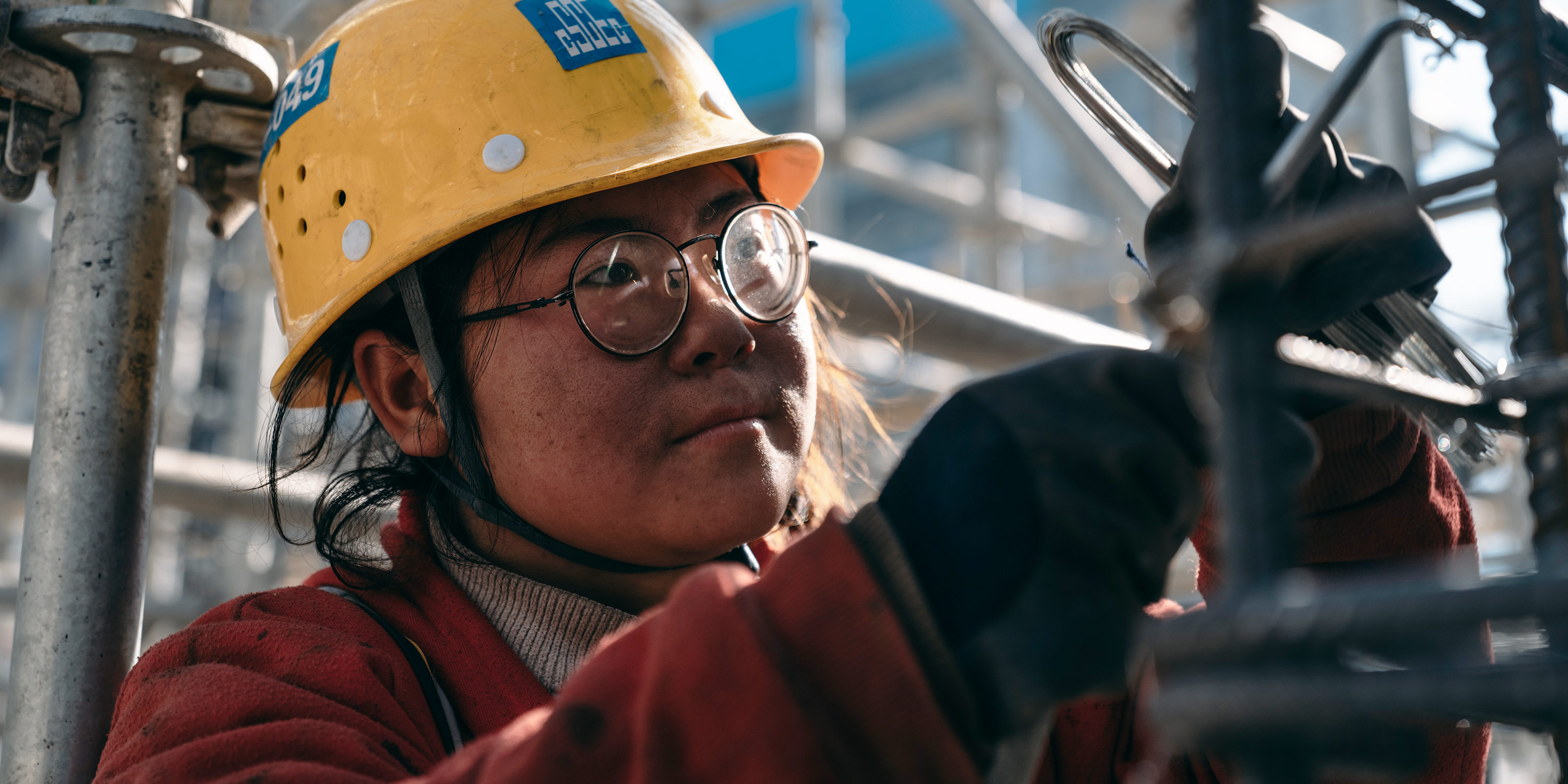
In the predawn darkness of a winter morning, wind whistles through the unfinished stories of a construction site in Xi’an, capital of the northwestern Shaanxi province. Liu Yan, severely nearsighted, pushes up her glasses with the back of a dust-covered hand, leaving black smudges on her face. The 24-year-old female rodbuster stands among the scaffolding, her hands moving tirelessly as she ties rebar after rebar. Around her, the construction site is still sleeping.
This is her sixth year bouncing between construction sites across China. As one of the few young women in a workforce dominated by middle-aged men, she stands out immediately — not just for her age or gender, but for her determination to survive.
Since she began posting videos of her daily work and life on Douyin, the Chinese version of TikTok, Liu has gained more than 145,000 followers. When she does livestreams, the warmth and care they show make her feel like they’re her family. Her two children are in the care of her parents back in rural Sichuan province, in China’s southwest.
Here is Liu’s story.
The weight of steel
The first time I reported to a construction site, I looked up at the scaffolding and froze. At least a dozen floors stretched above me. When I followed my colleagues up to the rooftop, I didn’t dare look down — I stared straight ahead and inched forward step by step.
The fear never fully disappeared. Sometimes, I have to stand on an A-frame ladder to tie rebars in place with wire. I’m short, so I have to stand on tiptoe to reach the higher bars. My high-prescription glasses make everything look farther away than it is. When the ladder sways, it feels like I’m even higher up — I get dizzy, my arms and legs tremble, and I go weak.
This winter, I’m working on the first floor — the foundation of the entire building, where the iron reinforcement is the most complex and the workload heaviest. The rebars are thick, often requiring two people to lift them.
Among the more than 30 workers on the site, most are husband-and-wife teams. The men carry and lift the rebars; the women tie them. When things get busy, I have to lift my rebars myself. I’m the youngest worker on the site and not particularly strong. Other workers can hold a bundle of steel stirrups in each hand, but I have to hug them in my arms.
In January, temperatures drop below freezing in the mornings. When I arrive at the site, it’s still dark and everything is white with frost. Before leaving home, I fill a bottle with hot water to warm my hands. I also pour hot water into two plastic bottles and tuck one into each pant leg.
I wear thin rubber gloves because they let me work faster, but when the wind blows, the cold cuts straight through them. As soon as my hands touch the rebar, it’s like they’ve been doused in icy water — so cold they go numb. When I first get to the site, I have to wait for my hands to adjust before I can start working.
My clothes can’t be too thick, either. I usually wear four layers, all thin sweaters or hoodies. A down jacket would be too bulky, making it hard to lift my arms or bend over inside the steel framework.
I usually don’t bother washing my face before leaving for work. The wind is strong and cold, and it stings wet skin. While I’m working, my glasses slide down; each time I push them back up, I leave another streak of grime. By the end of the day, I have the dirtiest face on the team.
I spend most of the 10-hour workday squatting. One day, while working during my period, my lower back hurt so much that I gave up after an hour and went home to rest. But guilt drove me back that afternoon after taking a painkiller. Taking a day off means losing a day’s pay.
Falling wages
I’ve been on this site for two months. Last month I only worked three days, earning just over 1,000 yuan. Wages have been dropping over the past couple of years. My day rate as a rodbuster used to be 320 yuan; now it’s only 310. My husband gets 320. Male workers generally earn 10 or 20 yuan more than women — supposedly because their work is more physically demanding.
Jobs on construction sites have noticeably decreased, and total income is about half of what it used to be. When work is scarce, sites often only hire male workers. On days when there’s no work for me, I stay at home waiting. I don’t dare call home during the day — I wait until evening and say I’ve just gotten off work.
I search online for job opportunities every day. My husband asks around in construction worker group chats and calls contractors. He makes more than a dozen calls a day.
There’s usually more work in summer, but ground temperatures can climb above 40 degrees Celsius, and the rebars get so hot they burn bare hands. Day wages are a bit higher — sometimes 320 or 340 yuan. Last year, though, wages mostly fell to 260 or 270 yuan per day.
Toil and sweat
During the hottest days, you’re drenched in sweat the moment you step onto the site. I bring two water bottles — one filled with cool water and the other frozen solid — so I have cold water throughout the day. Once, I nearly fainted: dizzy and nauseous, my heart racing.
After that, I switched to night shifts. I start around 7 p.m. and work for nine hours. High-risk tasks aren’t scheduled at night; it’s mostly basic work. But around three or four in the morning, the fatigue sets in.
I once stepped on a nail and punctured my foot. The wound was about a centimeter deep. Looking back, I guess I was lucky the nail was new and not rusty. I didn’t even get a tetanus shot.
When there’s a tight deadline, the construction site operates 24 hours a day and we work extra-long shifts with no days off. When I get back to my apartment, my entire body is limp.
It’s been six years since I started working as a rodbuster — I’m considered a skilled worker now. But every time I go to work, I’m still worried I’ll slow others down.
I was 19 when a girl from my village first brought me to work on a construction site. I was afraid the boss would think I was too stupid and fire me, so every night in the workers’ dormitory, I’d lie in my bunk and review the day’s tasks — how thick were the rebars I tied today, how far apart should they be spaced, how this joint was supposed to be assembled. I’d go over it again and again, like memorizing a lesson. I even secretly took notes in my phone’s memo app.
I’ve always felt like I’m not very smart. But when I was standing there on the job site, I didn’t see any alternative but to keep going.
A childhood of poverty
My hometown is deep in the mountains of Bazhong, Sichuan. Conditions in the village are generally poor, and my family is one of the poorest. I also have a sister three years younger.
My mother had encephalitis as a child, which left her with long-term cognitive impairment. Our father was always the one who kept our lives together. He used to work in a coal mine until an accident shattered one of his legs. Even after surgery, he couldn’t bend it properly.
We sustained our family through farming. My father would hike up the hill before dawn to do the daily farmwork, come home for lunch, then keep working until dark. He also took on odd jobs, helping neighbors fix electrical problems or build houses — whatever he could do to put food on the table.
When I was in my second year of middle school, my father was diagnosed with diabetes and needed more help with the farmwork, so I dropped out of school. Some relatives thought my parents should marry me off early to help ease our family’s financial burdens. But my father refused — he wanted me to continue my education. Later, my uncle gave us 2,000 yuan, which allowed me to return to school.
But I didn’t enjoy school — I was bullied. I looked unkempt, and other kids teased me for being in a tuition waiver program. After finishing my first year of high school, I told my family I didn’t want to continue. All I wanted to do was make money. I’d once thought about working as a makeup or nail artist, but had no way to pay for beauty school. A relative introduced me to an electronics factory in Dongguan in the southern Guangdong province. I earned a little over 2,000 yuan a month.
Later, I heard that many people from my village were working on construction sites and earning around 7,000 yuan a month, which was much better than factory work. I decided to give it a try.
Finding family
On the construction sites I’ve worked on, most workers are in their 40s or 50s. Many of them look out for me, sharing food or helping me with heavier tasks. When tying beams, they’d arrange the beams and set the stirrups in place, then call me over to just do the tying.
After I’d been working on construction sites for a year, my family arranged a marriage for me. At the time, my father was ill and hadn’t shown any improvement — people had advised him to make sure I was settled while he was still around. I was scared, too — afraid that one day my father might suddenly take a turn for the worse.
I met my husband through matchmaking. He’s from the next village over, eight years older, and has worked as a rodbuster for over 10 years. My first impression was that he seemed mature, with a husky voice and gray hair that made him look older than his age. We got married two months after meeting.
We didn’t have feelings for each other at first, but as we worked together on construction sites, affection gradually developed. He’s in charge of finding jobs, and I follow him from site to site.
Care from strangers
Besides shopping or visiting amusement parks, I also like filming myself with my phone. At home or on the construction site, whenever I notice a place to prop up my phone, I tap record, film for about 10 seconds, then stop. At first, I used filters, but once I accidentally posted one without a filter and more people watched it because it felt more real. So I kept posting unfiltered videos.
I also livestream when I have time. Once during a livestream, someone sent me expensive virtual gifts (worth about 340 yuan). I was completely stunned. Now the hype has died down, but I can still earn 20 or 30 yuan per session — enough to cover some living expenses at least. Some people have also offered to transfer donations, from a few dozen yuan to over a thousand. I never accept those. I don’t like accepting charity. Everyone works hard for their money.
One woman saw how lightly dressed I was on the construction site and offered to mail me clothing. I tried to decline, but she said her family runs a shop and could get them at wholesale prices. I almost never received gifts when I was growing up. I felt like someone had truly noticed me for the first time. Whenever someone asks, “Are you cold?” or says, “You’re wearing too little,” it’s like a heartwarming little surprise.
I often feel insecure about working in construction. Most people my age have respectable-looking jobs, but I come home covered in dust every day. Some people online told me that making a living with physical labor is nothing to be ashamed of. Many of my followers are my parents’ age. There’s one woman who joins every livestream, asking how my day was and if I’ve eaten. Things like these matter far more than money.
Some viewers told me, “If your husband ever mistreats you, we’ll stand up for you — we’re your family.” For the first time in my life, I felt protected. I’d never had that feeling of having a family backing me up before.
My supervisor knows I’ve been making these videos, and he’s quite supportive. He says getting this kind of traffic is a rare opportunity. On the construction site, more people recognize me now — some people even greet me when they see me. Some coworkers even joke that I’m an influencer. I don’t really like that term — I prefer it when people just call me “Little Liu.”
I’ve thought about growing my short video account as a source of income. Later, I relaxed my expectations. If my videos don’t bring income, I’ll just keep tying rebar like always.
Counting every yuan
Usually, if you work a full month on a site, the company only pays 70% or 80% of the wages up front — the rest is settled after the project is finished or at the end of the year. If we can still work another 10 days or so, we’ll have about 10,000 yuan saved by the time we go home for the holidays. That’s the best-case scenario.
Together, my husband and I are earning a living and building a life for our family. We move home frequently — construction isn’t stable work, and we have to follow the jobs. Last year, we moved four times. We packed our belongings in bags and suitcases and hauled them ourselves. We don’t own much: bedding, a few pieces of clothing. That’s about it.
We have two children, both back in our hometown. The older one is in kindergarten, and the younger one is just over a year old. Every month, we send at least 4,000 yuan back to cover their living expenses, and some more to support my parents. I also save for rainy days.
Every time I call home, my kids ask me when I’m coming back and if I can take them to the zoo. I want to buy a toy motorcycle for my son — nothing fancy, but other kids have them, and he’s wanted one for a while.
I also want to buy them some new clothes. I’m worried my eldest son might be teased for not dressing well. I’m away from home all year, and I already feel guilty. There were many things my family didn’t have when I was growing up, so I always think about how I can give those things to my kids, little by little.
A few days ago, I heard we finally had work lined up, and my first reaction was joy.
Every day, I head to the construction site full of energy. Having work makes me feel a little more secure — it means we can keep moving forward, no matter how slowly.
As told to reporter Lü Meng.
A version of this article originally appeared in White Night Workshop. It has been translated and edited for brevity and clarity, and is republished here with permission.
Translator: Carrie Davies; editors: Wang Juyi and Elise Mak.
(Header image: Liu Yan ties rebar at a construction site in Xi’an, Shaanxi province, January 2026. Lü Meng/White Night Workshop)