What Exactly Is a Qipao?
When you think of a qipao — also known as a cheongsam — what do you imagine? The demure women smiling on calendars? Characters in Eileen Chang’s novels as they drape their sensitive souls in elegant garb? The enigmatic Maggie Cheung in “In the Mood for Love,” expressing her unspoken desire through 23 outfits?
Suffice to say, the qipao is more than a mere garment: It is a core cultural symbol. Yet, the qipao also comes in such a wide variety of shapes and sizes that the more we dig into structural and design elements, the more complexity we uncover. It is as if whenever we try to define what precisely makes a qipao a qipao, we find that the answer is like the light glimmering atop the Huangpu River: brilliant, ever-changing, and elusive.
So much of what makes a qipao iconic comes back to its inception in 1920s Shanghai. At that time, the city was a melting pot, where people — and fashion — intermingled from all over and fusion garments emerged as designers took in styles from both East and West. Suddenly, there were lace dresses, skirt and tunic combos, and a wide range of hybrid outfits tailor-made for the female form.
The emerging qipao stood out for how it achieved a perfect blend of Chinese and Western styles. As it evolved into the now-iconic one-piece dress, it elongated tunics and robes, serving as an adaptation of the Western ballgown. It also took cues from and modernized traditional Chinese designs, such as the full-length vest from northern China, which became the “vest-style” qipao.
The one-piece “tight top, loose bottom” designs of the early qipao also reflected the inner struggles of many women carefully navigating the space between liberation and conservatism in an era of social reform. With the fitted shoulders and bust came a meditation on women’s nascent self-awareness and confidence in the new era, while the more flowing lower half maintained a subtle sense of modesty and elegance. It was as if change was stitched into the qipao’s DNA, and the more traditional Chinese shirts, skirts, and robes interacted with Western dresses, the more the qipao took shape and redefined womenswear.
Of course, the silhouette is everything to the qipao, particularly in terms of its power and adaptability to social norms. From the “tight top, loose bottom” style of the 1920s to the natural waistline silhouette of the 1930s, the qipao was evolving to highlight Chinese women’s curves in unprecedented ways. This became even more evident in the 1940s, as prominent styles emphasized the feminine form with lowered necklines, shortened sleeves, higher hemlines, and more fitted waistlines.
Even then, the qipao remained very much in conversation with women’s changing roles and evoked power as women entered factories, offices, and other typically male-dominated fields in large numbers during the war. At the time, international women’s fashion trends emphasized broad shoulders with designs that were comparable to, sometimes even more pronounced than, men’s suits, functioning like armor that helped women visually integrate into the workplace and announce the rise of female power. Yet while some gravitated toward this style, many others still preferred the power of the qipao, with its streamlined, form-fitting silhouette. As time went on, the female form took even more precedence in design and paved the way for the hourglass silhouette of the 1950s and ’60s.
Behind these dramatic design changes lay a silent revolution in technique that signaled the shift into a modern era. Traditional flat-patterned garments, such as the women’s robes and trousers from the late Qing dynasty (1644–1911) and Republic of China era (1912–1949), lay flat and folded neatly, like a two-dimensional painting. However, once Western three-dimensional tailoring techniques — such as bust and waist darts — were introduced, the qipao became three-dimensional, like a sculpture that enveloped the entire human body. The qipao was not just fabric to cover the body, but a second layer of skin. Just like steel reinforcing a building, these underlying principles and techniques supported the brilliant exterior. In essence, these three-dimensional tailoring techniques enabled women to balance practicality with subtly flattering silhouettes, becoming a way to freely express themselves and showcase their curves.
Fabric, too, played an essential role, taking cues from traditional silk textures and modern trends. In the 1920s, velvet — with its deep luster and rich patterns made with devore and embossing techniques — became a favorite for expressing mystery and allure. Meanwhile, lightweight, translucent georgette and lace created a modern, captivating sense of soft, mist-strewn light. Popular qipao designs in the 1930s and ’40s used indigo-dyed cotton fabric for a simple yet resilient declaration among educated women. In the latter half of the century, the gradual emergence of high-grade wool, knitted fabric, and even new materials like rayon and synthetic fiber blends declared the qipao’s ability to adapt to any situation, making it a staple in international wardrobes. The choice of a fabric is a choice of an era, and a choice of a lifestyle.
Patterns and decorations, meanwhile, are the qipao’s most heightened form of language. Early motifs, such as plum blossoms, orchids, bamboo, and chrysanthemums, along with common auspicious patterns, signified a deep-rooted cultural heritage. Once the waves of the Art Deco movement rolled from Paris’s Seine to Shanghai’s Huangpu River, qipao patterns underwent a seismic aesthetic shift. Patterns with sharp lines, bright geometric patterns, high-contrast color blocks, and metallic outlines all imbued mechanical aesthetics, which resonated with the fast pace of urban life and became the most direct visual declaration of modernity. Since then, the canvas of the qipao has showcased a vast array of designs — from pleasant floral and bird patterns to avant-garde visual art. Complementing this is the exquisite fusion of traditional Chinese piping techniques with Western embroidery and hand-painting techniques. All of this made each delicate qipao a unique and wearable work of art.
Yet the true brilliance of the qipao was in its boundless approach to styling and pairing, often combining Eastern and Western styles. As early as the 1930s, the women depicted in the calendar spreads demonstrated the importance of styling. When the qipao was paired with a blazer, the look suggested a capable professional woman; when wrapped in a fur coat, it exuded elegance and sophistication; when worn with a knit cardigan, it evoked a relaxed, leisurely afternoon at home. By the 1950s and ’60s, qipao sets were no longer put together at random and instead designed as complete ensembles, marking the qipao’s transformation into a core member of the modern wardrobe. From then on, different qipao ensembles helped urbanite women confidently navigate the workplace, social settings, and evening soirees, seamlessly blending every aspect of their lives.
Given all of these complex transformations, it begs the question: Is there some core element that makes a qipao a qipao, and not just another dress?
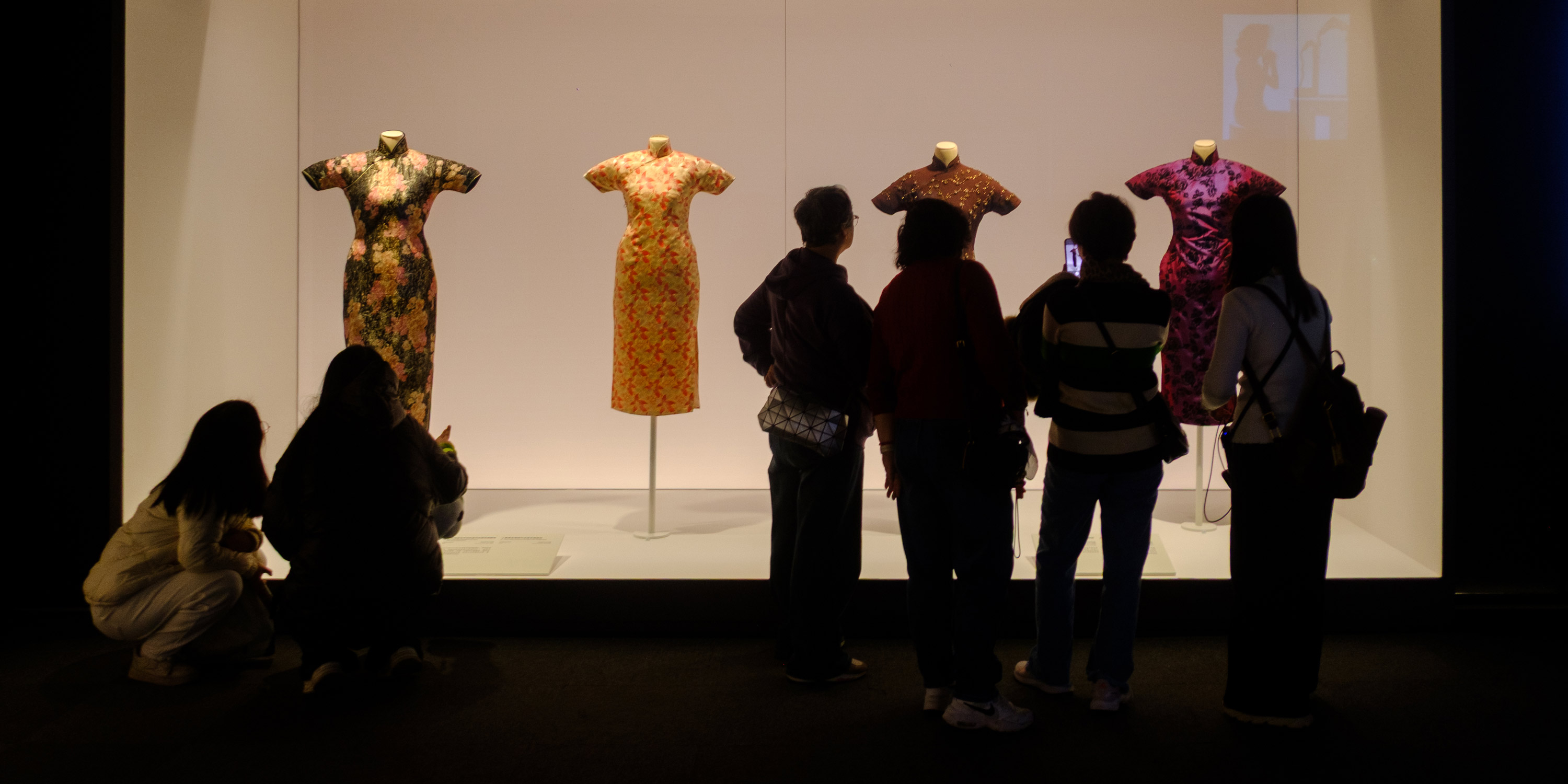
To try and provide a resounding answer, I’ve helped curate the exhibit “Qipao: Glamour and Modernity Beyond Shanghai,” currently on display at the Shanghai Museum. As we have worked to curate and compile the essence of the qipao, ultimately, the answer lies not in a specific neckline or cut, but rather in its inherent spirit of dialogue that began back in the 1920s. It has always stood at the intersection of East and West, tradition and modernity, personality and mainstream — endlessly integrating and innovating. It is a prism through which we can see a century of Chinese women’s explorations of identity, aesthetic awareness, and attitudes toward life.
So, what exactly is a qipao? It is the embodiment of Shanghai’s spirit — taking inspiration from all corners of the world, striving for excellence and innovation, and always presenting a sophisticated image to the wider world with an attitude of openness and change.
Translator: Hannah Lund; portrait artist: Wang Zhenhao.
(Header image: Visitors admire qipaos during the exhibition “Qipao: Glamour and Modernity beyond Shanghai” held in Shanghai, Feb. 10, 2026. Wu Huiyuan/Sixth Tone)