How China Can Protect Farmers From a Changing Climate
According to the World Meteorological Organization, 2025 was one of the three warmest years on record, with high temperatures fueling strong tropical cyclones, scorching heat waves, and heavy rainfall.
Among the people who bore the brunt of 2025’s extreme weather were the farmers of northern China, who experienced a nightmare fall harvest season. Instead of the usual crisp conditions, heavy rainfall made fields inaccessible for heavy combine harvesters. Corn and peanuts that should have been drying in the sunshine turned black from mold.
This was followed by public health concerns. People feared that farmers would sell their spoiled produce anyway, as they would otherwise miss out on a large chunk of their yearly income. Social media users shared images of moldy groceries. The Chinese government announced emergency funds that were partially intended to ensure food safety.
Even worse news: With the drastically shifting climate of northern China, the weather patterns that caused last year’s disaster are fast becoming the new normal.
Global warming is pushing China’s precipitation belt — the area in the country’s south that receives rain from the East Asian monsoon — further north. Every 1-degree Celsius increase in atmospheric temperature increases the atmosphere’s capacity to hold water by about 7%. The result is more record-breaking rainfall.
Simultaneously, extreme temperatures like those of 2025 cause the Western Pacific Subtropical High — a dominant high-pressure system — to channel tropical moisture farther northward. During the harvest season, that air will clash with colder air right above northern China’s agricultural areas, which will cause devastating downpours with increasing frequency.
These changing weather patterns won’t mean China’s north will become as warm and humid as the country’s south. Instead, the result will be extreme fluctuations that will have destructive consequences. Scientific studies indicate that, over the past two decades, the north has seen a significant uptick in extreme precipitation events. In other words, the dry winds and stable sunshine that northern agriculture has long relied on — a climatic gift — will increasingly be disrupted by relentless rain.
As a result, moldy grain could become an unavoidable headache, striking a blow against farmers’ incomes and northern China’s food security. Yet, society is unprepared for a wetter north: farmers lament the mud but feel all they can do is wait; some local governments dismiss heavy rains and the resulting mold infestation as an occasional “freak act of nature” — bad luck that couldn’t be helped.
But it can. To safeguard northern China’s farmers and food, building a climate-resilient agricultural system is an urgent task.
First, we must enhance meteorological forecasting and early warning capabilities. While most people only want to know rain forecasts for a day or three in advance, farmers want to know how much precipitation to expect in the next seven to 10 days.
A manager at a major peanut oil company told me that knowing long-term rain forecasts would allow better purchasing decisions. “This directly affects whether we can control the rate of mold contamination in raw materials.” A farmer expressed the same sentiment. “If I had been told a week in advance about the continuous rain, I would have sold my scallions earlier,” he told me.
However, current meteorological forecasting and warning capabilities are insufficient to meet these demands. Weather forecasts lose their accuracy the farther out they go. Predictions looking a few days ahead are most reliable. But beyond five days, the accuracy for where and how much it will rain decreases.
With forecasts beyond 10 days, even world-leading models can at best be accurate 60% to 70% of the time. So much uncertainty might be acceptable for scientists; for ordinary farmers, it is a high-stakes gamble they cannot afford to lose. To regain a sense of security as climate extremes become commonplace, our meteorological system requires ambitious investments in its observation networks, data processing, and artificial intelligence research.
Second, it is essential to enhance the climate resilience of northern China’s entire agricultural industry chain. Even during extreme weather events such as floods or droughts, farmers, food processors, and other industry actors must be able to operate smoothly and to continue to safeguard food safety.
The first barrier can be biological. Resilience will improve by breeding and planting stress-resistant crop varieties — with, for example, denser hulls or fungal resistance — as well as applying other biological techniques such as introducing benign microbial strains to outcompete toxic variants.
Produce is especially at risk of going bad during storage and transportation. Crops are mixed in high densities and ventilation is poor, making mold cross-contamination more likely. Engineering interventions — such as rapid drying within 24 hours after harvesting to keep moisture content below safe thresholds — can be decisive in interrupting the mold growth cycle. At the processing end, applying optical color sorting and efficient biological detoxification technologies can mitigate residual risks before food reaches consumers.
Building regional drying centers or climate-controlled storage facilities can require up to tens of millions of yuan (millions of dollars). Faced with the challenge of post-harvest infrastructure — for which payback periods are long and weather risks are high — the government must decide whether to rely on subsidies or to leverage private sector investment.
Current fiscal policies predominantly favor large-scale operations. In contrast, smallholder farmers — who lack access to equipment and climate insurance — bear a disproportionate share of climate risks. Without a more inclusive support network, these smallholders may sink into deeper difficulties due to their insufficient capacity to cope with climate change.
Given that the risk of climate hazards in northern China spilling over into public health crises will only increase, this must also be a key consideration. Farmers themselves face risks handling moldy crops. When the sun returns and they lay them out to dry on roadsides, they may inhale carcinogenic spores, for example. This is a severe climate cost borne by frontline workers.
More danger lies in the invisible flow of contaminated grain. There are currently no safe disposal pathways that would allow farmers to still earn money from moldy crops, such as, for example, converting them to ethanol. As such, the risk of moldy grain finding its way into the food chain remains. Climate change thus poses a food safety risk on the dining table.
Although the state revised its mycotoxin standards to be stricter in August 2025, a vast gap remains between regulatory requirements and frontline implementation. The central objective of future regulatory efforts must be to ensure the full-process traceability of disposal pathways. Perhaps, with the modernization of governance systems, we could establish a food tracking system comparable to express logistics: Where does every batch of contaminated grain go? Is it redirected as industrial raw material or thoroughly destroyed? Every step must be as traceable and verifiable as the tracking number of a delivery package.
As extreme weather becomes more frequent, such measures must be taken. Only a more resilient and equitable system can sustainably fill the food bowls of northern China in a future of rising heat, humidity, and climatic volatility.
Translator: Gabriel Kwan.
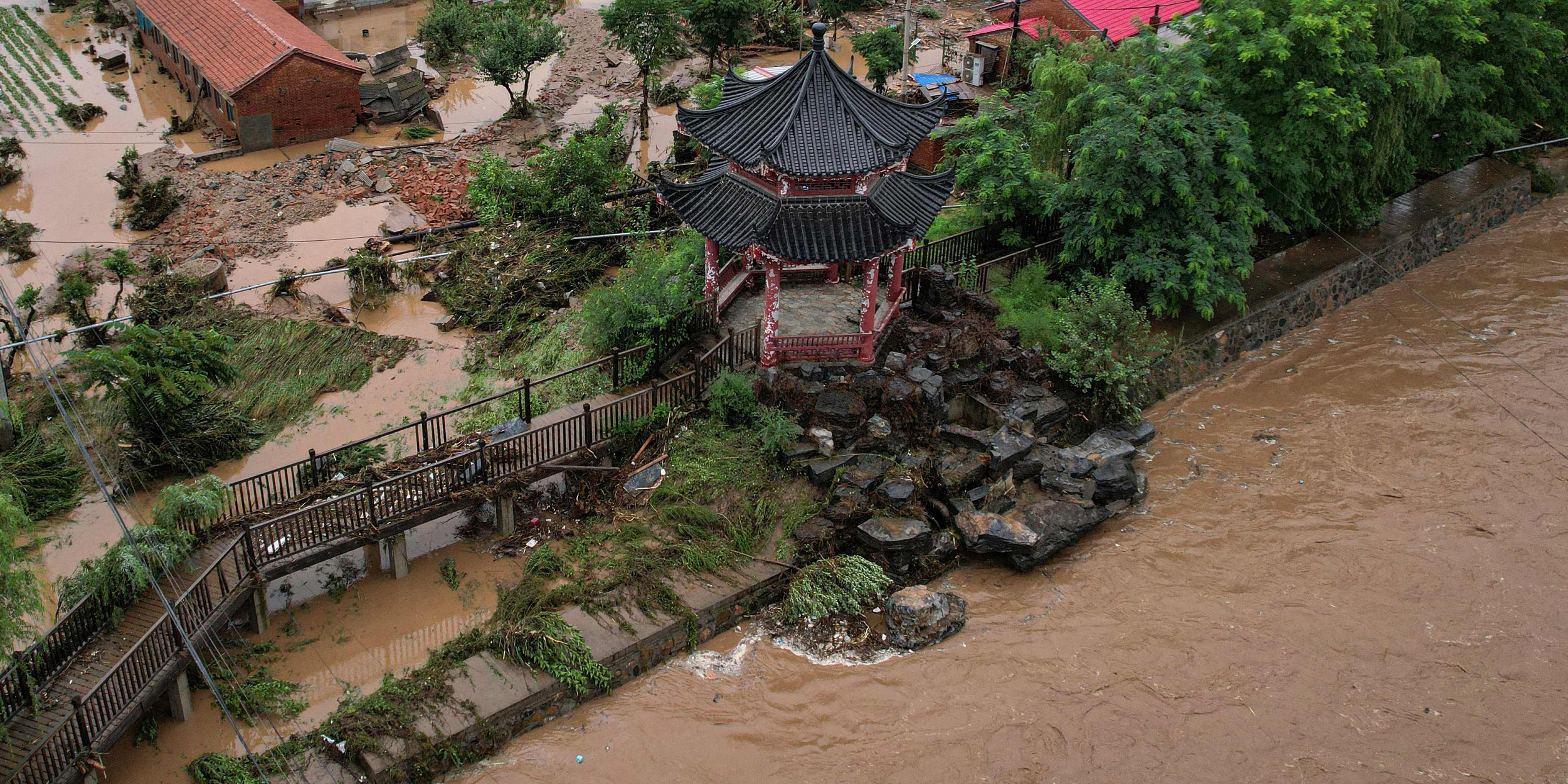
(Header image: Damaged buildings after heavy rains in Xinanzhuang village, Miyun District, on the outskirts of Beijing on July 28, 2025. Jade Gao/AFP via VCG)