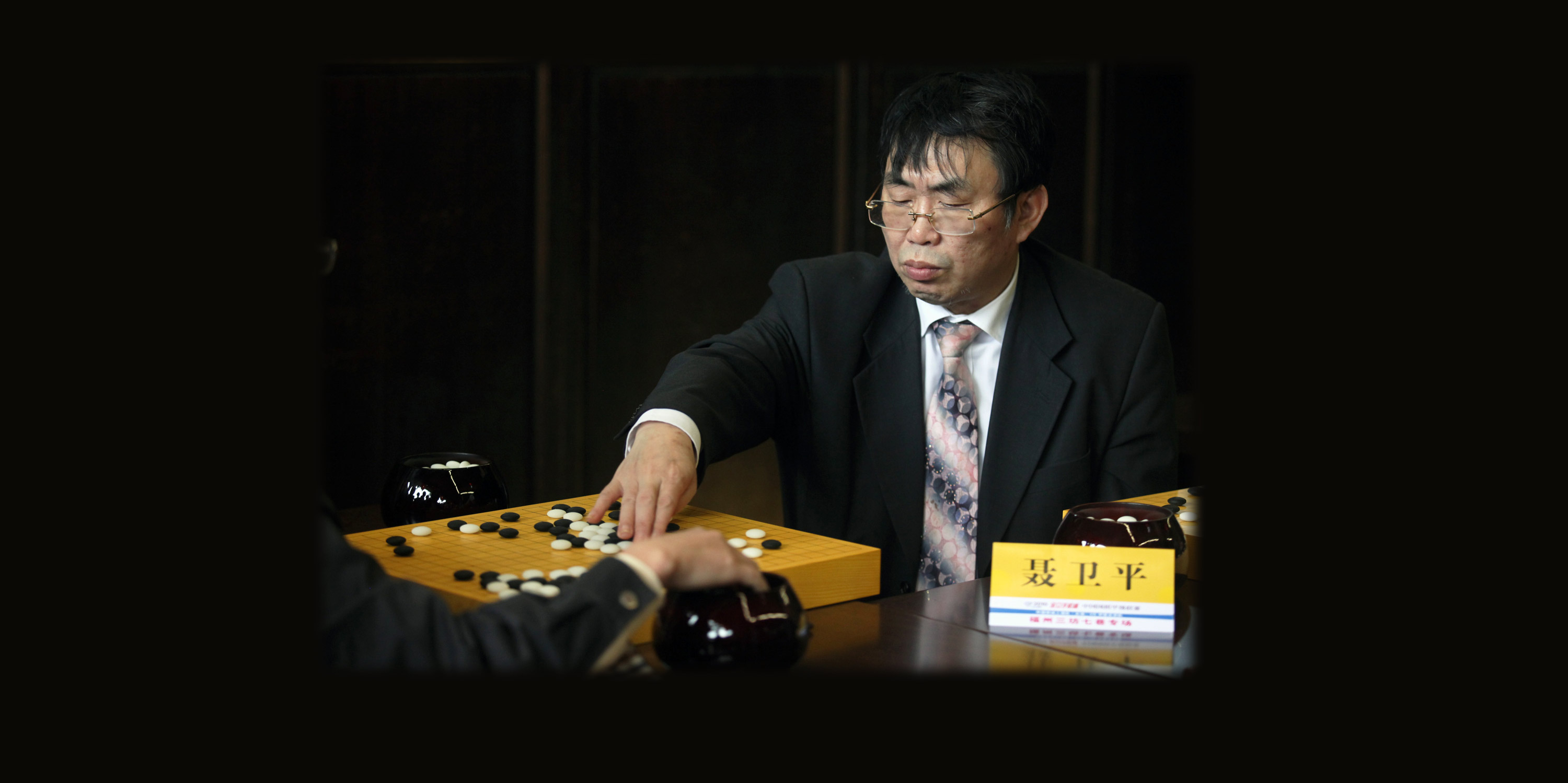
Nie Weiping, the ‘Wild Warrior’ Who Restored China’s Confidence in Go
In December 1974, Go player Nie Weiping wasn’t having a great run of matches. He’d won one and lost two, all against middling competition. For his next game, he would take on Japan’s Miyamoto Naoki, a player of the highest rank who had won six consecutive matches. Miyamoto’s dominance was emblematic of that era. Though Go was invented in China some 2,500 years ago, the country had, by the ’70s, fallen behind Japan — embarrassingly so, some thought.
Nie was “excited and nervous,” he wrote later, and vowed to give it his all. He played aggressively. In the end, after a 10-hour marathon of a match, he won — a moment that he repeatedly recalled was “the most memorable of his life.” The victory was to be his first in a string of international successes that earned Nie the title of “Sage of Go” and restored China’s confidence in the game, as well as beyond.
On Jan. 14, Nie Weiping died in Beijing at the age of 74, after a long career that coincided with his nation’s transformation: Nie helped turn Go into a global game, right as China reopened itself to the world.
Born in 1952 to industry officials, Nie grew up watching family members play Go, a two-player game in which each uses their pieces — black versus white — to claim territory on a 19×19 grid. Whoever controls the majority of the board wins. At the age of 9, Nie and his younger brother taught themselves the game. By the next year, he started to draw attention after defeating young Go players trained at a formal academy in Beijing.
To the era’s communist leaders, Go was not only a traditional art form but also a tool for cultivating strategic thinking and encouraging diplomatic engagement. In 1960, more than a decade before China and Japan normalized diplomatic relations, a Japanese Go delegation visited the People’s Republic of China for the first time. Go had prospered in Japan during the 20th century, with a professional competition system and plentiful media coverage. During successive visits, Japanese players’ advantage over their Chinese counterparts was so overwhelming it was regarded as a “national shame” in China.
In 1962, the Nie brothers were invited to play against Chen Yi, then China’s vice premier and minister of foreign affairs. In his 1999 autobiography, “The Life of Go,” Nie recalled his excitement over “mercilessly defeating” Chen, while his younger brother, the stronger player at the time, lost. After China detonated its first atomic bomb in 1964, Chen encouraged Nie to pursue the highest professional rank in the game — 9-dan, a level no player in China had ever reached — with the same determination as China had pursued its first nuclear test.
But as Nie and other young Go players set out to catch up with the world’s best, the Cultural Revolution erupted in 1966 and, as Nie put it, “halted the development of Chinese Go for eight years.” Suddenly, posters listed Go as one of the “old cultural practices” that were to be abolished. In 1969, along with many other students, he was sent to work in a remote northeastern farm. In his autobiography, he recalled that during this time, “he barely touched a Go board.” Yet he credited the later improvement of his Go skills to the mental resilience forged during those difficult years.
In 1971, Nie returned to Beijing. A new job in logistics gave him the excuse to visit factories to play against top Go players who had been sent to work there, polishing his Go skills. As political conditions stabilized, in 1973, Nie and over 30 other players were selected to join the newly reestablished national Go team. Eager to make up for lost time, they studied late into the evenings, analyzing the latest game records sent over from Japan. Nie emerged as their leader; at the 1975 National Games, aged 23, he became the national champion.
After his memorable defeat of Miyamoto, Nie went on to defeat two more Japanese Go legends, earning him the nickname “the Nie Storm.” In China, he was awarded the highest professional rank, 9-dan. Yet, after these friendly matches, Nie and his peers needed an official match to validate China’s comeback in Go. That opportunity arrived in the 1980s, amid China’s launch of “reform and opening-up” and the growing ties between China and Japan.
In 1984, two sports magazines from China and Japan decided to jointly hold a competition between Chinese and Japanese Go players. At the inaugural Sino-Japanese Go Duels in 1985, sponsored by the NEC Corporation, each country sent their eight best players to face off in a format where, after the first match, the losing player is eliminated, while the winner faces the other country’s second player, and so on. The country that beat all eight of its opponents would win.
China wasn’t confident. Less than 20% of readers of the Chinese magazine predicted their country would win. But China got off to a good start. While it lost the first game, Chinese player Jiang Zhujiu then won five consecutive games. However, Kobayashi Koichi regained Japan’s advantage by proceeding to win six in a row. China was on the back foot. Only Nie was left. Could he defeat Kobayashi and the two other remaining Japanese players?
By then, the duels had become far more than a niche event. Even the national leaders in Beijing were paying attention, checking in with Nie to inquire about the Chinese team’s progress. The state television’s flagship evening news program covered the match results. Footage of Nie, who had congenital heart disease, using supplemental oxygen during the games became a nationwide memory. As Nie defeated Kobayashi and his next opponent, public enthusiasm surged.
On Nov. 20, 1985, 1,500 spectators had crowded into the Beijing Gymnasium to watch Nie play Fujisawa Hideyuki, a legendary figure of 20th-century Japanese Go, in the tournament’s final match — both players were their country’s last player standing. More Go enthusiasts followed the game via the state television’s live broadcast. They witnessed Nie win a grueling seven-hour battle. Later that day, crowds gathered on Tian’anmen Square to celebrate two landmark Chinese victories that, by coincidence, occurred on the same day: Chinese Go players defeating their Japanese counterparts for the first time in an official match, and the women’s volleyball team winning its fourth consecutive world championship.
Nie’s victory ignited a nationwide Go craze. Countless college students began studying Go — out of more than just national pride. Their enthusiasm was rooted in a genuine love for Go as a cultural pursuit shared by East Asians. The manuals of the Japanese players Nie had defeated became popular too. These students would pass their love of Go on to the next generation, fueling the explosion of professional Go talent in China during the 2000s. In a 2024 interview with Sixth Tone, professional Go player Zhan Ying recalled that her father, an air force pilot who taught her the game, traced his Go passion back to Nie. “He could never forget seeing the news about Nie on television,” she said. “He was so excited.”
Another lasting impact emerged on the international stage. Inspired by Nie’s victory, Ing Chang-ki, a Taiwanese industrialist, launched the Ing Cup tournament. Alongside the Fujitsu Cup, founded in Japan in 1988, the Ing Cup became one of the first world professional Go tournaments, transforming the board game from a domestic or bilateral sport into a global phenomenon. In 1989, South Korean player Cho Hun-hyun won the inaugural Ing Cup, establishing the trilateral rivalry between Chinese, Japanese, and South Korean Go players. Professional Go was no longer just about defending national pride, but became a viable career, leading to an unprecedented surge in vitality and competitiveness within the Go community.
In 1988, Nie reached the peak of his career after helping the Chinese team win three consecutive editions of the Duels. That year, the Chinese Go Association awarded him the honorary title of Qi Sheng, or “Sage of Go.” An unprecedented honor, but one that also carried an implicit cost. In a 2002 interview, Nie recalled that the day after receiving the title, he visited China’s leader Deng Xiaoping, who told him, “It’s not easy being a sage — being an ordinary man is better.”
Deng’s words would in a way prove prescient. Nie divorced his first wife, Kong Xiangming, also a successful Go player. In his autobiography, Nie describes an anecdote when someone introduced Kong as “Nie Weiping’s wife,” prompting her to immediately retort, “I have my own name. I am Kong Xiangming.” The moment made Nie feel “embarrassed,” suggesting he could not stomach his wife’s independent personality.
On the Go board, Nie also reached a turning point. In the 1989 Ing Cup final in Singapore, he lost 2-3. In the 1990s, he missed another two opportunities in international tournaments. Nie later called his failure to win an international championship his “greatest regret.”
Nie compared his life to China’s Huangguoshu Waterfall, a natural landmark. His nine consecutive victories in the Sino-Japanese Go Duels that made him a national hero were, in his words, “as spectacular as the waterfall plunging down three thousand feet,” but his subsequent failures meant that, “upon hitting the ground, it became a murmuring stream.”
But he would further cement his legacy through education. In 1999, inspired by Japan’s Go training system, Nie founded China’s first professional Go academy, the Nie Weiping Go Dojo, cultivating talent that couldn’t secure a seat in the national team. Subsequently, more professional players established their own academies and trained a generation of post-1990 prodigies. In 2005, one of Nie’s earliest students, Chang Hao, became the first Chinese winner of the Ing Cup. In the 2010s, Chinese professionals expanded their dominance — world champions Gu Li and Ke Jie both trained under Nie.
Their victories no longer stirred nationwide ecstasy. People had become accustomed to the successes of Chinese players. Or, as Nie put it, “after 30 years of reform and opening-up, there are so many things we can be proud of.”
In later years, Nie frequently appeared on television as a Go commentator known for his harsh criticisms of Chinese players — including his own students. In a provocative move, he even included controversial interview excerpts in his autobiography, such as his advice for China’s chronically underperforming national men’s football team: “Learn from Go. Develop a broader perspective.” (On Chinese social media, Nie was among the most well-known football commentators, who traced his passion for football back to watching a match between China and the Soviet Union at the age of 7.)
Shen Chun-shan, a Taiwanese physicist and Go player, once contrasted Nie’s playing style with that of his international competitors: “Japanese players enter Go academies early and grow steadily, like standardized products,” he wrote in the preface to Nie’s autobiography. “Nie Weiping, on the other hand, is a wild warrior, shaped through self-training across desolate mountains and grand rivers.” Unlike Japanese-style Go matches that may last for days, Nie trained by playing rapid games to develop an intuitive style. Nowadays, Go matches are time-limited, but he believed that players who felt time pressure ultimately suffered from an “inability to make decisive moves at critical moments.” He considered confidence “an absolute necessity” for players and stated that he himself had plenty of it. “If there is a line between confidence and arrogance, then I stand right on that edge — sometimes crossing it,” he wrote.
Over half a century of competing and teaching, Nie helped revitalize the Chinese Go community and helped bring about the rise of the board game — and his country — on the global stage. In the final chapter of his life, he witnessed another profound transformation of Go: the rise of artificial intelligence’s integration into the game.
In 2016, DeepMind’s AlphaGo took on South Korea’s world champion Lee Se-dol in a five-game match. Though AI had mastered chess and other games, Go had long been considered too complex for computers. Like most Go professionals at the time, Nie was initially unimpressed by another challenge from AI against human players. But as the games unfolded, especially after AlphaGo made a highly creative move, Nie changed his mind. “I bow to AlphaGo,” he commented, believing that AI could teach human players. Lee managed to win just one of the five games.
Soon after, AlphaGo’s upgraded version, dubbed “Master,” solidified AI’s dominance by winning 60 consecutive online matches against global top players — including against Nie’s former student Ke Jie, then the world’s top-ranked Go player. At the end of this series, it played against Nie Weiping. As the game concluded, Aja Huang, the DeepMind researcher behind “Master,” gave a voice to the machine and wrote in the comment section:
“Thank you, Mr. Nie.”
(Header image: Nie Weiping plays Go against an amateur player in Fuzhou, Fujian province, 2010. VCG)