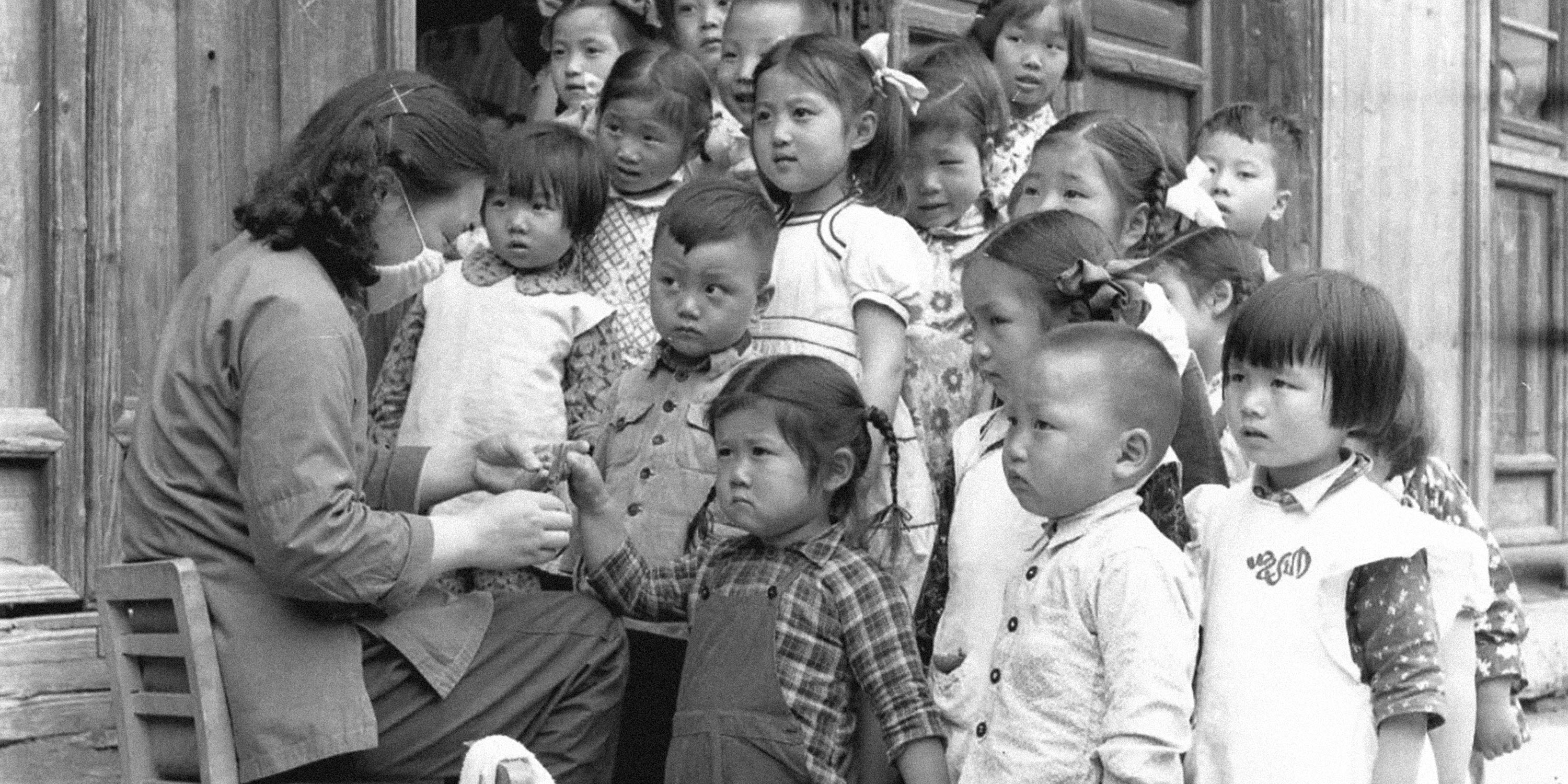
Her Eye, Her Era, Her Archive: Xiao Zhuang, One of China’s First Female Photojournalists, Dies at 93
Xiao Zhuang, one of China’s pioneering female photojournalists, passed away in the eastern city of Nanjing on Jan. 4, 2026, at the age of 93, leaving behind a vast array of visual archives that quietly narrate the nation’s development and transformation.
In the spring of 1950, 17-year-old Zhuang Dongying stood on the rocky shore of Zhoushan Archipelago off the coast of eastern China, a heavy German-made camera in her hands. The Zeiss Ikon had been captured from enemy troops and entrusted to her by her unit, a People’s Liberation Army’s newspaper. As she photographed soldiers building coastal defenses, she began a journey that would span seven decades under the pen name Xiao Zhuang — later to become her official name — one of the few women to document the making of modern China behind the lens.
“There were only a handful of people who worked as photographers in the early 1950s, and female photojournalists were even rarer,” Xiao recalled decades later during an interview with the magazine Chinese Photography.
When she learned she would be transferred by her unit to state-backed news outlet Xinhua Daily in 1952, she requested that her unit change her name from Zhuang Dongying to Xiao Zhuang to “remove any trace” of gendered expectations — her birth name implicitly means “winter has gained a girl.” The unit accepted, and Xiao moved to Xinhua.
The arrival of an “inexperienced young girl” was met with silent astonishment — the newspaper had expected a seasoned male photographer. “Female photojournalists in the 1950s had to face the traditional ideas of male superiority,” she said. “For me, as long as I could take good photos, I didn’t care about the biases other people had. From the moment I picked up a camera, my strong-willed nature made me determined to work like a man and to endure arduous training and refinement.”
Her assignments led Xiao to trace the official narrative of the newly built nation — parades, political ceremonies — while battling limitations in camera technology and dangers to her physical well-being. When the Nanjing Yangtze River Bridge opened in 1968, due to the limited field of view of her Rollei camera lens, Xiao painstakingly took photos of the road bridge, railway bridge, and the ships over the river separately, which were stitched together in the darkroom. She also spent a whole month trying to find an ideal angle to capture the bridge in its entirety, and at one point almost fell into the river.
Yet her gaze often drifted away from China’s modernization efforts. “I prefer going to the countryside to report. What you shoot in the city always ends up following the same old formula — machines and people — and I find that boring,” she said. She preferred the countryside for its “better natural environment” and “more straightforward folk customs,” offering her more creative freedom.
It was in the rural outskirts of Nanjing, in 1962, as the nation emerged from years of famine and scarcity, that she captured her magnum opus and personal favorite image during a reporting trip on the local agricultural industry. “Treading Through Silver Waves” pictures a flock of geese startled into flight at Gucheng Lake, a gentle and spontaneous capture, and a quiet testament to her search for beauty within the frame of her times.
At the time, a camera could be viewed with suspicion. Once, while photographing a visiting Soviet expert without proper governmental clearance, she was detained by security agents. On another occasion, the flashbulb of another photographer’s camera exploded during a government meeting and she was taken in for questioning.
The era of “reform and opening-up,” beginning in 1978, brought a subtle thaw. Xiao named and helped found the photography magazine Light and Shade in 1981, advocating for work that was “both aesthetic and documentary.” It was a small space for a different kind of visual language.
Later in her career, a traffic accident in 1996 left her wheelchair-bound. During her more than two-year-long recovery, she turned inward, devoting herself to sorting through a lifetime of negatives. Then, in 2004, with the help of her coworkers, she found thousands of photos she’d taken in the 1950s and ’60s, left forgotten in Xinhua Daily’s old filing cabinets. It was as if a submerged part of the past — and herself — had suddenly surfaced.
In her later years, Xiao Zhuang still frequented Nanjing’s parks with her camera. “Only when I am with my camera do I feel my spirit remains young,” she said. But her lens no longer sought grand narratives. Instead, she focused on ordinary people taking a stroll, playing chess, or basking in the sun. “A person’s expression is more important than the peonies in the park,” she explained. The “uncles” and “aunties” in the parks might well have been the young faces she once captured in parades and rallies decades earlier. Half a century later, through her viewfinder, she quietly reunited with the era she had witnessed in her youth — this time from a wheelchair.
Xiao devoted much of her later years to sorting through the nearly 10,000 negatives she had recovered, publishing six illustrated books and organizing four photographic exhibitions. Her later collections, including “Fleeting Memories,” “The Red Albums,” and “Portraits, 1950s-1980s” stand as a testament to her long, meticulous labor.
For Xiao, the path she had “walked” was traceable. It unfolded across the pages of the 1952 National Day Parade, developed in the geese that had flown, startled, over the lake in 1962, and resided in the thousands of reclaimed photographs that can now be displayed.
“Whenever I look back on the past, it takes me a long time to calm myself,” Xiao told Chinese Photography. “I talk about it, I write it down, because I simply want to tell those who come after how our generation of photographers walked this road.”
A version of this article originally appeared in Chinese Photography, reported by Chen Qiu. It has been translated and edited for brevity and clarity, and is republished here with permission.
Translator: Wu Huiyuan; editors: Marianne Gunnarsson and Ding Yining.