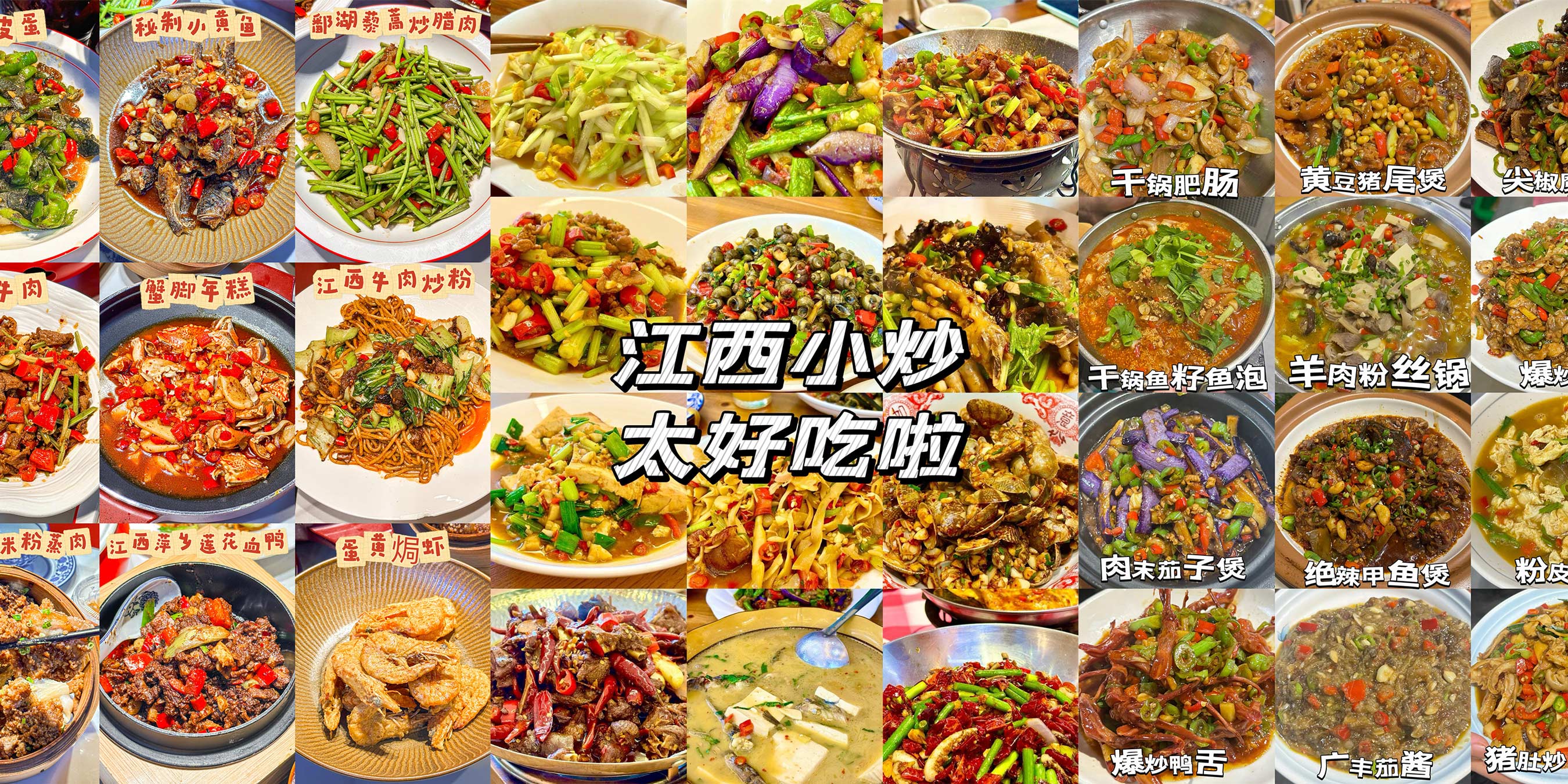
In a Chilly Year for Chinese Restaurants, Jiangxi Food Was the Hot Exception
The past year was a testing one for the Chinese food industry. The government restricted its officials from organizing fancy banquets, and regular consumers also spent less on expensive restaurants. Some high-end establishments specialized in popular Chinese cuisines such as Cantonese lowered prices, or even set up food stalls to survive.
Down-market restaurants also had a challenging time. Starting in summer, an aggressive subsidy war among food delivery platforms squeezed restaurant profit margins. And in September, an internet celebrity’s attack on a chain restaurant over “serving pre-made dishes” exposed chain restaurants’ use of central kitchens to public scrutiny.
Yet, one category of restaurants is thriving, growing its presence in Chinese cities large and small: the cuisine of Jiangxi, an inland province in eastern China that is an unlikely source of this downturn-defying trend. Apart from its porcelain industry — beloved but nevertheless long past its imperial-age heyday — it is not known as an economic or cultural powerhouse.
The names of these restaurants often include the term xiaochao — simple stir-fried dishes. Jiangxi cuisine first spread in the 2010s to sell cheap and familiar meals to the province’s migrant workers who had moved to Shanghai and other prosperous cities in the Yangtze River Delta. It became so widespread that during a music festival in Yiwu, in neighboring Zhejiang province, at the end of 2023, when one singer asked the audience what the local specialty was, the crowd jokingly shouted back, “Jiangxi xiaochao.”
The cheap Jiangxi cuisine eateries have since been joined by chain restaurants. These design their interiors to transport diners to the province, featuring greenery, stone walls, blue-tiled roofs, and blue-and-white porcelain plates. According to industry statistics, the number of Jiangxi-style restaurants in China soared from 11,000 in 2023 to more than 37,000 in 2025.
Jiangxi food faced steep challenges on its road to countrywide recognition. Jiangxi has long been overshadowed by the six provinces that surround it, all of which are more economically successful. It has given rise to the online “Jiangxi Economic Encirclement” meme.
Their cuisines, such as those from Guangdong, Hunan, Zhejiang, and Anhui, are also more famous. One of the reasons is that Jiangxi cuisine lacks a coherent, memorable identity. Geographically, Jiangxi can be divided into the Poyang Lake Plain in the north, the Gan River Basin in the center, and the Hakka mountainous areas in the south. The cuisine of each of these three regions has its own cultural origins and characteristics.
Jiangxi cuisine is also overshadowed by similar dishes from neighboring areas. Northern Jiangxi’s clay pot soup, fish dishes, and steamed rice flour creations are not that different from, and less famous than, counterparts from surrounding provinces. The Hakka culture of southern Jiangxi is more often associated with Hakka areas in Guangdong, Fujian, and Taiwan.
The “Jiangxi dishes” that many diners have recently come to know mainly come from the food culture of central Jiangxi’s Gan River Basin. The most prominent dishes of this area’s cuisine are stir fried and spicy — stir-fried meat with dried chilis, fried rice noodles, braised chicken feet in soy sauce.
Three core features explain their popularity, and the sudden rise of Jiangxi cuisine. They are cooked with wok hei — meaning the food is so hot diners can sense it has only just left the wok — and they present good value for money. Most of all, they are spicy.
First, the fresh and fast nature of Jiangxi stir-fried dishes directly counters the “pre-made meals anxiety” that has erupted this year. Xiaochao was once considered a less refined cooking method, but it is now exactly what discerning diners are looking for. In many restaurants, the cooking process is on full display, giving consumers a sense of safety and the confidence that the wok hei is no illusion.
Second, the low price of Jiangxi xiaochao helped make it popular among urbanites feeling less economically secure. Even at more upscale Jiangxi restaurants, a xiaochao meal costs only about 50 yuan ($7). And, compared to eating dishes that were prepared in a “central kitchen” and only heated up, having meat cut and stir fried on the spot gives people the sense that their money was well spent. It didn’t go toward firing up a microwave, but toward fresh ingredients and skilled labor.
Finally, there’s the spiciness of Jiangxi cuisine.
As someone who researches the culture of spiciness, my deepest impression of Jiangxi cuisine from the Gan River Basin is that it is very spicy — probably the spiciest among all the spicy food regions of southern China. It’s an unadorned spiciness, unlike Sichuan’s numbing and oily spiciness, Hunan’s fragrant and gingery spiciness, or Guizhou’s complex and smoky spiciness. It is a simple spiciness, without any assistance from other flavors. It is spice for the sake of spice alone.
In Chinese cities, eating spicy food has become the default option for people looking to relieve stress — see, for example, the popularity of hotpot. Having Jiangxi xiaochao with colleagues, ending a day of overtime with a burnt tongue and sweaty forehead, is a habit grounded in physiological mechanisms, psychological needs, and social trends.
Spicy is not a “taste,” but a pain sensation. Capsaicin activates receptors in the mouth and digestive tract, and the brain misjudges this stimulation as an injury, thus activating self-protection mechanisms and secreting substances like endorphins, dopamine, serotonin, and so on, to relieve pain and soothe emotions. This is similar to the pleasure of riding a rollercoaster or doing intense exercises.
At the same time, the strong sensory stimulation of eating spicy food can also have a psychological effect. It shifts one’s attention. When the mouth is hot and the eyes are teary, the brain’s focus shifts from worrying about your job performance or relationship tensions to the hot and fresh stir-fried dish in front of you. In that sense, spiciness provides a “controllable pain”: you know it will end, and you know you can endure it. This brief and predictable discomfort actually brings a peculiar sense of security.
To China’s food industry, Jiangxi xiaochao also brought security. In a year when the industry's options seemed limited, this unlikely up-and-comer provided a sense of freshness. Consumers who had tired of the classic hits — Cantonese, Sichuanese, Hunanese — could satisfy their curiosity for something new.
For food industry professionals, the characteristics of Jiangxi cuisine being “light on capital” and “easy to transition into” were the perfect answer to the catering industry's headwinds. Running a Cantonese restaurant usually requires the careful and costly management of fresh seafood; in contrast, Jiangxi xiaochao is made with cheaper ingredients and simpler operations. Though low prices mean thinner profits, a xiaochao menu is far less risky than maintaining a high-priced but rarely purchased list of seafood dishes. No wonder some restaurants switched cuisines.
Sometimes when I eat Jiangxi cuisine, I think about the history of the province. It was hit hard by 19th-century upheaval – the Opium Wars, the Taiping Rebellion. It lost population and prosperity. At the same time, the love of spicy food rose. Over the following two centuries, as people migrated out of Jiangxi in search of better livelihoods, laborers looking not just to stay awake but to forge connections with home brought their food to various parts of China. This same mechanism also played a role in the expansion of Sichuanese and Hunanese restaurants in China.
Through spice for the sake of spice and visible wok hei, Jiangxi cuisine provides the emotional value of a “small and certain happiness” that is difficult to satisfy in daily life in an era where wellbeing, security, and psychological support have become more important than ever, and has become a testament to the transformation of China’s food industry, economy, and society.
Translator: Matt Turner.
(Header image: A collage of Jiangxi dishes from Xiaohongshu posts. From @逗芽菜爱吃, @ZHANG芝士, and @乡村小吃华丰店 on Xiaohongshu)