In Wuhan, A Race to Study a 3,500-Year-Old City Between Seasons
HUBEI, Central China — For a few cold, dry months each winter at Panlongcheng, conditions briefly align for archaeologists to work on a 3,500-year-old city.
That brief reprieve leaves no margin for delay. Archaeologists rush to open trenches, record fragile layers, and gather samples, knowing that spring rain and rising moisture will soon compromise both access and preservation.
Beneath the surface is Panlongcheng, an urban settlement built during the Shang dynasty (c.1600–1046 BC). Discovered in the 1950s near present-day Wuhan, far from the Shang heartland, the site provided the first clear evidence that Shang political power and bronze culture extended south of the Yangtze River.
Despite more than half a century of excavation, Panlongcheng remains only partially understood. Bronze, jade, and ceramic artifacts have been recovered, along with city walls, palace complexes, craft workshops, elite tombs, and residential areas. But how these pieces fit together remains unclear.
Fundamental questions about the city’s political role, its relationship to the Shang state, and the rhythms of daily life remain unresolved. Was Panlongcheng a tightly controlled outpost of Shang power, a more autonomous regional center, or part of a wider network that included other Bronze Age cultures such as Sanxingdui?
Access determines those answers. Panlongcheng lies on the northeastern edge of Wuhan, a city shaped by water, where the Yangtze River meets the Hanjiang River, and lakes and waterways spread across the surrounding plains. That landscape drew the Shang here more than three millennia ago, and in 1954, revealed the buried city again when catastrophic floods exposed ancient walls and bronze artifacts.
Those same conditions now dictate the limits of research. Acidic, waterlogged soil destroys organic remains; flooding confines excavation to winter; and large portions of the ancient city lie submerged beneath lakes that cannot be drained.
What survives is partial and uneven, forcing archaeologists to combine excavation, laboratory analysis, and remote-sensing techniques to reconstruct a complex urban society shaped — and continually obscured — by water.
At the surface
On winter mornings, the Panlongcheng National Archaeological Site looks almost idyllic. It sits inside a 1,200-acre public park, where residents walk along paved paths, exercise on open lawns, or pause on grassy slopes overlooking the water — part of a national effort to turn major archaeological sites into everyday civic spaces.
And nearby, the ground breaks into neat excavation squares, each corner marked by a wooden stake. Along the trench walls, stratigraphic profiles remain exposed, their layers of differently colored soil reading like the rings of a tree.
Graduate students work the trenches with trowels and brushes, calling out observations as they scrape away the soil. Moving among them is Sun Zhuo, an associate professor at Wuhan University, who oversees the work and tracks its pace.
The team works deliberately, aware that their time on the site is limited.
Sun traces that pressure to the landscape itself. The area, he explains, is dense with rivers, lakes, and smaller waterways whose water levels fluctuate over the year. “During the rainy season, low-lying areas become submerged,” the 37-year-old tells Sixth Tone.
“For example, Wangjiazui, at the southern end of the site and once yielding large quantities of bronze artifacts and turquoise fragments, remains underwater for much of the year.”
That reality shapes how work is organized on the site. Since 2013, when excavation shifted from emergency salvage to long-term investigation, digging at Panlongcheng has been planned around short periods of relative stability, with teams concentrating their efforts when the ground can briefly support sustained work.
Water, however, does more than interrupt excavation.
Over centuries, repeated scouring by surrounding rivers and lakes has stripped away much of the overburden, leaving cultural layers unusually close to the surface. At early Shang sites in northern China, archaeologists often dig several meters — sometimes more than 10 — to reach deposits of comparable age. At Panlongcheng, layers dating back three millennia can emerge after removing only a few dozen centimeters of soil.
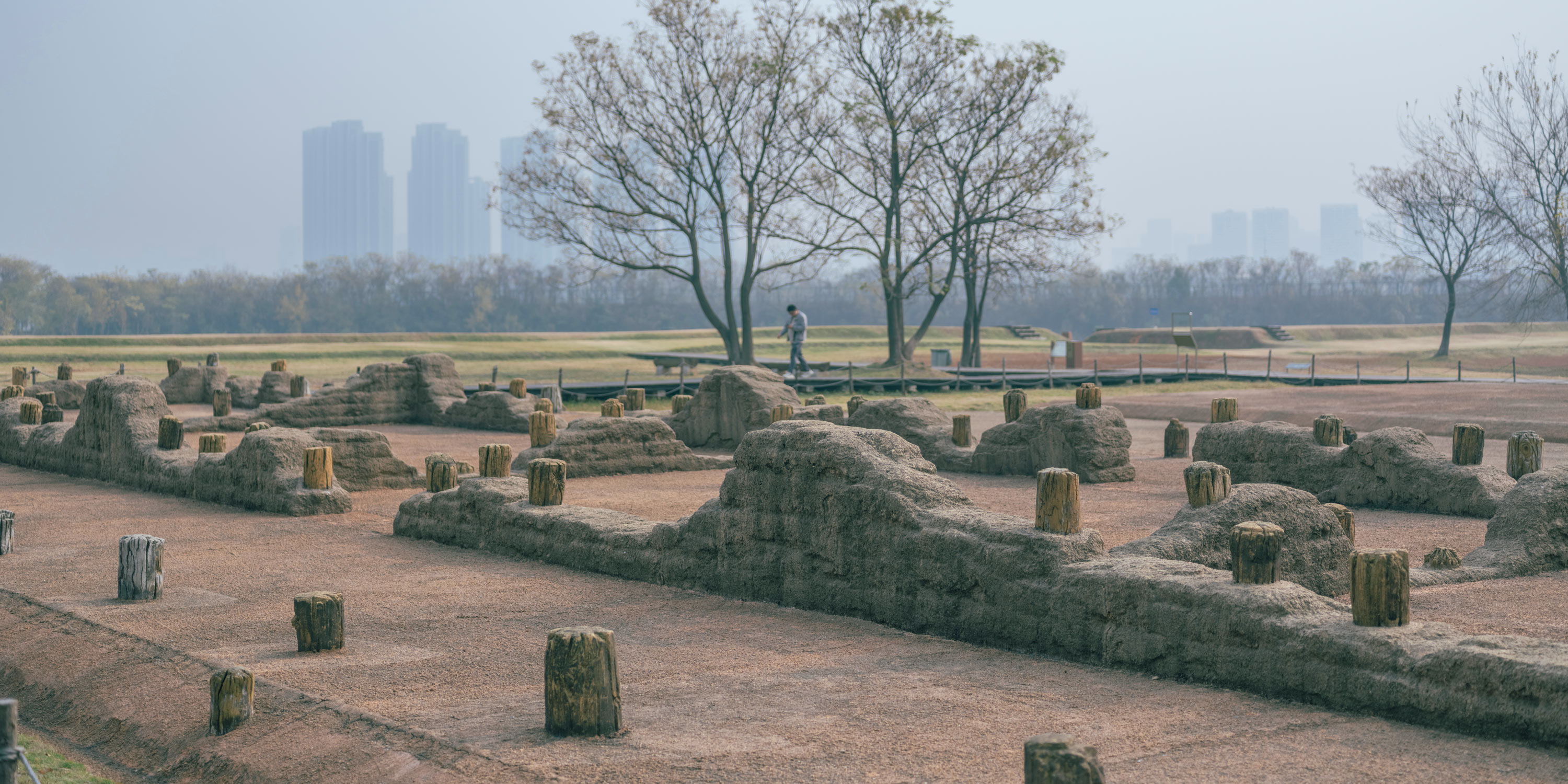
The city’s most important buildings, the foundations of two Shang-period palaces, sit just 30 centimeters below the surface.
Uncovered by archaeologist Yu Weichao and his students from Peking University, one of them, Palace No. 1, is nearly 40 meters wide, an unusually large footprint for early Shang architecture. Its layout separates a formal front court from living and ritual spaces behind it, a division that would later become standard in Chinese palaces and temples. This is the earliest known example of that spatial logic.
Their placement was no accident. Both palaces occupy the highest point within the ancient city. Chen Xianyi, who directed excavations at Panlongcheng for many years, argued that the elevation served several purposes at once: projecting authority, surveying the surrounding landscape, and keeping the buildings above the worst effects of moisture and flooding.
The construction itself reflects similar calculations. Main pillars and supporting eave columns — early forerunners of later bracket systems — helped distribute roof weight and extend eaves outward, shielding walls and foundations from rain.
More recently, that same shallow burial produced an unexpected find. In 2024, Sun’s team exposed a long, clearly oriented stone structure dating to the Middle Shang period (c.1300–1200 BC).
Built from cobbles of varying sizes, the structure runs east to west. One exposed section measures about 81 meters in length and five meters in width, but survey data suggest it may extend for roughly 600 meters across the site.
Sun believes the construction follows a pattern. Eight large stones, each roughly 60 to 100 centimeters square, are set at regular intervals of about 1.2 meters along a central axis. At either end, smaller stones form two parallel east-west rows, each about two meters wide. Additional stones extend southward at five-meter intervals, perpendicular to the main band.
“This is the first large-scale Xia-Shang stone structure discovered in the Yangtze basin,” says Sun, referring to the period spanning the Shang and the preceding Xia dynasty (c.2070–c.1600 BC). “Its importance is self-evident. It represents a high-intensity social project with significant social status — but its exact function remains unknown.”
Why people 3,500 years ago would build a stone band stretching hundreds of meters across the landscape is still an open question. Possibilities range from city walls and revetments to architectural foundations or ritual installations. The presence of neatly arranged ceramic jars alongside the stones has added weight to a ceremonial or sacrificial interpretation, but no single explanation fully accounts for the structure’s scale or design.
“Archaeology is like this,” says Sun. “Even when a structure is right in front of you, it can still be a huge mystery. That’s precisely what makes this work fascinating.”
In the soil
The same water that exposes parts of the ancient city also saturates the soil below, degrading what archaeologists hope to recover almost as soon as it is uncovered.
Sun explains that the local soil holds moisture year-round and is mildly acidic, with an average pH of about 6.5. Over time, that combination is destructive to organic material. “It’s like a giant stomach,” he tells Sixth Tone. “Bones and carbonized plants — they all get digested.”
Sun recalls a recent excavation that appeared to be a burial. Ceramic vessels, arranged like grave goods, were intact. Human remains were not. “A grave should have a body, right?” he says. “All we can do is collect soil samples and see whether we can detect human DNA in the lab.”
The pattern helps resolve a long-standing puzzle. At northern Shang-period sites such as Yinxu, the dynasty’s final capital in modern-day Henan province, archaeologists have uncovered large numbers of human sacrifices. At Panlongcheng, comparable finds are rare.
The contrast has led some historians — including Li Shuo, author of the bestselling book “Revelation” — to ask whether the Shang people became less violent in the south. A simpler explanation is more likely: the practice may have been the same, but the evidence did not survive.
Human remains are not the only losses. Animal bones — equally critical for understanding how people lived — have also fared poorly. Zooarchaeology, which examines how past societies used and related to animals, faces particular constraints at Panlongcheng.
That work is led by Liu Yiting, a 35-year-old associate professor at Wuhan University’s School of History. Before arriving at Panlongcheng, she had worked at major northern sites such as Miaodigou in Henan and Zhouyuan in the northwestern Shaanxi.
She came with a long list of questions: whether residents relied mainly on pork; whether they kept animals beyond subsistence needs; whether cattle from the north were present alongside local water buffalo; and whether Panlongcheng, as a southern outpost under Shang control, followed subsistence patterns distinct from those of the Central Plains.
Those questions ran up against the condition of the material itself. After reviewing decades of animal bone samples from the site, Liu found that very few were usable. Most were badly degraded — crumbly, softened, or reduced to powder. The better-preserved fragments resemble charred wood; the worst are nearly indistinguishable from the surrounding soil.
As a result, many of the standard tools of zooarchaeology simply cannot be applied here.
“When animal remains are abundant and well preserved, there’s a lot we can do,” Liu explains. At sites such as Zhouyuan, she adds, archaeologists can count and compare pig, sheep, and cattle bones to see which animals were most heavily exploited.
From there, analysis becomes more precise. Patterns of tooth eruption and wear, along with the fusion of skeletal joints, can indicate how long animals lived. DNA and isotopic testing can reveal whether they were domesticated or wild, local, or brought in from elsewhere, and how they were managed over their lifetimes.
“Putting all of this together,” she continues, “we can assess whether animals were used for food, ritual sacrifice, hunting assistance, or as pets. If a sheep lived to an advanced age and consumed large amounts of fodder, for instance, it was likely kept not just for meat, but also for wool or milk.”
At Panlongcheng, however, those approaches rarely apply. The small number of surviving fragments makes quantitative measures such as minimum numbers of individuals or identified specimens unreliable, and the condition of the material largely rules out DNA analysis. In many cases, Liu says, it is difficult even to determine which species a fragment came from.
With few alternatives, Liu relies on painstaking visual inspection. Using basic morphological analysis, she identifies skeletal elements, species, and age where possible, fragment by fragment. “I’ve accepted that progress here will inevitably be slow,” she says, “and that a great deal of uncertainty is unavoidable.”
Still, Liu looks for what can be salvaged. Bone is usually too degraded to analyze, but animal teeth survive better. If enough intact teeth can be recovered, chemical traces locked in the enamel may still offer clues about what animals ate and the environments they lived in.
“Of course,” Liu adds with a smile, “that would require exceptionally good luck.”
Under the water
But luck only goes so far at Panlongcheng. Beyond the trenches, much of the evidence lies underwater.
Zou Qiushi, an archaeologist at Wuhan University and one of the site’s core researchers, has spent years studying the lake beside Panlongcheng rather than the ground beneath his feet. Trained at Wuhan University from undergraduate through doctoral levels, he began taking courses in remote sensing and geographic analysis as a student to expand the tools available to archaeology.
“Today, our goal in archaeology is to reconstruct ancient societies,” the 34-year-old says. “That includes their production activities, daily life, and belief systems. That requires interdisciplinary knowledge and methods.”
As a graduate student, Zou began collaborating with remote-sensing specialists to document Panlongcheng at a scale that excavation alone could not manage. Using drones, RTK surveying, and other mapping tools, the team digitized data from more than 30,000 test pits over several years, building a detailed geographic information system of the site.
During that work, Zou noticed several Shang-period tombs appeared to extend beneath Panlong Lake. The observation raised a basic question: had water always occupied this part of the landscape, or had portions of the ancient city once stood on land that later disappeared?
To test the idea, the team drained a shallow section of the nearby Pokou Lake and excavated the lakebed. Shang-period pottery shards emerged, confirming that the city extended beyond the present shoreline.
Zou then worked with researchers from the Nanjing Institute of Geography and Limnology at the Chinese Academy of Sciences and Wuhan University’s School of Remote Sensing and Information Engineering to survey Panlong Lake more systematically.
They identified additional Shang-period remains beneath the water and carried out underwater topographic mapping. Combined with earlier test-pit data, the results allowed the team, in 2017, to reconstruct the ancient landscape of Panlongcheng.
The reconstruction showed that during periods of high water, lake levels in the Shang period were at least five meters lower than they are today. The city’s land area may have reached about 3.24 square kilometers — nearly 1.5 square kilometers more than what remains exposed. In practical terms, at least half of Panlongcheng now lies beneath the water.
Yet, the discovery did not lead to large-scale underwater excavation. “When people hear ‘underwater archaeology,’ they usually think of shipwrecks, sending divers down or using salvage operations,” Zou explains. “But the situation here is different.”
The lakes are shallow — no deeper than 10 meters — and apart from sediment, the lakebed offers little to excavate directly. Most artifacts lie buried seven or eight meters below the surface.
Draining the lake isn’t an option either. When Panlongcheng was developed as a national archaeological site park, the surrounding land was acquired by the city, but the lakes were not. Most remain in use as fish farms.
“When we’re working in the field, we often see large mechanical cranes by the lake, lifting truckloads of fish,” Zou says. “So, draining the lake for excavation is out of the question. Even if we wanted to, environmental and water management authorities wouldn’t allow it.”
Instead, research continues indirectly. Using coring techniques, archaeologists extract narrow columns of sediment from the lakebed and bring them back to the laboratory for analysis.
Zou is particularly interested in pollen and phytoliths — microscopic traces left behind by plants — that can survive in lake sediments long after fields disappear.
Excavations at Panlongcheng have uncovered palaces, workshops, and residential areas, but no obvious farmland. In a Bronze Age city with limited transport, crops would have had to be grown nearby. The team suspects that fields once lay in areas now submerged beneath the lake.
“To reconstruct the economy and daily life of an ancient society,” Zou says, “information preserved in the sediment may be even more valuable than artifacts.”
Within a few months, fieldwork will slow again. As spring rain returns and soil conditions become unstable, excavation gives way to a different phase of work. Samples collected during the winter are analyzed in laboratories.
Data from trenches, cores, and surveys are organized, compared, and reassessed. Plans for the next season are drawn up, often shaped as much by what could not be recovered as by what was found.
Water, soil, and time continue to set the terms, but each season adds a little more to the record.
Editor: Apurva.
(Header image: Ruins of a Shang-period palace at the Panlongcheng National Archaeological Site, Wuhan, Hubei province, December 2025. Wu Huiyuan/Sixth Tone)