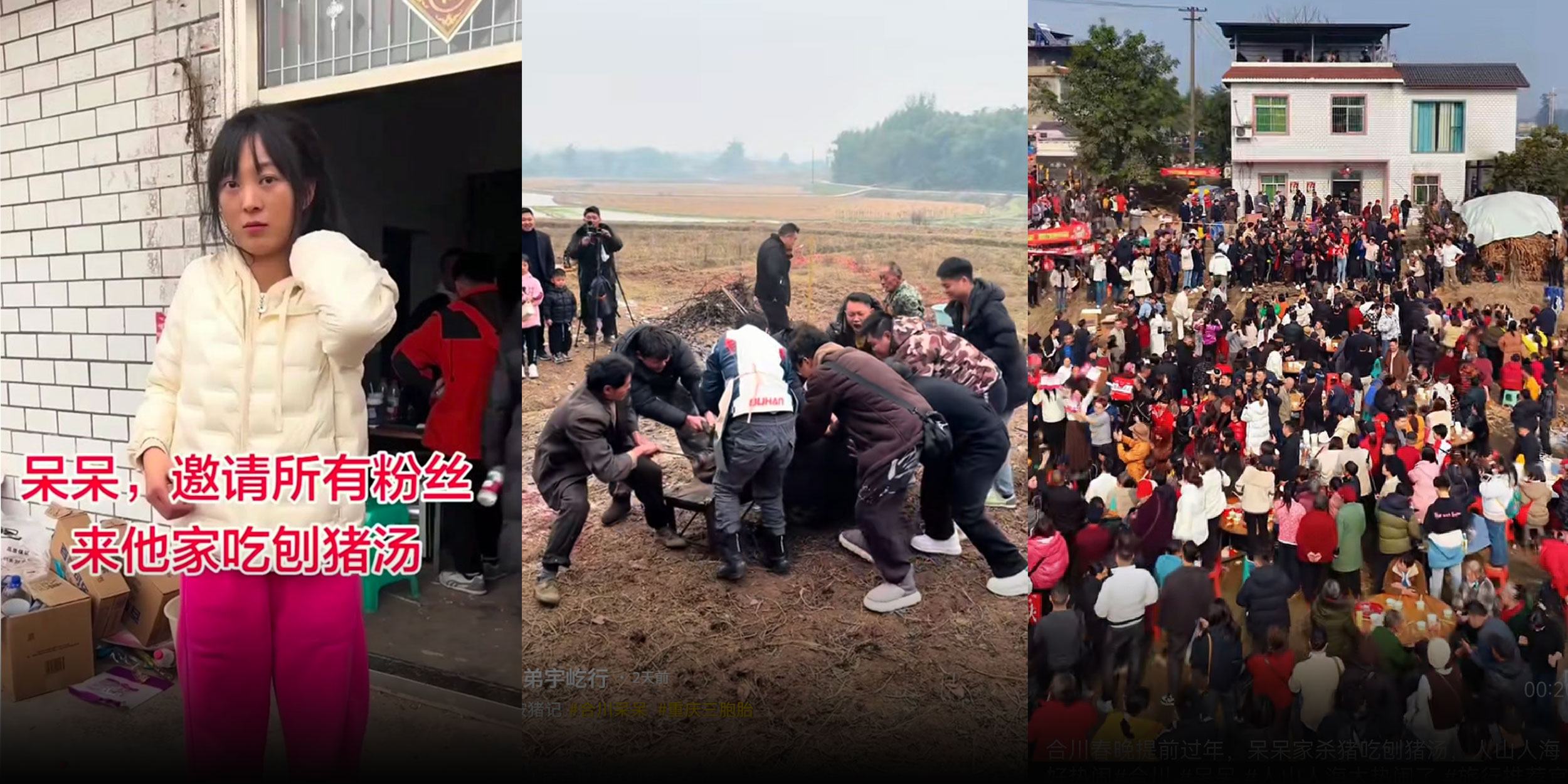
Hog Wild: Pig Feast Goes Viral, Overwhelms Village in China
“On Jan. 11, my family is going to slaughter two pigs; can anyone help me restrain the pigs during the slaughter? My dad’s old — I don’t think he has it in him to restrain them.”
This message posted on Jan. 9 to Douyin, China’s version of TikTok, by a user known as “Daidai,” was meant to attract a handful of people to help with a traditional rural chore. Instead, it set off a wave of online attention that drew thousands of visitors from all over China to her village and hundreds of millions of views online.
Daidai’s short video showed little more than a pig, a narrow village road, and a vegetable garden outside her home in a rural district of Chongqing in southwestern China. In exchange for help, she offered free paozhutang — a communal meal made from freshly slaughtered pork.
In many parts of rural China, slaughtering pigs ahead of Chinese New Year is a social ritual. Families invite relatives and friends to help butcher the animal, cook together and prepare preserved pork, turning labor into a daylong gathering.
Within a day, her post had gone viral, racking up 180,000 likes and 140,000 reposts, while Daidai’s Douyin following surged by 1.5 million. By Thursday, she had more than 2.3 million followers.
The online attention soon spilled offline. According to the local culture and tourism bureau, more than 10,000 people arrived in the village over two days, with peak crowds of around 3,000 at a time. Traffic backed up for nearly two miles, and Daidai’s livestreams at times drew more than 100,000 simultaneous viewers.
What began as a plan to slaughter two pigs rapidly expanded. Daidai ultimately slaughtered five, bringing in a designated cooking team to cope with demand. Local authorities stepped in, sending volunteers and officials to help manage crowds and arranging additional telecommunication service.
On social media, visitors described the scene as reviving a long-lost Lunar New Year atmosphere, with attendees bringing gifts or pitching in to prepare food.
Others captured a more chaotic picture. Videos showed crowds lining up outside Daidai’s home, shouting, livestreaming, and jostling for attention. Accounts impersonating Daidai or claiming to be her relatives also surfaced, hoping to cash in on the viral traffic.
After one meal, Daidai broke down in tears on camera, citing a lack of manpower and her mother’s exhaustion from cleaning up after days of nonstop hosting. On Tuesday, she said she had slept only four hours over two days and felt “extremely fatigued and mentally unwell.” She announced the event would be halted so her family could return to normal life.
Viral moments built around local food traditions are not new in China. In recent years, individual vendors or dishes — from fried chicken stalls to regional hot pot — have briefly turned small towns into national attractions.
In Daidai’s case, official Douyin accounts joined in. Between Jan. 11 and 13, local government accounts posted more than 20 videos from the site and promoted other nearby attractions, inviting visitors to return during the Lunar New Year. Officials even announced that Jan. 11 would be designated as Paozhutang Day each year in a bid to extend momentum.
In the wake of her popularity, villages in other provinces began organizing similar pig slaughter events. In one village in central Hunan province, another woman drew widespread attention after inviting netizens to attend a traditional slaughter and feast. She told domestic media that nearly 10,000 people nationwide have signed up. What was initially planned for two pigs may now involve as many as 20.
Experts say the appeal lies in a mix of sincerity and novelty. Lu Junwei, an associate professor at Hubei University’s School of Journalism and Communication, said Daidai’s simple desire to help her parents resonated emotionally with viewers and generated what he described as “unconditional support.”
Editor: Marianne Gunnarsson.
(Header image: Left: Daidai pictured in front of her house; middle: A group helps restrain a pig in preparation for slaughter; right: A crowd gathers in front of Daidai’s house. From Douyin)