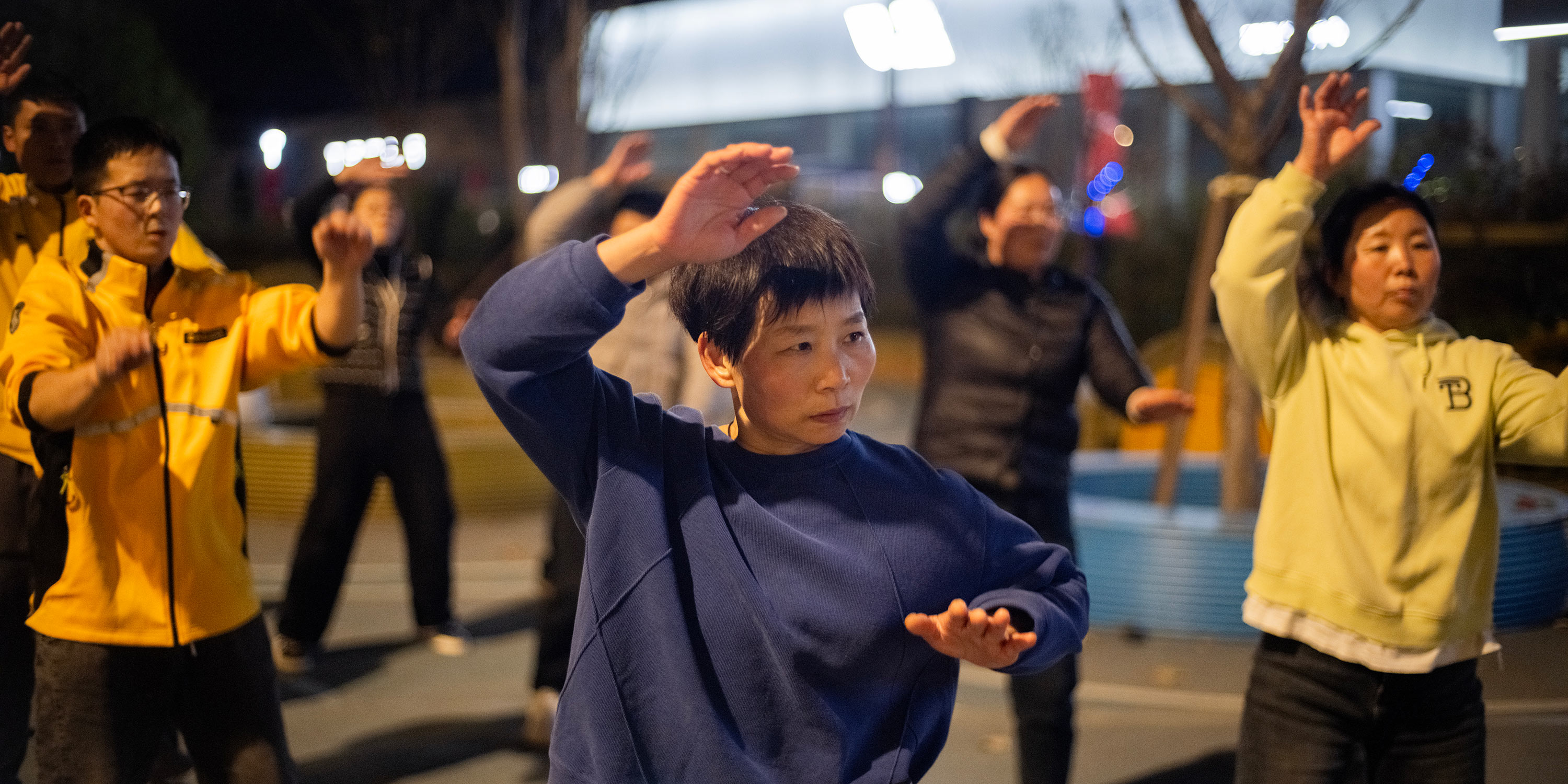
The Chinese Parents Dancing to Shake Their Kids’ Cancer Blues
Editor’s note: After losing his 5-year-old son to cancer in 2025, self-taught livestreaming coach Yang Zhipeng, who prefers to be known as “Douding’s Dad,” began helping parents with severely sick children make extra income by offering free training and organizing nightly, hours-long dance sessions, which are broadcast live on Douyin, the Chinese version of TikTok, from a plaza in Jinan, capital of the eastern Shandong province. Here, the 40-year-old shares his story in his own words.
As soon as the song “Qinghai Shake” comes on, all 14 of us step into frame. It’s crucial we start our nightly livestream with a lot of dancers to boost energy and engagement.
We have three phones set up at the front of our makeshift dance floor, which is in a plaza about two kilometers from the Cancer Hospital of Shandong First Medical University, next to a statue of a bear holding a red heart. One phone is recording, another plays the music, and the third relays our livestream channel, “Little Fighters,” so that we can monitor and respond to audience interactions.
The parents are in two rows, with a “star” spot front and center. Whoever is in this spot needs to stay in frame at all times and thank viewers for any gifts and donations. They can’t even step out to get a sip of water.
Each livestream starts after 8 p.m. and lasts about four hours, with two sets of dancers across two sessions. Our star dancer tonight was Ziqi’s mom, who at 51 is the oldest member of the group. She’s not tall, but she has incredible energy. As she was dancing, she was calling out the screen names of viewers who had sent us hearts, badges, and other virtual gifts (Editor’s note: Channel owners on Douyin receive these gifts as currency).
“Qinghai Shake” was my son Douding’s favorite. When he was in the hospital, he spent a lot of time watching short videos of people performing the dance trend, swaying to the beat. The original choreography is quite difficult. Our group practiced for two months, but we still couldn’t get it right, so I simplified it into six sets of moves, making each more forceful and deliberate — and a bit clumsier. The sequence lasts 28 seconds, and we repeat it roughly 130 times an hour.
Before we start the livestream, you’ll see parents strapping on knee supports and applying herbal medicine plasters; some even take painkillers just to get through the night. We’ve had someone throw up before. No one has any formal dance training — we all have different styles. A viewer once described a particularly uncoordinated dad in the back row as “looking like a construction worker swinging a sledgehammer.”
We dance outdoors, so it’s hot in summer, and now the temperature has dropped below freezing. We don’t wear our jackets because they look clumsy. In winter, you have to start warming up straight away or the cold will cut right through you. I tell the group that we don’t need to be the best or most attractive dancers, we just need to be willing to push ourselves.
Most of our dancers are moms who care for their children during the day, although there are some dads who work as takeout delivery drivers. They have come to Jinan from all over China — many from rural areas — to seek treatment for their children, who have blastoma, a type of cancer that develops in immature cells.
The costs of surgery, chemotherapy, and medication mean money flows out like water. Our children need treatment, so we need to set our pride aside. Some of the group’s children are already in the advanced stages of their illness. We all know about the low survival rate for this form of cancer, but we don’t talk about that. As long as their child is still here, they allow themselves to feel hope.
Keep moving
Douding was diagnosed with hepatoblastoma, a rare form of liver cancer in children, on Dec. 13, 2023. He was 3 years and 9 months old.
My wife and I used to run a barbecue pork shop in Linyi, Shandong province, but we relocated to Shanghai when Douding got sick. Over the next eight months he underwent surgery and two rounds of anti-infection treatment, costing more than 600,000 yuan ($85,790). The doctor said his tumor had nearly completely filled his lungs and needed to be surgically removed. We were already almost out of money — we’d sold our car, jewelry, and restaurant, and had borrowed from everyone we could. It felt like the road ahead was suddenly blocked.
On July 1, 2024, Douding was admitted to the Cancer Hospital of Shandong First Medical University. We’d heard it had lots of experience treating blastoma, and that living costs in Jinan were relatively low.
All of the parents in our dancing group have quit their jobs to care for their children. It’s virtually impossible to work normal hours — the situation is so unstable, you have to be ready to drop everything and rush to the hospital at any moment.
After we arrived in Jinan, I started working in food delivery, but the area around the hospital is sparsely populated; I’d only get 20 to 30 orders a day. From day one I knew I’d never be able to cover the costs of Douding’s surgery that way.
After a while, I noticed other parents posting short videos and doing livestream sales to raise money. The content followed a fixed formula — telling how the couple met, married, and started a family, only to receive a serious and sudden diagnosis. We studied the format and made our own video, spending three days filming and editing. It ended up receiving more than 10,000 views, and someone even donated 100 yuan.
With the help of another parent, I then started selling trash bags via livestream. We made almost no money in the first two months. Every day, I just sat there forcing myself to talk into the camera. I once streamed for nine hours straight, repeating the same lines until my voice was so hoarse I could barely speak. I started looking at other options; I sold toys on the street dressed in a frog costume, and even tried singing on the livestream. Nothing was working.
Last summer, I learned that some fathers on Douding’s ward were dancing as a group online, so me and three other dads decided to work together. At first, we just imitated whichever livestreamers had the highest traffic. We’d practice a popular routine in the afternoon to get familiar and try it out live the next day.
I was really embarrassed and could barely move my legs, but just like I tell newcomers now, after you take that first step, the rest falls into place. After four months, we’d made about 30,000 yuan from virtual gifts, traffic-based revenue, and targeted donations.
During that time, Douding underwent nine surgeries. I had no mental space for anything else. I’d livestream a dance at noon and another in the evening, often going late into the night.
But in the end, we couldn’t save him. My son passed away in May from organ failure. In his last 10 days, he spent more time asleep than awake, but he wasn’t in pain. He still called out “Mom” and “Dad” now and then, and spoke a little. When he was eventually declared brain dead, I held him in my arms and watched the numbers on his vital signs monitor slowly fall to zero.
Chorus of support
After Douding passed away, my wife and I returned to Linyi to make the funeral arrangements. Later, I received a message from a woman who had helped us that said: “Even though Douding is gone, the other children are still here. You could help them. Will you consider coming back?”
I had my concerns. Now that we were no longer attempting to save our son, would people think we were trying to profit from the situation? Unfortunately, there really are people out there who claim to be raising money for a sick child’s treatment but are actually keeping it for themselves.
We ultimately decided to move back to Jinan to continue livestreaming with other parents because I thought it could help us survive, while also offering others a path forward. Another reason is that our viewers call me “Douding’s Dad,” and hearing his name makes it feel like my son is still here. This keeps him with us.
In June, we moved back into the small house where we lived with Douding and began offering coaching to budding livestreamers. The first to come were two mothers who were starting from scratch, so I taught them the basics: account operation, dance moves, and how to overcome performance anxiety. We started with 30-minute dance sessions, then gradually increased this by 10 minutes each time to help build their stamina. They also had to take turns taking center stage on camera.
Initially, the livestreams did poorly — a good session received fewer than 20 viewers. We were each earning just 10 yuan a day. Despite that, one mother was determined to keep going. Her husband was working two jobs more than 20 kilometers away in the city center, delivering food during the day and working the late shift at a barbecue restaurant until 1 a.m. Dancing at least helped her cover the cost of groceries.
Ziqi’s mom joined us in September. She’s a single mother who used to work at a shoe factory in the eastern Zhejiang province, but for the past five years has been caring for her sick daughter. When she has time, she takes on hotel cleaning jobs that pay by the hour.
Initially, Ziqi would also come along to the livestreams. At 13, she’s one of the older children in the group. When she returned to school — bald from chemotherapy — her classmates had teased her, and she struggled to keep up with her studies. Ziqi didn’t tell her mom about these things, afraid that it would only make things worse. She said she sometimes wore a wig to “look like an ordinary girl.”
When parents visit our home for dance rehearsals, we’ll often sit together and chat while their children play. It can offer some relief. But we’re a transient bunch. Families will disappear to take their children to Beijing or Shanghai for surgery; others return home. The happiest thing for us is to hear that a child has completed their treatment.
Five children in our group have already passed away, including Douding. Another was Zixuan, who came here with her family from the northwestern Shaanxi province and stayed for four years. In November, we heard that her condition had deteriorated. We all went to the hospital, and everyone chipped in what they could — 100 yuan here, 200 yuan there.
Zixuan died early the next morning. I went to the funeral home with her parents to make the necessary arrangements. Before the couple returned to Shaanxi, they came to our home to say goodbye to everyone. As they were leaving, one mom called out, “Don’t delete us.” Some parents have left our online group chat without a word after their child passes — staying would only have caused them more pain, I think. But Zixuan’s mom promised she wouldn’t sever contact. She feels the bond we share is stronger than the heartbreak of the illness.
Ties that bind
When I first started dancing online, a viewer challenged me to dance nonstop beyond two hours, promising to send a virtual gift worth 120 yuan in return. I gritted my teeth and did it. By the end, the skin on my chest was raw from my shirt rubbing against it. That’s when I understood that no gift is free. The only thing that matters is that you give everything you’ve got for the camera.
Since June, we’ve helped teach more than 40 parents about livestream dancing. Those two mothers, our first students, now run their own channel on Douyin. We’ve also had influencers and even celebrities come to help us. We never imagined any of this.
Most comments in our livestream are supportive, urging us to take care of our health. But we’ll also still get questions like, “If you have enough time to livestream, what’s stopping you from working as a delivery driver?” I try to explain, but have to be careful not to say the wrong thing.
When viewers send a donation, we split it evenly among all the dancers present. Every single yuan is recorded — where it came from and where it went. When our group channel began gaining traction, I urged the other parents to start livestreaming using their own channels, too. Once their personal earnings surpass what they make from our group, they will be self-sufficient.
Livestreaming is the tie that binds us. We didn’t have much contact before; everyone stayed holed up in their rented rooms, consumed with monitoring their child’s condition, enduring the suffering with no relief. Dancing and fundraising help us shift our attention for a little while.
A few days before Ziqi’s birthday on Dec. 20, we decorated the small plaza and surprised her mom. Ziqi had bought matching green dresses, and she presented one of them to her mother in a gift box.
That night, Ziqi’s mom, wearing her new dress, took center stage in our livestream, balloons fluttering in the wind behind her. Afterward, I looked on to the main road nearby, where the line of vehicles seemed endless. I wished that our children could be like that traffic: continuing ever onward toward some place far away, without end.
As told to reporter Lü Meng.
A version of this article originally appeared in White Night Workshop. It has been translated and edited for brevity and clarity, and is republished here with permission.
Translator: Carrie Davies; editors: Wang Juyi and Hao Qibao.
(Header image: Parents of young cancer patients dance during a livestream in Jinan, Shandong province, December 2025. Lü Meng/White Night Workshop)