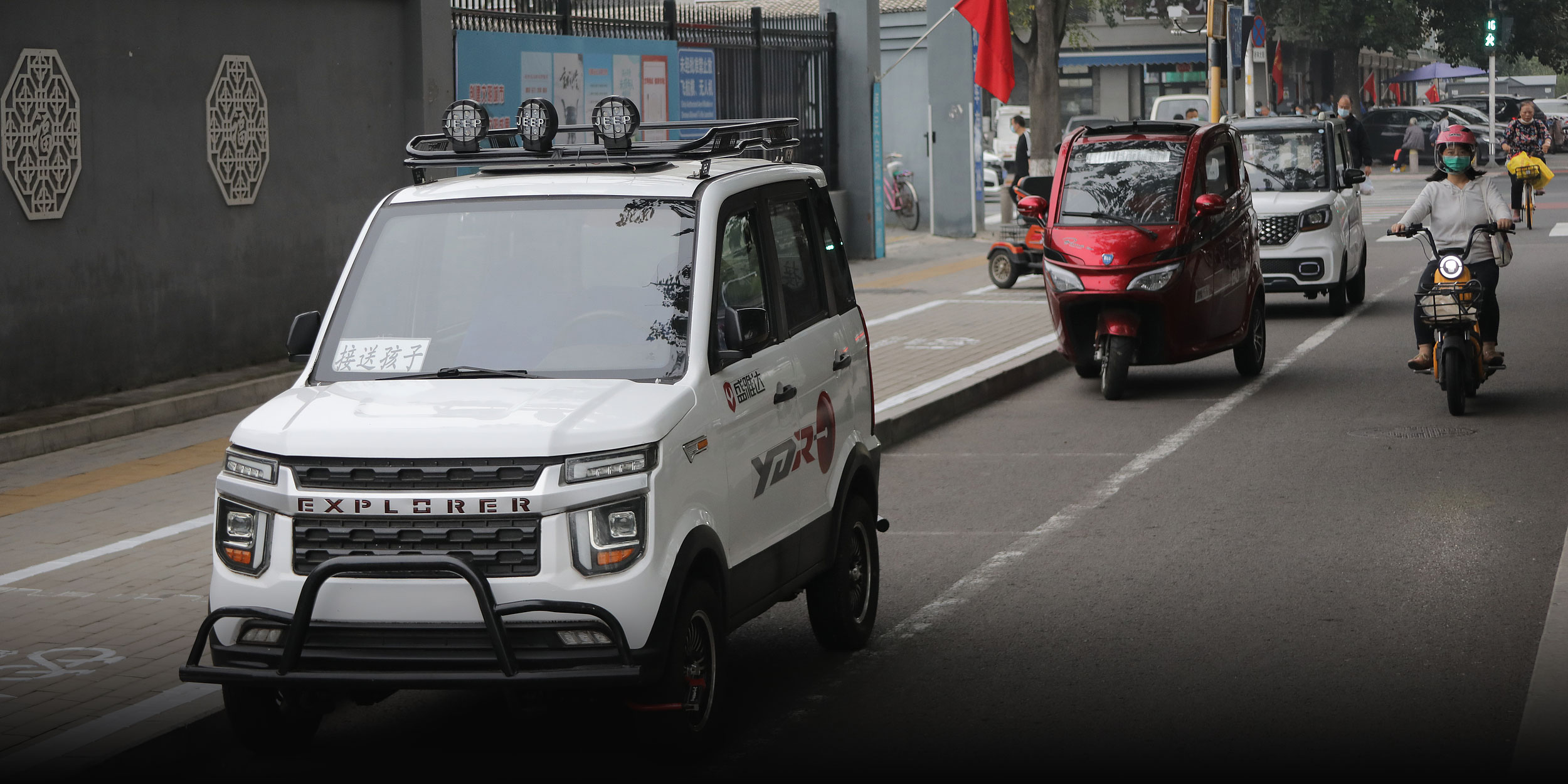
China’s ‘Old Man’s Joy’ Cars Test the Limits of Road Safety
From “new-energy Maseratis” to “license-free Porsche Cayennes,” a growing number of elderly mobility vehicles informally known as laotoule are appearing on rural and suburban roads across China, drawing scrutiny from regulators and road-safety experts.
Many laotoule vehicles — commonly translated as “old man’s joy — are sold without registration or licensing and are increasingly marketed online as low-cost luxury car lookalikes, according to a recent investigation by Banyuetan, a publication under the state-run Xinhua News Agency.
Although intended for use in enclosed areas such as factories, parks, or tourist areas, sellers often promote them for driving on public roads, without clear disclaimers about where they can legally operate. With prices ranging from 1,760 yuan ($250) to 20,000 yuan, models often mimic the styling of brands like Maserati, Porsche, and Mini Cooper, but are equipped with low- to mid-powered electric motors and can reach speeds of up to 70 kilometers per hour.
Laotoule vehicles first appeared in the 1990s, when farmers modified tuk-tuks and other small vehicles with canopies and seats for short-distance travel. Today, some models can seat up to five passengers.
For many elderly residents in rural areas, the vehicles serve as a primary mode of transport, used for errands or picking up grandchildren. But in recent years, they have grown popular among younger users, including rural mothers, who value the enclosed space for children to eat, rest, or for protection from weather.
Their spread has coincided with rising incomes and unmet mobility needs. According to the China Electric Vehicle Association, annual sales of off-highway, four-wheeled shuttles rose from about 1.1 million units in 2017 to roughly 2.1 million in 2023, with models marketed to elderly users accounting for almost 1.4 million of those sales.
Safety experts warn that despite their car-like appearance, laotoule vehicles are not subject to the same regulatory standards as passenger cars and often lack basic safety features such as airbags or reinforced steel frames.
Recent incidents underscore the risks. In December, a 59-year-old man driving an unlicensed laotoule vehicle fatally struck a pedestrian in northern China’s Hebei province.
Some local governments have moved to restrict their use. On Jan. 1, 2024, both Luoyang city in central Henan province and Beijing banned low-speed electric three- and four-wheelers from public roads.
Industry and legal experts have sought a balanced approach. Last August, China issued norms covering technical specifications and safety requirements for low-speed EVs, classifying laotoule vehicles as motor vehicles under the law.
“(We) should acknowledge the real demand for low-speed vehicles and strengthen the design at the national level for both industry development and traffic governance, moving quickly to introduce clear and enforceable rules for product and driving standards, as well as road access,” Lu Yong, a low-speed EV industry researcher, told local media.
Editor: Marianne Gunnarsson.
(Header image: Laotoule vehicles in Beijing, 2021. VCG)