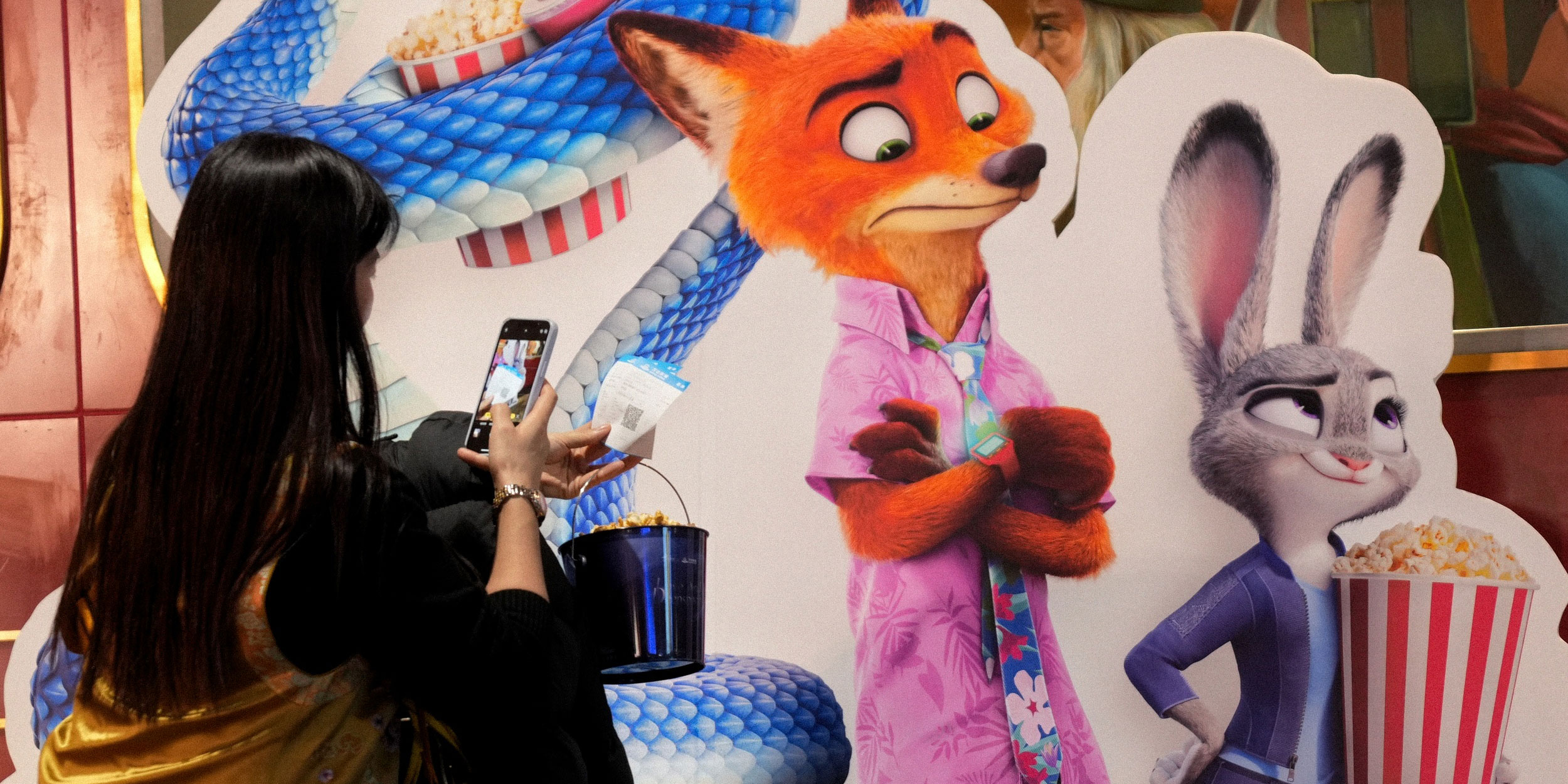
How ‘Zootopia 2’ Rode China’s Animation Boom to Success
Since its release on Nov. 26, “Zootopia 2” has shattered multiple Chinese box-office records. In its opening week, it surpassed the single-day record for takings by a foreign film set by “Avengers: Endgame.” A month into its run, it had firmly established itself as the most-watched foreign film in 2025. Notably, the film’s revenue in China is double that of North America, and accounts for roughly half of its global total.
Why has it achieved such staggering success? Have Chinese audiences suddenly regained their appetite for Hollywood? Not necessarily. When “Avatar: Fire and Ash” — another high-profile, effects-driven Hollywood franchise film — arrived a month later, it barely made a ripple.
In my view, Chinese audiences’ fondness for “Zootopia 2” stems less from its Hollywood origins than from its genre: animation. In recent years, animated films have repeatedly outperformed expectations in China. Case in point: Earlier this year, “Ne Zha 2” ignited a nationwide viewing frenzy and raked in 15.4 billion yuan ($2.1 billion).
In 2025, animated features grossed a combined 25.5 billion yuan in China, the highest annual total in the country’s cinematic history. Four of the year’s 10 highest-grossing films were animated movies. “Zootopia 2,” which earned over 4 billion yuan, took the second spot.
Some commentators liken China’s current animation boom to Japan’s anime craze that coincided with its economic boom of the 1980s. I would argue, however, that while the economic backdrops are similar, the cultural dynamics differ sharply.
Works conceived during Japan’s boom years, as well as during the “lost decade” of stagnation that followed, were essentially products of an elite-driven subcultural market. “Neon Genesis Evangelion” and “Ghost in the Shell” were saturated with social critique, existential philosophy, and experimental form. Crucially, they first attained cult status among a narrow audience before reaching the mainstream.
In contrast, animated movies that become hits in Chinese cinemas are those that connect with a wide audience, from trend-chasing teenagers to mellowed-out middle-aged viewers. Nearly half of China’s “Zootopia 2” audiences were 20-29-year-olds. Ne Zha’s rallying cry — “I’m the master of my own fate!” — pushed the 40-plus demographic past 20%. “Nobody,” last year’s fifth-highest grosser, dramatized the anxieties of wage “slaves”; 42% of its audience were 30-39. The cartoons that break out in China, in other words, latch onto broadly felt social moods and offer instant emotional fixes.
The cartoon boom thus reflects the contradictory spirit of contemporary China. While the economy continues to grow as EVs, AI, and other technologies advance rapidly, the psychological aftershocks of the pandemic and the relentless grind of workplace “involution” have fostered a collective fatigue. People yearn for an emotional outlet.
“Zootopia 2” offers exactly that — an expertly calibrated balm. It revisits the first film’s central conceit: a metropolis that looks utopian yet teems with prejudice and structural inequity. Main characters Nick Wilde and Judy Hopps confront not just a crime case but intertwined institutional barriers. The sequel supplies a clear, comforting route: cling to procedural justice, and the little guy can still topple entrenched power.
Animation’s power lies in the fact that it is not limited by reality. It can create any world, any character, and make every single detail serve the story. Stylized, emblematic creatures — foxes, rabbits, monsters — shed specific cultural baggage and become projection screens for universal emotions. A fox’s guile or a bunny’s grit is legible in any language. Thus, the medium can address subjects that live-action might find too raw. The cold-blooded versus warm-blooded rifts found in “Zootopia 2,” as well as its “climate wall” set piece, smuggle discourses on class immobility and systemic bias into a soft, palatable storyboard.
The 2016 original arrived amid social justice currents that rewarded overt moral statements; it flung unambiguous indictments of racial profiling, media manipulation, and institutional prejudice at the viewer. The sequel, unveiled in an era of global exhaustion and fragmentation, swaps critique for cure, foregrounding the more universal theme of “embracing difference.”
Nick and Judy, the smallest possible unit, do not seek to overthrow the system; they exploit its loopholes and secure justice within the rules. It is the safest of Disney’s trademark conservative gambits, designed to keep the franchise hospitable to the broadest family audience and to deliver the greatest common denominator of cultural comfort. The film offers a mild reformist fantasy, a two-hour emotional stipend for atomized individuals who feel powerless to alter the larger structure.
Of course, genre and solace do not fully explain the frenzy; the first film’s popularity also counts. The sequel’s very first controversy was tied to that legacy. The Mandarin dub dropped the seasoned voice cast and installed celebrities Wang Anyu and Jin Chen. Core animation fans balked; for them these characters are not mere pixels but vessels of personal coming-of-age memories. Change the voice, and you rupture the bond.
Only weeks ago, the Cambridge Dictionary crowned “parasocial” as its 2025 Word of the Year, describing the one-sided emotional ties individuals form with celebrities, fictional characters, or AI. Devotees of “Zootopia” had clearly adopted Nick and Judy as parasocial intimates; inserting the highly idiosyncratic voices of pop stars felt like a forcible invasion of that private relationship. The boycott was, at bottom, a collective declaration of emotional sovereignty. But it did not mean a refusal to buy tickets; audiences simply opted for the original, subtitled version instead of the dubbed version.
Lastly, Nick and Judy are the red-hot objects of “shipping” — the fan practice of imagining favored fictional characters as romantic partners, or CP, short for couple pairing. This has become a mainstream social activity in China’s fan-economy ecosystem, and one that film studios are more than happy to monetize. Disney clearly knows how to play the game. “Zootopia 2” stuffs its runtime with two-shots: exchanged glances, wordless teamwork, life-saving embraces — each calibrated to feed shipping demand. By one tally, clips tagged #FoxBunnyCP on Douyin, China’s version of TikTok, passed 8 billion views during the film’s release window. Such deep engagement prolongs the film’s buzz and generates a subtle social penalty: if you haven’t seen it, you can’t join the conversation.
Whether audiences sought solace or shipping, these emotional needs inflated the income of “Zootopia 2.” Animation may never solve real-world problems, yet in 120 minutes it can grant a precious possibility: the most improbable partners can still nudge the world toward change by prioritizing common ground over difference. The idea of an interconnected world — embattled yet enduring — rests on precisely this subtle power: the ability to foster dialogue and guide us toward coexistence.
(Header image: A woman takes a photo of her tickets to “Zootopia 2” in Beijing, Dec. 7, 2025. Zhang Xiangyi/CNS/VCG)