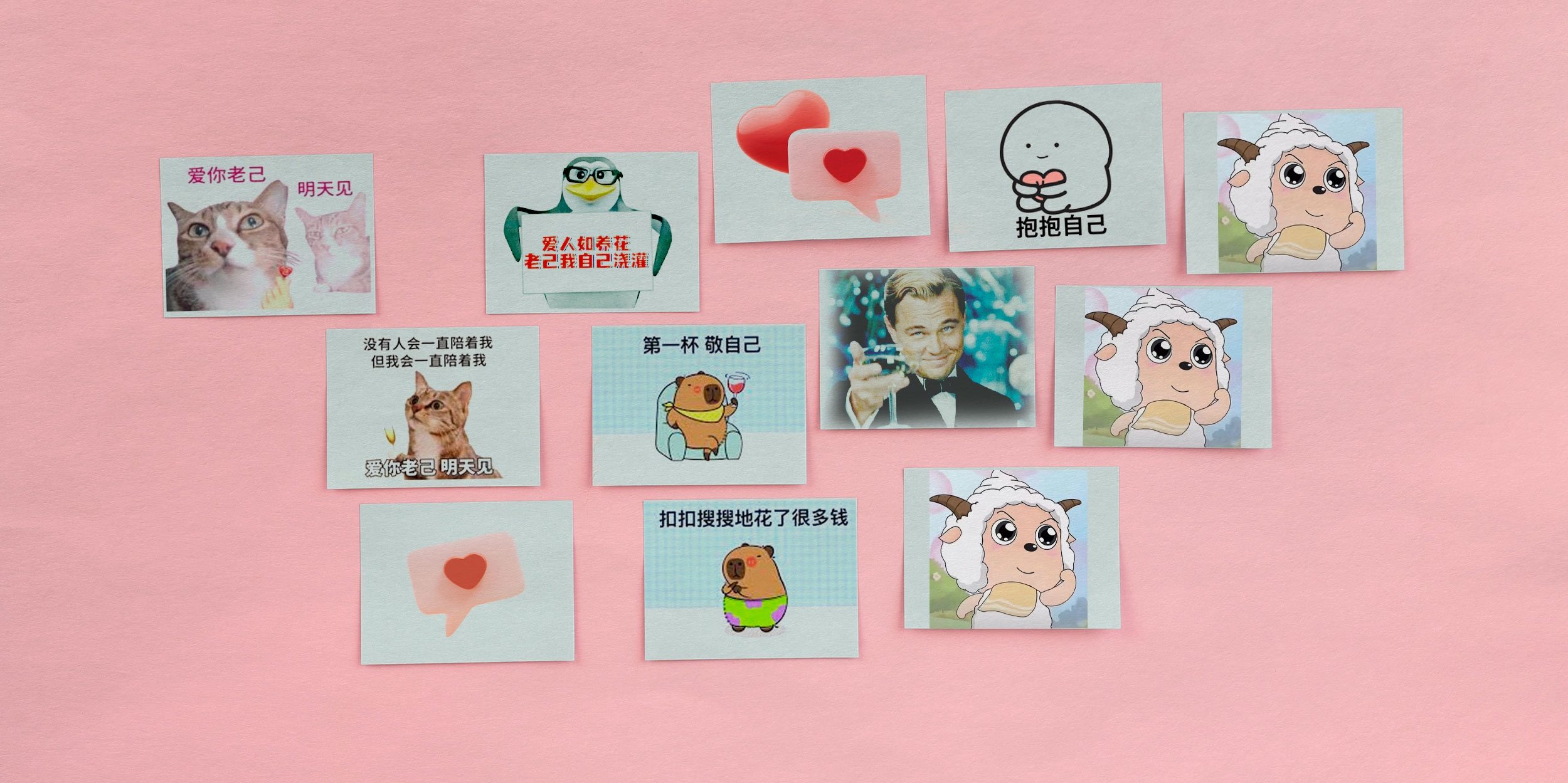
Cheers to Me: The ‘Self-Love’ Memes Taking Hold in China
From “love you, my dear self” to “a first toast to myself,” some of China’s most popular buzzwords from 2025 point to a turn inward — toward self-care, gentler expectations, and emotional well-being.
In recent years, young Chinese have embraced concepts such as “lying flat” and “FIRE” to express exhaustion and disillusionment with long hours, intense competition, and traditional markers of success. Now, a looser, more playful trend has emerged for relief, dubbed “self-love memes” by the state-run People’s Daily.
The trend began gaining traction in March, when a hashtag about young Chinese “raising themselves again” trended on microblogging platform Weibo. On the social platform Douban, a group named “Re-parenting Myself From Today” has drawn about 46,000 members.
Under the hashtag, users shared small acts of self-compassion, giving themselves attention they felt they lacked growing up, offering encouragement, or “permission” to rest or enjoy life.
Some wrote about buying toys their parents once refused to buy; others described returning to hobbies abandoned under academic pressure.
By August, short videos themed “a first toast to myself” began circulating on Douyin, China’s TikTok, drawing more than 1 billion views.
In traditional Chinese dining etiquette, toasts are typically offered to seniors first as a sign of respect. In these videos, however, creators raise a glass to themselves for effort, persistence, and even failure. Some toast themselves for “surviving” the day’s small challenges, such as eating regularly or remembering to water a houseplant.
More recently, the phrase “love you, my dear self” has spread widely since December. Adapted from a line in a video game — “love you, mom, see you tomorrow” — it has become shorthand for self-acknowledgement.
“It’s honestly the most spot-on meme I’ve seen all year,” one Weibo user wrote in a post that drew more than 27,000 likes. “I always overlook my own feelings and tell myself I didn’t try hard enough or fight hard enough. But I did. I just didn’t love myself enough — I subconsciously erased my own pain.”
In a commentary, People’s Daily described the memes as a form of “low-cost self-healing” that signal a “gentle shift in social values” towards attention to individual feelings in an era “dominated by the pursuit of efficiency and success.”
Critics, however, argue that some self-love memes encourage excessive self-indulgence or performative weakness. Among them are “self-mommying,” or zi mo in Chinese, a concept borrowed from fan-fiction culture emphasizing one’s vulnerability and pain in search of comfort, and likening oneself to a “brave little lamb.”
Counselors interviewed by domestic media have urged moderation. While acknowledging the appeal of online self-care narratives, they warn that much of the internet’s “self-growth” rhetoric does not always align with professional psychological frameworks. Developing a stable sense of self, they underscore, is a gradual process that cannot be reduced to a slogan alone.
Editor: Marianne Gunnarsson.
(Header image: Visuals from VCG, Weibo, and Xiaohongshu, reedited by Sixth Tone)