A Rural Mother’s Unfiltered Rage Gives Chinese Comedy Its Edge
“I got my big break at 50 — the same time as menopause.”
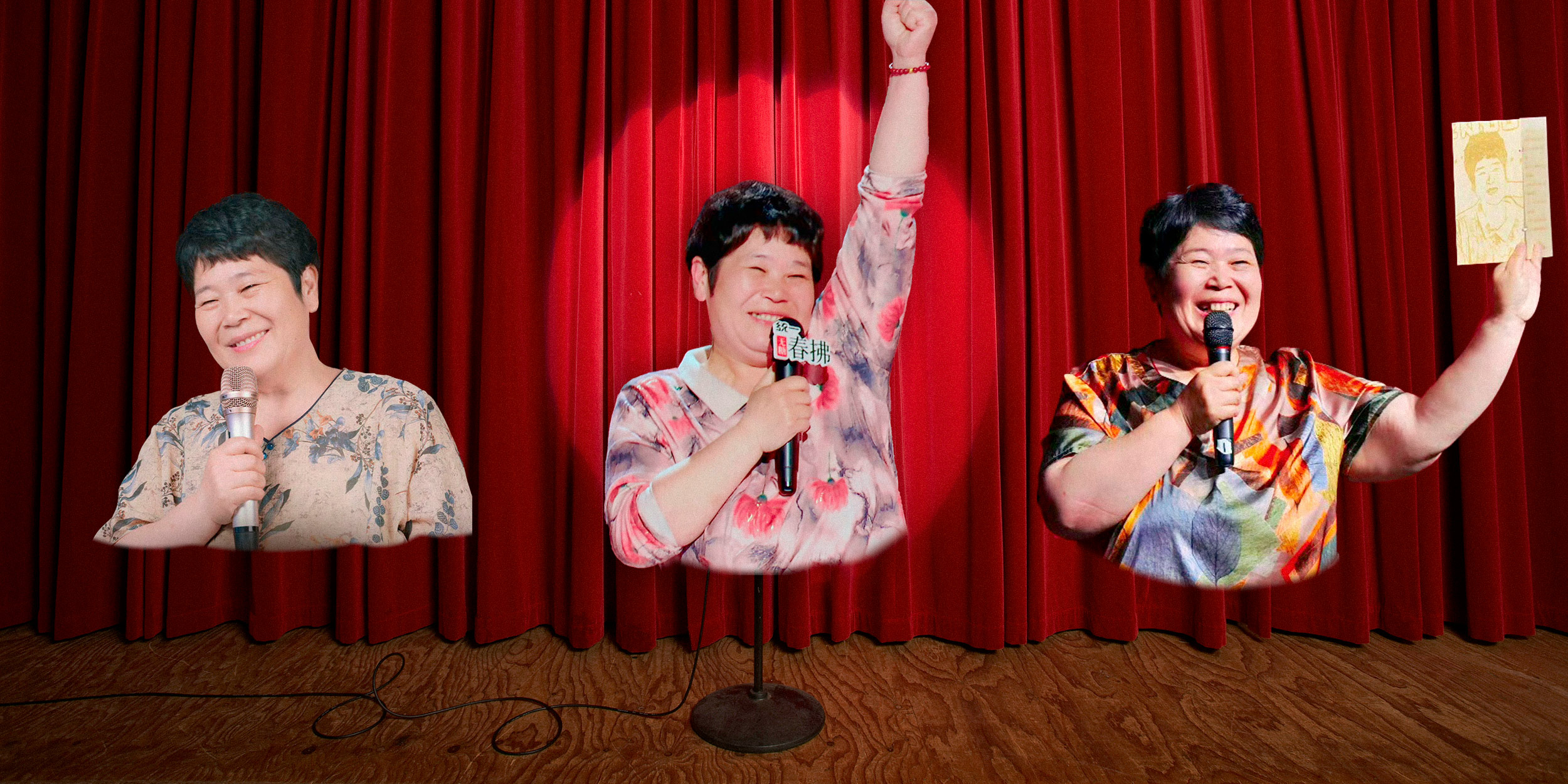
Fang Shaoli is on stage, mic clamped in her right hand, a huge smile on her face as she revels in the laughter. Although still a relative newcomer to China’s standup comedy scene, she’s been playing to sell-out crowds up and down the country in recent months.
That “big break” she jokes about came on this summer’s “King of Comedy,” a showcase for fresh talent on the Chinese streaming platform iQiyi, where she won over judges and viewers alike with her authentic, down-to-earth style.
As well as jokes on the universal experiences of middle-aged women, she’s received praise for her emotionally raw material, delving into domestic violence, her divorce, and other hardships she’s endured to escape her once hand-to-mouth rural existence.
One online review described Fang’s comedy as “not only reflecting her rebirth but also that of countless women who bravely pursue their true selves and find healing through laughter.”
Despite her newfound celebrity status, Fang still refers to herself as an “ordinary migrant worker.” Yet for the first time, she finally feels in control — on stage and off.
Suffering in silence
Fang was born and raised in the countryside around Linyi, a city of about 11 million people in China’s eastern Shandong province. She began working away as a teenager, but resettled in the area after getting married at 20.
To give an example of what village life was like, one of Fang’s routines is about the time she traveled for hours to a neighboring town to see a “miracle doctor” who claimed to sell medicine that guaranteed a woman would give birth to a son. She’d already had one daughter and was trying for a second child — another girl would have been considered a “great misfortune,” provoking gossip and ridicule among her peers.
She returned home with the medicine — frozen with fear as the motorized tricycle carrying her wound its way through the mountains in the pitch-black night — only to discover later that the “doctor” was actually a veterinarian.
Naturally, Fang’s second child was also a girl.
Twenty years on, she bursts into laughter when she thinks about that trip. But the mockery she received from relatives and neighbors cut deep at the time. Whenever she reacted with anger, she was made to feel that she was in the wrong.
“It’s always suffocating like that. If you get upset, they say you’re too sensitive,” Fang says. She explains that many rural women tell her how validated they feel after hearing her tell such stories on stage.
In fact, it was only after she began performing that Fang learned just how bad the situation had been for some women, including close friends.
She mentions Zhao, a mother with three daughters who she’s known since they were both teenagers. After seeing Fang’s appearance on “King of Comedy,” Zhao said she’d spent the next three days crying at home. “You finally said what we went through out loud, so everyone could hear it,” she told her childhood friend.
Despite outwardly appearing cheerful and extroverted, Zhao revealed that she’d been in a state of silent despair. Shortly after the arrival of daughter No. 3, her mother-in-law had openly instructed Zhao’s husband to find another woman who could give them a son. Zhao became so depressed that she kept a lethal dose of the herbicide paraquat hidden for 18 years, waiting for the day she would finally decide to drink it.
Along with mountains of praise, Fang has also received much abuse online. Some people have accused her of concocting a tragic past to solicit sympathy, casting doubt on her claims of working manual jobs at farms, construction sites, carwashes, and in sanitation. Fang wept as she read some of the negative comments and even felt the need to post several videos in response.
However, one message she later received from Zhao put everything into perspective: Her friend had written to say that she’d thrown away that bottle of herbicide.
Fang replied, “Even if you’re the only person I impact, knowing that my comedy brought you some peace makes the whole thing worth it, no matter how much hate I get.”
The change
Fang’s own marriage was fraught with problems, too. She describes her ex-husband as a chronic gambler who was “too weak for manual labor,” which left her as the family’s main breadwinner.
She recalls being branded a “shrew” after attempting to physically force him out of a rural casino one time, even throwing punches at him. Her pleas in private had already fallen on deaf ears and led to her husband and father-in-law beating her black and blue.
Fang later discovered that her husband had taken their first daughter to gamble while she was away, causing her to feel hopeless. “I couldn’t let her be dragged into the abyss with him,” she says. “I had to stop him gambling — even if it killed both of us.”
Her determination eventually paid off, and the family enjoyed more than a decade of relative peace. The couple opened a fruit shop, earning enough to pay their daughters’ school tuition.
This was Fang’s life until early 2023, when Li Bo, one of China’s top female standup comedians, arrived in Linyi to perform a solo show. A longtime fan, Fang splashed out 220 yuan ($30) for a ticket in the second row, and interacted with the comic during her crowdwork. In the exchange, which was shared online, Fang describes her job as “director of the village information center,” meaning the “village gossip.” (Now, on stage, Fang is introduced as “Director Fang.”)
Public speaking had never been Fang’s strength — at village gatherings, she would tremble with nerves whenever she had to open her mouth. But after that night, she contacted Li to express her desire to try standup. Li was encouraging and recorded a video message to personally invite Fang to a comedy training camp in Shenyang, capital of the northeastern Liaoning province, even offering to pay for her airfare and accommodation.
Like Fang, the 45-year-old Li had experienced domestic violence and divorce, and had raised a daughter alone. Today, she is the founder of the Bobo Laugh Theater, based in Shenyang, and has more than 14 million subscribers on Douyin, the Chinese version of TikTok.
With her daughters now grown and no elderly relatives to care for, Fang felt she was no longer needed at home, so decided to accept Li’s offer.
However, her first forays into comedy in Shenyang produced more tears than cheers, with tales of violence and discrimination touching a nerve with her fellow students. Fang knew that comedy was meant to make people laugh, but exposing her wounds to an audience still felt too heavy. “What I learned was that you need to process your own sadness first,” she says. What followed was an arduous period of reflection and introspection.
Fang’s stage presence initially also felt unnatural; she was tense, her voice trembled, and the energy would quickly drain from the room. Her open mic spots flatlined every time.
At the end of the training camp, she went home briefly while her daughter took China’s high school entrance examination, but then returned to Shenyang to continue her standup education. To make ends meet, she worked part-time in customer service for the Bobo Laugh Theater.
Her performances were still failing to win over audiences. Now she knows that what she lacked was confidence, the ability to control a room. “When you’re nervous, the crowd can tell, and it makes them even more nervous than you,” she says.
At the same time, Fang was experiencing menopause. She was feeling physically and mentally exhausted, and had to force herself to keep getting on stage.
When she was on the verge of quitting, her brother told her: “Don’t push yourself so hard. If you ruin your health, what then? If it’s not working out, just come home.” In February 2024, she followed his advice. Maybe it was time to start life over again, she thought.
Breaking free
For years, Fang had repeatedly told her girls that had it not been for them, she’d have left her marriage long ago. Her mindset only changed after one daughter pointed out that it was actually Fang’s lack of courage holding her back. “Don’t put that responsibility on us,” the daughter told her.
It was an emotional blow — and a wakeup call. From that day, Fang decided to stop making excuses and to put “becoming herself” above all else.
Shortly after coming home, Fang caught her husband drinking porridge directly from the pot with a ladle, something she and her germophobic daughters had been begging him to stop doing for 30 years. She felt her blood boil, and suddenly thought of her mother-in-law, who had collapsed and died during an argument. Fearing the same fate, she asked for a divorce. The following April, Fang left the marriage with nothing but her daughters and a small amount of savings.
Since childhood, she had been a “good girl.” Before meeting her husband, she worked for two years in a factory in Suzhou, in the eastern Jiangsu province, and sent every penny home to her parents. Then she got married, had kids, and took whatever job paid. “I’d never once thought about what I wanted,” she says.
An avid reader from a young age, Fang now admires Granny Liu, a character in the classic Chinese novel “Dream of the Red Chamber” who shows resilience in the face of hardship. It was a quality she endeavored to emulate. Yet, on reflection, Fang saw that she’d spent her life both resigned to her fate while also struggling against it.
Now alone, Fang realized that her daughters were the only people who had always stood by her — and that standup comedy might be her only chance to break free of her old life.
Show of strength
Fang returned again to Shenyang to give her comedy career one last shot. If it didn’t work out within three months, she would quit for good. She set aside some money for her daughters’ tuition and allowed herself a daily budget of just 30 yuan.
She signed up for open mic nights around the city and would rehearse new material each morning at the Bobo Laugh Theater. Prepared or not, she forced herself onto the stage.
Her memory and ability to learn aren’t what they used to be. She also has a herniated lumbar disc and a degenerative joint disease in her legs, causing her intense pain when she stands or sits for long periods. But as she practiced and performed, her routines became more fluid, like muscle memory.
She tried to stop caring about the audience’s reaction. Instead, her mantra became: “I’m on this stage doing standup to tell you a little about my life.”
Finally, one night, she brought the house down.
Fang was invited to appear on “King of Comedy” in early 2025. She spent weeks polishing her set for the first round, dusted off some old material for the second, but when she reached the third round, she was all out of jokes — she needed to write and memorize a brand-new set in just five days.
“The stress sent me to the verge of a complete breakdown,” she recalls, explaining that she woke up early to rehearse, repeatedly tested the material at open mic nights, and cried herself to sleep every night.
On the day of recording, her systolic blood pressure soared to 200, a perilous hypertensive state. She lay down and took some medication to help lower it, but an ambulance was parked on standby outside the venue just in case.
When Fang finally made it onto the stage, she was so nervous that she forgot her lines. She covered it up by pretending to hiccup.
But as the show went on, she stopped caring about the outcome. She thought, “I’ve already made it this far. I’ve achieved my goal for the year.” Fang eventually finished 11th in the competition.
When the first episode of “King of Comedy” went online in July, Fang went viral. Soon after, the Bobo Laugh Theater began promoting her as a headline act, meaning she needed to write and perform new material at a relentless pace. Over the past two months, she has toured more than 20 cities.
For the first time, Fang is no longer worried about making a living, and even has her own apartment in Shenyang, which Li purchased for her. Having her name on a deed is a “completely new feeling,” Fang says. “No one can tell me to get out.”
She no longer haggles over the price when she goes to the vegetable market, or thinks twice about buying someone a gift, and has tearfully begged people not to “throw away their hard-earned money” buying tickets for her shows from scalpers, some of whom charge upwards of 1,000 yuan due to the huge demand.
Despite the attention from fans and the media, Fang still sees herself as “just an ordinary rural woman who has come to the city to work.”
“A person who leaves their village to do standup comedy isn’t superior to a person who stays to farm the land or raise their kids,” Fang asserts. For her, stepping out and speaking up was a way to relieve the burdens that she had been carrying for years — to be seen and understood. “When someone is willing to listen,” she adds, “you can leave the past behind.”
Reported by Zhao Min.
A version of this article originally appeared in The Beijing News. It has been translated and edited for brevity and clarity, and is republished here with permission.
Translator: Carrie Davies; editors: Wang Juyi and Hao Qibao.
(Header image: Visuals from Fang’s Weibo and VCG, reedited by Sixth Tone)