The Making and Unmaking of China’s Backpacker Hostels
Huang Pei can afford to stay in five-star hotels. But on a recent visit to Suzhou in eastern China, he paid just 60 yuan ($8.50) for a dorm bed at a hostel run by an old “donkey friend” — what China’s early backpackers called people they kept meeting again on the road.
“We met when the hostel first opened, more than 10 years ago,” he says, referring to Xiaohai, the owner. “Back then we talked about routes and budgets. Now we talk about our kids.”
Lately, though, each return visit has felt slightly more out of time. “These days it’s different,” the 50-year-old tells Sixth Tone. “You sit next to younger roommates, and everyone is on their phones. Sometimes you’re told you’re too old for a youth hostel.”
Xiaohai has watched the change from the other side. “People like Huang don’t come often anymore,” he says. “In a good year, maybe three to five still come.”
For two decades, hostels like his formed the backbone of China’s independent travel scene, linked by the Youth Hostel Association network and plugged into a global system familiar to backpackers around the world.
The model was simple. YHA hostels were usually near major transport hubs, with dorm beds priced far below nearby hotels. Yet their value lay in the social infrastructure built around them: guests slept in bunk rooms, shared bathrooms, and often made their own beds.
At its peak, the YHA certified more than 300 hostels nationwide, from Mohe in the far north to Sanya in the south, from Kashgar in the west to Dongji Island off China’s eastern coast. For a generation of travelers, these were places to meet strangers, trade information, and move without fixed plans.
By 2025, fewer than 70 hostels remain.
Many were pushed out by rising rents; others converted into boutique hotels or left the YHA system as traffic dwindled. And with little sign of a return to backpacking as it once existed, operators still in the YHA system say they are at a crossroads: to radically adapt to new expectations, or to close quietly, as so many already have.
On the road
For Huang’s generation, the most tangible souvenir of those heady backpacking years is a piece of plastic.
On social media, old YHA membership cards have been resurfacing in a small wave of nostalgia posts. The card is instantly recognizable to anyone who traveled that circuit: white and blue, its corners marked with a blue triangle and a red square.
Once, the annual fee was 50 yuan, mainly for a 10% discount at YHA hostels worldwide. In the photos now circulating, many cards appear worn, edges peeling, and colors dulled, accompanied by captions like “the utopia of backpackers” or “a farewell to my youth.”
Yin Chen, CEO of YHA China and one of the earliest promoters of the youth hostel concept in the southern Chinese city of Guangzhou, calls it “a return of the emotions of the times.”
Rapid urbanization, she says, has left many young Chinese with “very little to look back on.” “Under constant pressure and uncertainty, people are responding to not just cheap accommodation,” she adds. “But a memory of travel that felt slower and more communal.
Yin traces the emergence of backpacker culture to the 1990s, when the “reform and opening-up” period produced the country’s first middle class and a small but growing number of young people with both the means and curiosity to travel beyond their hometowns.
In 2006, YHA China joined Hostelling International, linking the country’s hostels to a global system of 60 member associations and more than 2,650 locations globally. Expansion accelerated after the 2008 Beijing Olympics, when rising mobility and international attention helped push youth hostels from a niche option into the mainstream of independent travel.
One of them was Wu Sihong. Born in the 1970s in Dali, in southwest China’s Yunnan province, Wu grew up near the city’s so-called Foreigner Street, where backpackers from around the world gathered.
After graduating, he left a job at a foreign enterprise, joined by a friend who quit a state-owned company. In 2007, the two opened their first youth hostel, Blue Mountain, in Shanghai, at a moment Wu later described as the peak years of China’s backpacker culture.
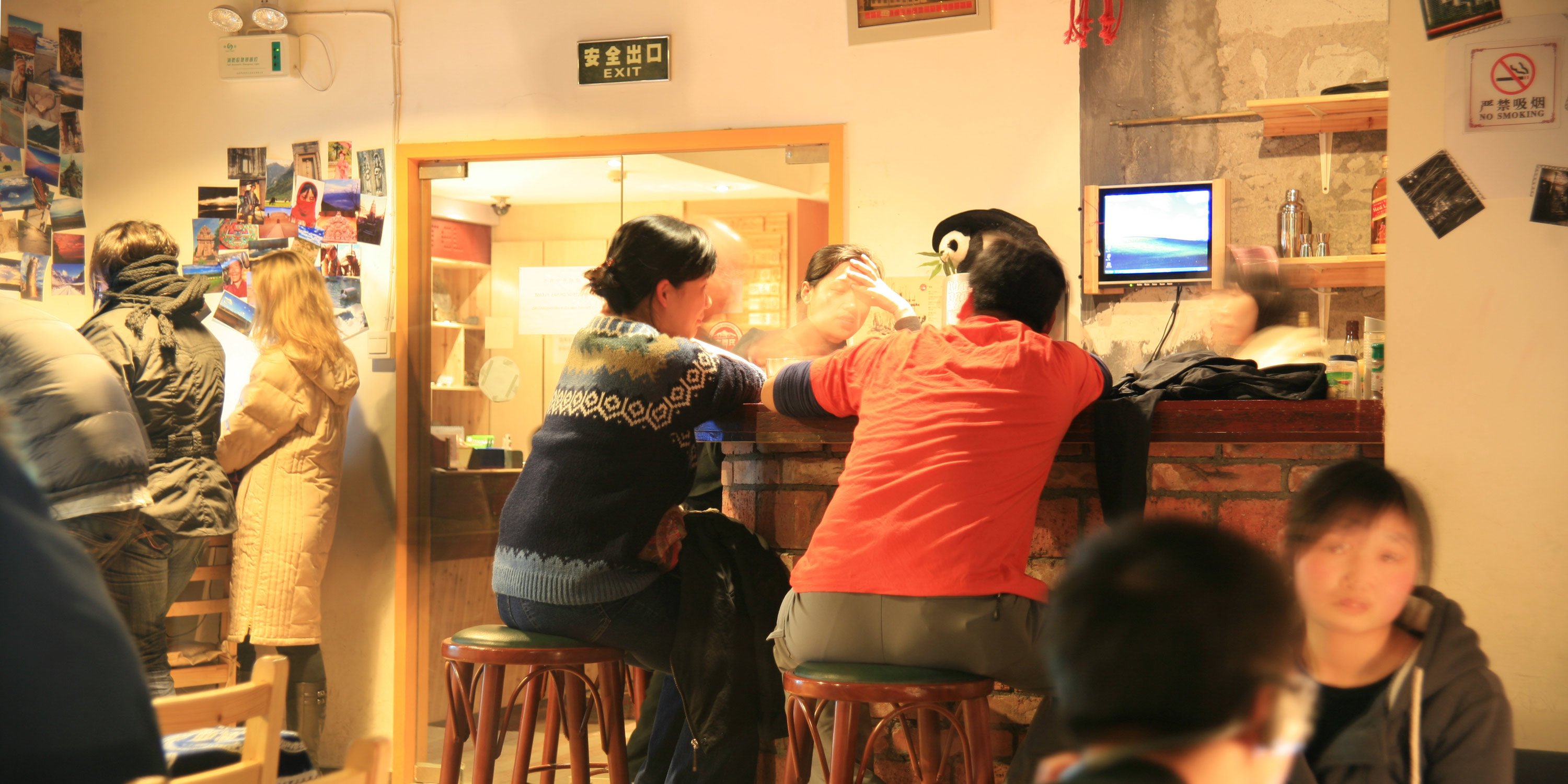
The heart of youth hostels was the common room. It was where people spent their evenings, often sitting shoulder to shoulder at long tables or on worn sofas. Shelves held travel guides — Lonely Planet was almost always there — and walls filled with handwritten notes, postcards, and photos left behind by guests.
In some hostels, guests picked up their own linens at the front desk and made the bed themselves, returning the sheets at checkout, a routine that kept costs down and blurred the line between host and guest.
“The internet wasn’t like it is today,” says Wu. “The most trustworthy source was Lonely Planet — and the other source was every traveler’s mind.” Each day around 8 p.m., travelers gathered in the common room, where a large blackboard served as a public notice board.
People wrote messages looking for travel companions, rides, or help planning the next leg of a trip. Conversations followed. Routes were adjusted. Groups formed and dissolved. “If you were traveling alone,” Wu says, “it was the most fashionable way to socialize back then.”
For Yin, those early years represented a purer form of travel. “It wasn’t about showing how much money you had,” she says. “It was about going further with less.” The simplicity, she adds, created a sense of warmth, a feeling of being at “a home away from home.”
First window
After the 2008 Beijing Olympics and the 2010 Shanghai Expo, youth hostels were among the few places where young Chinese regularly encountered foreign travelers arriving to travel, study, and work across China.
As one of the limited number licensed to host them, Wu Sihong’s Blue Mountain hostel quickly became a hub.
Wu recalls police officers joking during routine meetings at the time that Blue Mountain’s annual number of foreign guests nearly matched that of a nearby Marriott hotel. The Marriott had more than 100 rooms; Blue Mountain had fewer than 30 beds.
Wu deliberately set the hostel up for international travelers. He replaced China’s standard dorm beds — 90 centimeters wide and 190 centimeters long — with larger ones. “A longer, wider bed was a basic form of respect,” he explains.
The hostel also attracted young Chinese staff eager to practice English or prepare for study abroad, creating an environment where interaction came easily. Over time, Wu watched attitudes shift. “At first, staff treated foreigners with a kind of reverence,” he says. “After working here, that turned into something more equal and grounded.”
One night captured the spirit of that period. On Aug. 8, 2008, the opening ceremony of the Beijing Olympics played on a television in the common room. Chinese and foreign guests packed the space together.
When the national anthem began, the Chinese guests stood, and pulled the foreign travelers up with them. “That kind of shared excitement,” Wu says, “can only happen in a youth hostel.”
Over the following years, operating on what Wu described as a “low profit, high volume” model, he expanded Blue Mountain’s youth hostels to four locations across Shanghai, each opening a little closer to the Bund.
To showcase Shanghai culture, he salvaged a retired shikumen — the stone-framed doorways from which the city’s old lane houses get their name — from a demolition site and installed it inside one of the hostels. At its peak, the Jiangyin Road branch counted foreign guests as much as 70% of its stays.
Yet, even as Blue Mountain grew, the way people traveled was beginning to change. “Early on, the eight-bed dorm was the most popular,” Wu says. “Then it shifted to six and four beds. Later, standard rooms were becoming more sought after.” As spending power rose, expectations shifted with it.
At the same time, operating costs climbed. Commercial rents typically increased by 5% to 7% every two years, Wu says, with occasional spikes as high as 70% at renewal. The margins that had once made the hostel model viable narrowed quickly.
One branch closed after the landlord reclaimed the space; another was absorbed into a redevelopment project; a third was taken back by a state-owned administration. The last — on South Shanxi Road — shut in 2022, after the landlord refused to offer rent relief during the pandemic.
“The day that last hostel was shut,” Wu says, “I didn’t dare go back.”
Lights out
As early as 2014, Wu had concluded that the hostel model had reached its ceiling. His team began shifting toward boutique hotels, with higher room rates and greater leverage in negotiations with landlords.
Not everyone pivoted. In Suzhou, Xiaohai left the YHA system in 2022. The decision was practical: annual fees no longer added up and bookings had thinned. “Very few people came through the YHA website,” he says. “With Trip.com and Booking.com, everything was already handled.”
The business itself barely broke even. When Xiaohai opened the hostel nearly two decades ago, dorm beds cost 40 or 50 yuan a night. Today, they rent for around 55. “That’s not sustainable,” he says.
His hostel survives for a simple reason: the building belongs to his family and is protected as a historic structure. “If I wanted to make money, I’d rent it out,” he admits. “But others would change everything.”
Inside, Xiaohai refuses to install bunk curtains, believing they interfere with how backpackers once interacted. Yellowed YHA posters hang on the wooden pillars, collected from gatherings where hostel owners used to travel city to city to meet. “It used to be incredibly lively,” he says.
For YHA CEO Yin Chen, such places now sit at the margins of a system reshaped by the pandemic. “We kept thinking things would improve in a year, then another year,” she says. “But three years wiped out all our savings.”
Many hostels locked into long leases collapsed, and those that survived often did so by abandoning shared space. “Some places have turned hostels into sleeping machines,” she says, packing in beds at the expense of common areas.
And younger travelers, Yin observed, are less interested in moving slowly or meeting strangers along the way. “Train stations used to be full of backpacks,” she says. “Now it’s almost all suitcases.” With rising spending power, travel has shifted from seeing the most places for the least money to checking off landmarks, taking photos, and moving on.
Amid these pressures, YHA has begun edging into new directions. A small number of projects are still joining the system, often backed by institutions rather than individual travelers.
In some cities, state-owned enterprises have built large hostels on their own properties, designed less for backpackers passing through than for organized exchanges, study tours, and group programs.
Yin recently visited another example in Fuping, in northwestern China’s Shaanxi province: a rural youth hostel jointly funded by the China Rural Development Foundation and the Samsung Group. The area has built an entire industry around persimmons — from food processing to eco-friendly dyeing using persimmon peels, in partnership with university design programs and environmental groups.
All of it is a long way from the common rooms Wu remembers.
Before Blue Mountain’s hostels began to close, Wu made one final attempt to revive the old atmosphere.
One evening in 2018, an accidental power outage shut off the lights and the Wi-Fi. Guests began talking again and the common room filled with a low, easy buzz. Encouraged, the hostel tried to recreate the moment with an “artificial blackout.” Once a week, staff cut the electricity for two hours, shutting off both power and internet.
It didn’t last. “We tried it twice,” Wu says. “It made no difference. Everyone has mobile data now. Even without power or Wi-Fi, their phones still work.”
Editor: Apurva.
(Header image: Guests chat with each other at the Blue Mountain hostel, Shanghai, 2008-2009. Courtesy of Wu)