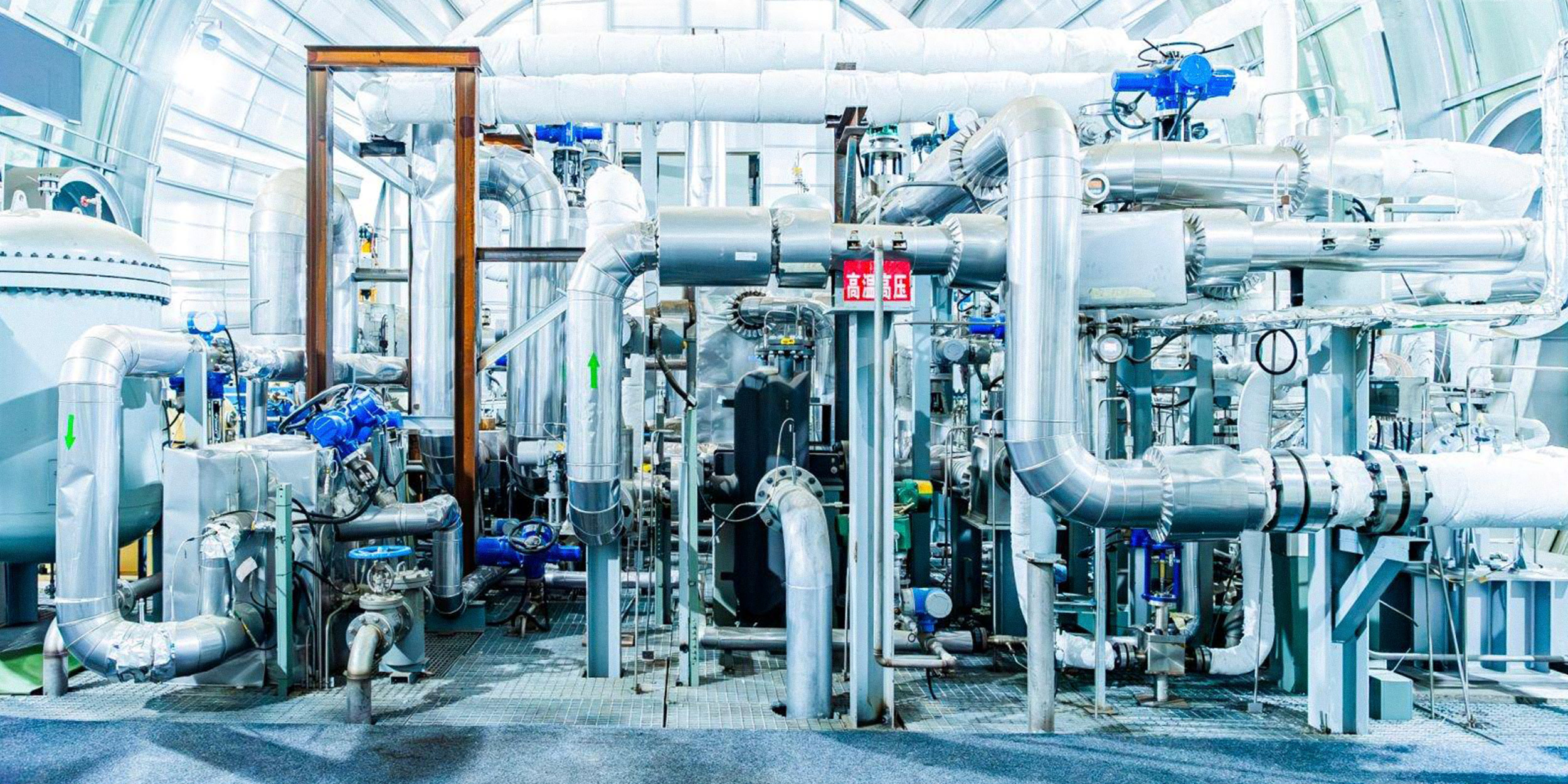
China Puts CO2-Based Power Generation Into Commercial Use
China has begun commercial operation of a power generation system that uses carbon dioxide instead of steam, marking the first real-world deployment of the technology.
On Dec. 20, a supercritical CO2 power unit entered operation at a steel plant in southwest China’s Guizhou province. The system uses CO2 in a state in which it behaves as both a liquid and a gas, allowing it to drive turbines more efficiently than conventional steam systems.
The breakthrough lies in the system’s ability to capture industrial waste heat — energy otherwise discharged into the environment — and convert it into electricity, reducing both fuel consumption and carbon emissions, according to state-owned China National Nuclear Corporation (CNNC), one of the project’s main designers.
Construction of the unit began in 2023. CNNC said the system is more than 85% more efficient at reusing industrial waste heat than conventional steam systems, and can increase net power output by over 50%, generating an additional 70 million kilowatt-hours of electricity each year.
Conventional thermal and nuclear power plants rely on steam turbines, which work best with strong, steady heat. Supercritical CO2 carbon dioxide, by contrast, remains effective under weaker, fluctuating heat sources.
In this state, CO2 is far denser than a gas, allowing it to carry more energy, while being less viscous than a liquid, making it more effective at driving turbines.
A 2021 study found that while the technology’s upfront cost is nearly one-third higher, its average cost per kilowatt-hour over a 30-year plant lifespan is roughly comparable to conventional steam systems.
In 2021, the technology received policy backing in China’s 14th Five-Year energy innovation plan. State broadcaster CCTV reported that the technology could help advance China’s “dual carbon” goals of achieving peak carbon emissions by 2030 and carbon neutrality by 2060.
If deployed across the country’s industrial waste-heat recovery systems, CNNC estimates the technology could save more than 4.8 million tons of coal annually, and cut CO2 emissions by over 12.8 million tons.
In recent years, China has ramped up wind and solar power generation, but growth in actual electricity output has lagged behind the surge in installation capacity.
By the end of 2024, wind and solar accounted for 42% of China’s total installed power capacity, yet produced only 18% of total electricity generation, largely because of changing weather conditions.
To help address the gap, CNNC plans to complete another project by 2028 in northwest China’s Xinjiang Uyghur Autonomous Region that combines supercritical CO2 power generation with molten-salt thermal storage.
CCTV also noted that supercritical carbon dioxide power systems require roughly half the space of conventional steam-based units, making them potentially suitable for space-constrained settings such as offshore energy platforms and large vessels.
Editor: Marianne Gunnarsson.
(Header image: Equipment used for the CO2 power generation tests, Liupanshui, Guizhou province. From CCTV News)