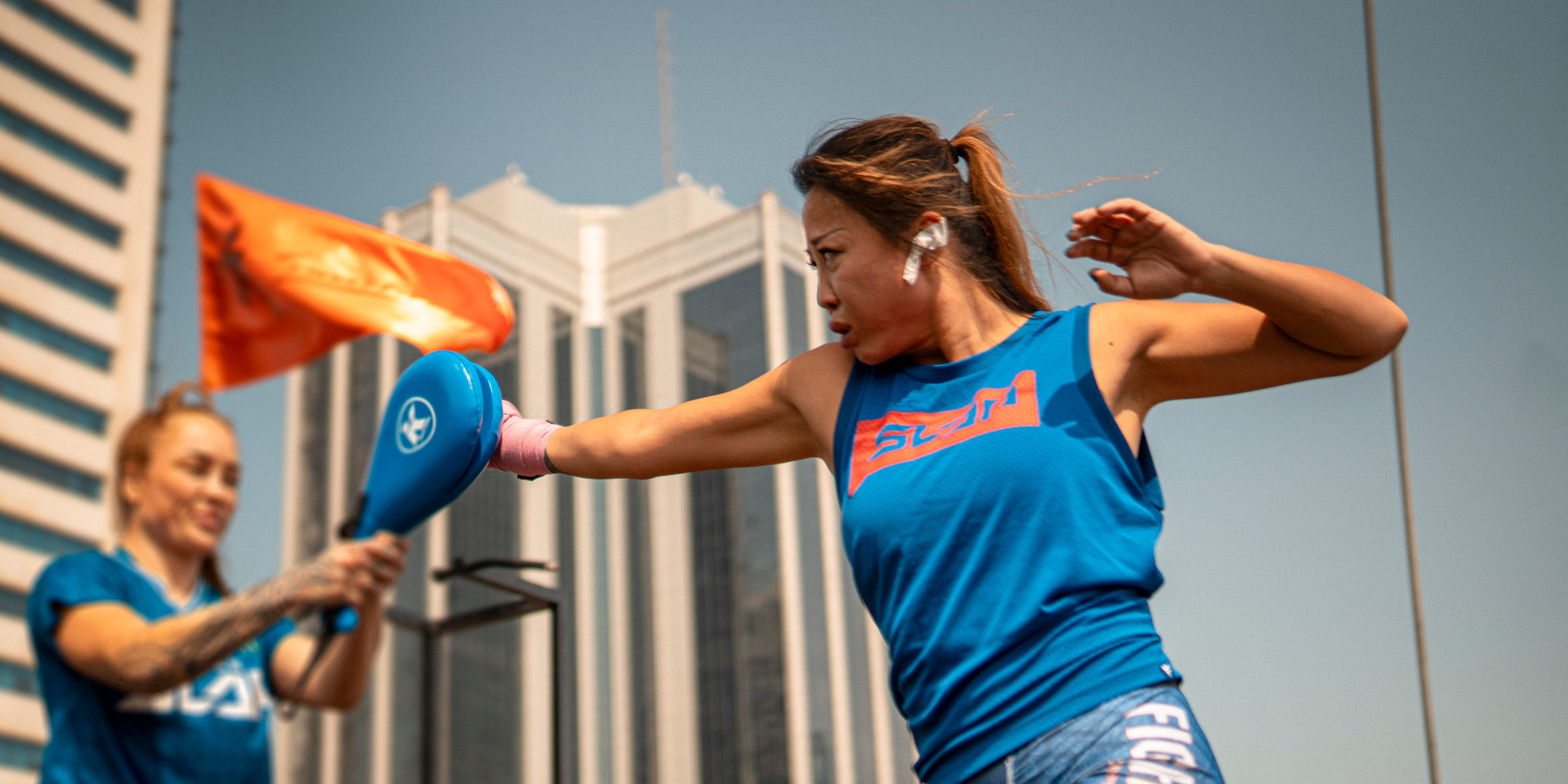
China’s Artist-Turned-MMA Star Tries Her Hand at Slapping
Ding Miao is no stranger to bold life choices. A 33-year-old oil-painting graduate from China’s Central Academy of Fine Arts, she quit the art world nearly a decade ago for a professional career in mixed martial arts (MMA), and this summer became the first Chinese woman to sign with the U.S.-based slap fighting promotion company Power Slap.
Slap fighting is a combat sport that originated in Russia and has been popularized globally in recent years by Dana White, CEO of the MMA promoter Ultimate Fighting Championship (UFC). It involves two competitors taking turns slapping each other in the face, with no dodging or blocking allowed.
Here, Ding tells The Paper what she hopes to achieve and discusses some of the controversies that surround this nascent sport.
The Paper: How did you first learn about slap fighting?
Ding: I heard about the competition in Russia back in 2022, but at that time the women’s division felt more like a commercial showcase — the contestants were all dressed up and looked like they weren’t hitting very hard. I remember thinking, “This looks badass, I want to try it.” But as a professional MMA fighter, I knew I’d hit hard, and I figured they probably wouldn’t want someone like me. Then, in 2023, the UFC launched Power Slap, refining a lot of the earlier “free-for-all” rules and significantly reducing the risk of injury. When I saw three of my former training partners competing, I felt a strong urge to join. I thought, “I can do this too.”
The Paper: What was it like competing for the first time?
Ding: I hadn’t felt that kind of pre-fight excitement in a long time. Since it’s a large-scale event backed by the UFC, the atmosphere in the arena really gets your blood pumping. I’d done plenty of training beforehand, with every session focused on building resistance and desensitizing my stress responses. Naturally, people flinch when a punch or slap comes their way and try to avoid it. But through training I had conditioned myself not to react, so I wasn’t too nervous in the ring. I knew what to expect. I imagined what it would feel like — maybe akin to being hit in the face with a baseball bat. I mentally prepared for the pain, which is why I actually smiled after taking one slap during the match. My opponent was experienced, but the slap she landed wasn’t enough to hurt me, no way as heavy as I’d imagined.
The Paper: How exactly are wins and losses determined in these contests?
Ding: Fighters get three turns to attack in each match. When it’s your turn to attack, you have to declare whether you’re using your left or right hand. A knockout is obvious to everyone. The other way to win is through scoring. Penalties are given for fouls, and there’s no limit to how many fouls you can commit. If neither fighter fouls or gets knocked out, and the match is close, the judges look for the most effective strikes — like who got pushed back more, who looked more dazed after a slap, or whose strikes seemed weaker compared with their opponent’s.
The Paper: According to the rules, which parts of the face are off limits?
Ding: You can strike only the area below the cheekbones. Other parts — like the temples, chin, ears, and throat — are strictly prohibited.
The Paper: As a former MMA fighter, you already have old injuries. Were you worried about the risks of competing in slap fighting?
Ding: I did think about the risks for a while. As an MMA fighter, I’ve had my share of injuries, including fractures to my face and skull. My doctor, who happens to be a fan, gave me the confidence to compete. He told me to go for it and promised to help with any issues I might experience. I’m really grateful to him. That said, I also signed a waiver, which means the promotion company won’t take any additional responsibility for problems that arise from old or pre-existing fractures. I went into this with my eyes wide open.
The Paper: Beyond the health risks, getting a slap in the face has traditionally been seen as a humiliation. What are your thoughts on it now being a spectator sport?
Ding: First, let me ask you — do you enjoy watching it? Honestly, I think most people watch for the spectacle, and they find it entertaining. There’s certainly commercial value to this sport, and it’s designed to grab attention. There’s a saying: “The way to overcome a fear is to face it.” When someone’s hand is firing toward your face, you have to stay calm and look them in the eye. This competition forces me to confront fear head-on, and allows me to showcase my personal strength and charisma in the ring. When we first started watching soccer or basketball, didn’t we also tune in because it was exciting to watch? Not everyone understands the technical aspects of every sport, but we can all appreciate the drama of victory and defeat, as well as the individual performances.
The Paper: What do you say to those who argue that slap fighting results in less physical damage than from a traditional combat sport?
Ding: The force behind an average person’s punch and slap might be similar, but a professional athlete’s punch is easily two to three times more powerful than their slap. Some MMA fighters and bare-knuckle boxers refer to this sport as “easy money,” thinking it’s a breeze. But I don’t think it’s easy for everyone — it’s just over quickly. This sport still requires extensive training, with its own system for building power and technique. It’s not as simple as just stepping up and slapping someone three times.
The Paper: And what about those who question the meaning or purpose of slap fighting?
Ding: I think most people find it thrilling to watch — simple, direct, and powerful. On a deeper level, as I mentioned, it helps me face my fear and exert my strength in the ring. At the end of the day, it’s a competitive sport that offers entertainment value. For me, I’m not too focused on chasing online clout. I have a day job (Editor’s note: Ding also works as a bodyguard) and don’t have much time to manage social media. But I also don’t want to compete without anyone knowing — I want people to recognize me as the first Chinese woman to participate in this sport. If a fighter wants to make a living in combat sports, they need to generate some commercial value. But I believe the most important thing is to train hard, compete well, and deliver results.
The Paper: What do your family and friends think about you competing?
Ding: Well, my parents are resigned to it. They think I’m a bit foolish for doing this. They worry about me, of course, but they also want me to be happy doing what I love. They’ve grown accustomed to my life changes, from art director to MMA fighter. Once, after I was injured and went home to recover, my mom cried because she was so heartbroken. Now, if I get hurt after a match, I don’t go home. Before I chose this path, I had a friend who died taking part in combat sports, so I knew what I was getting myself into. I believe life is about doing what you want within your capabilities. The only time I considered quitting fighting was after the pandemic. I was in debt after a failed business venture, my immune system was weak, and I was constantly sick. So, I stepped away. But a year later, I met my current sponsor — who’s also my boss — and he supported me in chasing my dream again.
The Paper: Every professional athlete has an ultimate goal. What’s yours?
Ding: I’m not out to achieve anything specific in Power Slap. After competing in the six matches I’ve agreed to, I plan to return to my MMA career. And when I retire, I want to observe the special tradition for MMA fighters — after finishing your final fight, you take off your gloves and leave them in the center of the cage. That symbolizes the end. To me, that ritual is sacred.
Reported by He Kai and Liu Jingwen.
A version of this article originally appeared in The Paper. It has been translated and edited for brevity and clarity, and is republished here with permission.
Translator: Kiong Xin Xi; editors: Wang Juyi and Hao Qibao.
(Header image: Ding Miao during a training session, October 2025. Photo taken by Nour Landolsi, courtesy of Ding)