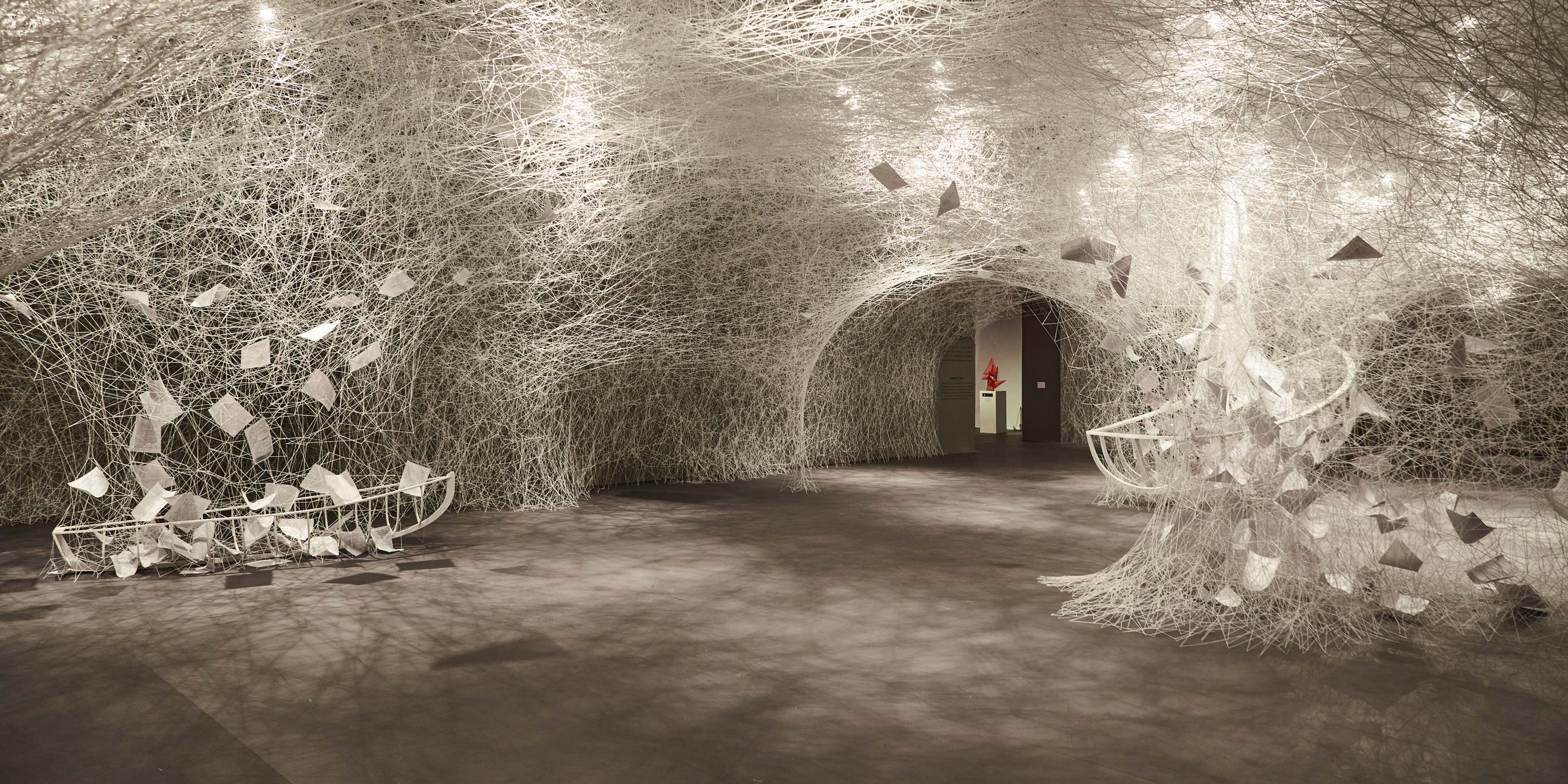
Work of Art: The Cost of Keeping a Private Museum Open in China
Inside a gallery on Shenzhen’s eastern edge, a wall covered with clear resin disks, each trapping a patch of mold, suspends organic life between growth and decay.
Created by Zhou Zhiyuan, a local ICU doctor, the piece is titled “Quiet Night Thoughts,” after a classical Chinese poem about stillness and reflection. It appears in “0755 Locality,” an exhibition named for the southern megacity’s area code at the Jupiter Museum of Art featuring work by 20 local contributors from a range of professions.
Six months earlier, the privately owned Jupiter Museum had closed its doors after years of financial strain and shrinking sponsorship. But with support from local authorities and art foundations, Jupiter has now relocated to a cultural park on the city’s outskirts.
That support came with new terms. Jupiter’s operations are now tied to a public cultural program intended to anchor the surrounding district, a markedly different arrangement from the privately funded model it once relied on.
“As long as the museum can continue, that’s what matters,” founder Lü Hongrong told Sixth Tone. “For me, the most important thing is that the brand survives — like knowing your child is being taken care of.”
Jupiter’s return is the exception. Across China, private art museums that once rode the real estate boom are now closing or suspending operations as private funding dries up and operating costs rise. In the first half of 2025 alone, at least five — some internationally visible — shut their doors or halted programming.
Most never reopen. Built largely on developer money and rising property values, private museums have long lacked stable funding models. Ticket sales and memberships rarely cover costs; corporate sponsorship has grown harder to secure; and long-term endowments remain rare. When investors pull out, founders are often left to absorb the losses themselves.
And with funding channels narrowing, founders and artists are now being forced to improvise new ways to keep independent art spaces operating.
Borrowed time
The money had begun to run out as early as 2021.
Founded in 2019, the Jupiter Museum opened during a period when contemporary art spaces were rapidly expanding across China. At its peak, the museum occupied an 11,000-square-meter venue. By the time it closed in June, that footprint had shrunk to just 3,000 square meters.
In its closure announcement, the museum pointed to familiar pressures: post-pandemic economic strain, dwindling audiences, and mounting operational costs. “The glow of ideals requires the fuel of reality,” the statement read. “The words ‘hold onto our ideals’ feel unbearably heavy against the cold backdrop of reality.”
Lü said private investors stopped injecting capital that same year. “Their own businesses struggled to survive,” she told Sixth Tone. “How could they keep funding a museum?”
Over the next four years, Lü kept Jupiter operating by selling parts of her personal art collection and property, absorbing nearly 40 million yuan ($5.7 million) in losses. The money went toward staff salaries, exhibition fees, insurance, transportation, and production costs.
The first two years were the hardest. “With money, you can outsource many tasks. Now we have to do everything ourselves — from building walls to designing interiors. Even our front-desk staff learned how to paint walls,” she said.
Staff numbers fell from more than 40 to just 13. Exhibition space shrank accordingly.
Like many private museums in China, Jupiter relied primarily on ticket sales and memberships. Corporate sponsorships provided additional income, while the museum also qualified for limited government subsidies.
As Jupiter’s profile grew, staff took on consulting roles in urban planning projects, earning service fees from advising local governments on public cultural spaces. Some curated exhibitions toured other cities, generating modest income and attracting more artists willing to collaborate.
“It finally started becoming a healthy cycle,” Lü said, adding that the gallery might have even broken even this year had they not been forced to close.
The final blow came from rent. Jupiter’s landlord had initially waived rent to boost the area’s cultural value. This year, that policy ended abruptly. “(The museum) can’t survive if every project has to come out of my own pocket,” Lü said.
Private museums have long served as incubators for emerging artists, and Jupiter was no exception. The museum became known for supporting large-scale installations and sculptures that required space and technical backing.
Installation artist Huang Siqi, who has worked in the field for more than a decade, now collaborates with 25-year-old newcomer Wang Aiju as the art duo “Size.”
She underscored that funding for installation projects has contracted sharply. “For the same work, our budget dropped from half of its original level last year to one-third this year,” she said.
To stay afloat, the pair took on freelance design, illustration, and commercial exhibition work, while running their own social media channels.
“Jupiter was different from traditional museums. They were willing to work with visually bold young artists,” Huang said. “Some museums still dare to take risks, giving space to emerging artists instead of always chasing traffic or collectors.”
Shrinking spaces
Most of China’s private art museums emerged after 2011, when the real estate boom created both the capital and the physical space to support them.
Gao Peng, former director of Beijing’s Today Art Museum — one of China’s leading private nonprofit contemporary art institutions — told domestic media that real estate developers were once ideal investors: they had capital, they owned large spaces, and building museums boosted their brand value.
Cultural venues often accompanied luxury real estate projects, raising property prices and signaling corporate taste. And local governments favored museums as anchors for new districts, viewing them as magnets for investment, talent, and tourists.
That model, however, was never designed to sustain itself.
“Less than 10% of museums make money,” said Li Lindong, a curator and space designer. “About half operate at a loss.”
Li founded Ye Museum in Dongguan, southern Guangdong province, in 2022. The name — meaning “wild” — reflected his belief that art should grow freely, outside rigid institutional frameworks. He renovated exhibition spaces himself and kept operations lean, but financial pressure mounted quickly. Last year, the museum closed.
Li’s experience is increasingly common. Private art institutions across the country have struggled to establish long-term funding models beyond their original backers. Ticket sales and memberships rarely cover costs, while corporate sponsorship has become harder to secure.
According to Gao, the problem runs deeper than any single downturn. Most private museums, he said, rely heavily on individuals or enterprises, without a mature ecosystem of foundations, patrons, or transparent donation systems to pool public support.
“In China, there are few neutral third parties to supervise and manage museum donations, and tax incentives for private museums are limited,” Gao said. “Donors receive little tangible return, which naturally weakens enthusiasm for public giving. With such a narrow funding pipeline, uncertainty becomes inevitable.”
Gao said museum operations are inherently lengthy undertakings and advised new institutions to establish endowment funds from the outset. Ideally, half of all initial funds should go toward construction, while the other half should be reserved for investment into long-term operations, he added.
For Li, closure has not meant retreat. “Art spaces are shrinking like a compressed spring,” he said. “Physically smaller, but gathering energy for the next moment.” He now works through temporary venues, collaborations, and exhibition design projects, allowing his museum to surface in different forms and locations.
That logic is increasingly familiar to artists as well. Months earlier, as Jupiter Museum’s future hung in the balance, installation artist Huang Siqi wrote on social media: “Perhaps the meaning of art was never about finding certainty within a system, but about continuing to shine amid uncertainty.”
Editors: Marianne Gunnarsson and Apurva.
(Header image: A view of the exhibition “At the Edge of Fate” in Shenzhen, Guangdong province, 2025. Courtesy of the Jupiter Museum of Art)