How a Bullied Teenager Built China’s Unlikeliest Music Festival
BEIJING — The building where Beijing’s most unlikely music festival was born no longer exists. The dilapidated table tennis club in the capital’s northeastern suburbs was demolished early this fall, another casualty of urban “beautification and renewal.”
For three summers before that, its worn courts hosted a festival with no tickets, few rules, and little interest in behaving like one. And it was built almost entirely by a teenager who had dropped out of high school the year before after years of bullying and self-harm.
Zhao Ziyi, 18, launched “You and Me” in 2023 after finding refuge in the chaos of experimental music and deciding to build a place where musicians and misfits could exist without explanation.
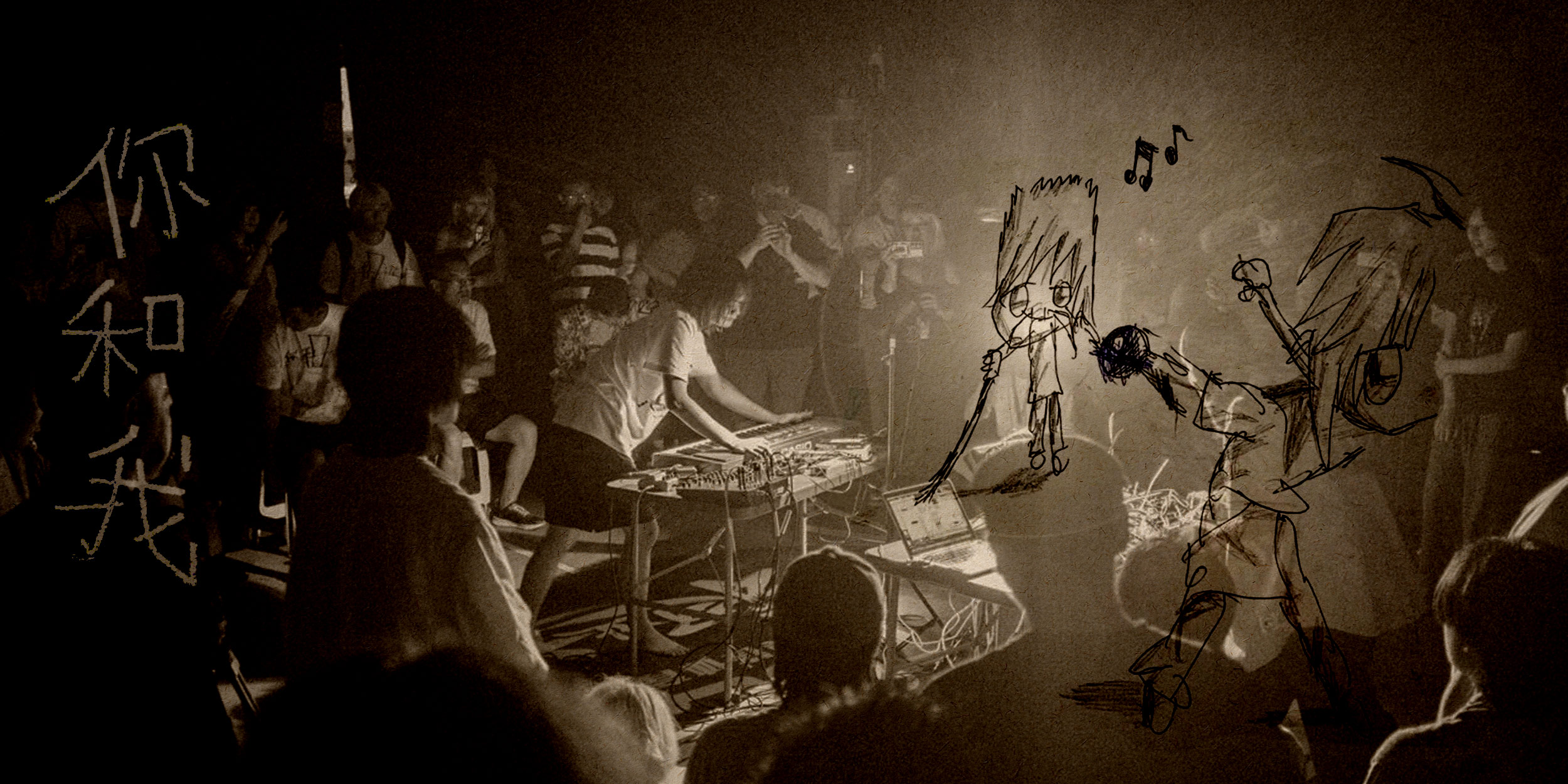
On most nights, the space filled with improvised, experimental music. Guitars were driven into feedback. Voices slipped from melody into breath, shouts, or silence. Sets swelled into noise, then collapsed back into clicks, drones, or nothing at all. People came and went freely. Some stayed for hours. Some lay on the floor.
What started as a loose plan for an improv duo quickly outgrew itself. This year, “You and Me” ran for nine days and featured more than 50 performers from China and abroad.
Now, with the venue gone and the festival running at a steep loss, Zhao and a handful of friends are scrambling to keep it alive, hoping to hold on to those few summer nights each year when the world briefly feels like it belongs to them.
Free for all
Those nights began in the summer of 2023 at Rongyao Dongfang — or “glorious orient” — a table tennis club in Beijing’s northeastern suburbs. Zhao’s parents were regulars there, so when he decided to hold a music festival in the space, his father helped coordinate with the club’s organizer, and friends helped set up a sound system.
Over three sweltering summer nights, 32 sets of performers took the stage. Most were based in Beijing. Some were Zhao’s musician friends. Others only knew him because of the event. Audiences could freely come and go. Payment was optional.
“I see this as a festival for friends’ gathering,” Zhao says. “People come and get what they want, and so do I.”
The music was experimental — a genre that has long occupied a small but persistent corner of China’s music landscape. Since the early 2000s, events such as Sounding Beijing have helped cultivate a modest following for free improvisation, electronic sound, and hybrid forms incorporating traditional instruments. Festivals including A Bunch of Noise in Shanghai and Over Trip in Wuhan, along with venues such as Dada in Beijing and Trigger in Shanghai, have sustained the scene.
Yet when Zhao first invited musicians to play at “You and Me” in 2023, many declined.
“Both the venue and I were so strange to them: an unknown place and an unknown person,” Zhao tells Sixth Tone. Even those who agreed often arrived skeptical. He also booked performers he liked, gravitating toward musicians he described as soft, tender, and passionate, and avoiding those with large egos.
“For many of the musicians at ‘You and Me,’ you would normally have to pay high fees to see them play individually,” says Lekasky, a 21-year-old college student and amateur experimental musician, and one of the festival’s earliest fans. “Here, you can watch all of them at no cost.”
The space mattered as much as the music. The now-demolished table tennis club also hosted basketball, archery, and martial arts. Located in Xiaodiancun, an urban village in Beijing’s Chaoyang District, it was modest and rough, with little separation between rooms or uses.
“Everything felt simultaneously local and enchanting,” says Lekasky. Just a 15-minute drive away is Picun, which was once home to a vibrant literary community for migrant workers.
Though the table tennis club was the only viable option for Zhao and his team because of budget and procedural constraints, the space aligned with the festival’s ethos.
Na Rongkun, an assistant curator at Beijing’s Inside-Out Art Museum who attended “You and Me,” says the venue’s rawness matched the event itself. “I could watch the performance in the room, chat with other people in the corridor, and even play table tennis,” she recalls. “When I watched the show, I could stand, sit, or lie down. There were no rules.”
“You and Me” is one of the reasons she decided to stay in Beijing. It gave her a sense of the city’s spiritual identity, she says — a place where cultures can still take root. “People can hardly find any event like this elsewhere in China that requires nothing from you, no restrictions or boundaries.”
Over time, a community formed, and the festival expanded with it. In 2024, an eight-day second edition featured around 60 groups of performers. And what began with indie music fans widened to include people with no particular attachment to experimental music, even neighbors who wandered in to see what was happening inside the sports club.
“I rarely thought about who would come to watch the show when I first launched and organized it,” Zhao says, as he believes people come seeking something of their own, something rooted in their own experience and far beyond his control. “As long as the audience stays quiet during the performance and doesn’t disturb others, that’s enough for me.”
And this year, “You and Me” stretched to nine consecutive nights beginning Aug. 1. Musicians from China and abroad crowded into a small basketball court inside the sports club. Some visitors had nowhere to stay overnight. One evening, the festival’s sound engineer offered to take dozens of audience members back to his studio, about 30 minutes away by car.
Lekasky even moved from the audience to the stage. Australian experimental musician John Wilton called for volunteers to participate in a performance of “The Great Learning,” a work by Cornelius Cardew, inspired by the Confucian classic of the same name and written for large numbers of voices. About 20 people signed up. Lekasky was one of them.
Participants were given a score and a simple set of instructions. Each singer chose an initial pitch, while the lyrics and length of each line were fixed. As they sang, they listened closely to the sound around them, shifting pitch when someone else introduced a new one. The piece unfolded as a continuously evolving loop, with each voice shaping the others while being shaped in return.
“We kept interfering with each other, sensing each other, and responding to each other,” Lekasky recalls. But the night did not end there.
“We grabbed some food nearby after the show, chatted, and went to the studio together,” he says. “It was like a utopia.”
Finding noise
In November, Beijing remains warm and mild. Yet when Zhao arrives at a small restaurant on Dongsi North Street in the city’s center, he’s bundled in a long down coat, fur-lined shoes, and a beanie with tassels. “I don’t like the cold,” he says. “I prefer warm weather.”
It’s why he schedules “You and Me” every August. And outside those weeks, he spends most of his time alone.
That isolation goes back to kindergarten, when the bullying began. “I can’t really think why it began,” he says. “I just stayed on my own in school.”
It lasted until the pandemic disrupted school in 2020. When classes moved online, Zhao stayed home, spending most of his time on the internet. “I didn’t have friends to talk to at school after all,” he says. At home, the environment felt safer and quieter.
That’s when he encountered experimental music, first through video clips of performances online. “The music felt uncontrollable, extreme, and complete to me,” Zhao recalls. “And I liked it.”
Not long after, he attended a live performance by Li Jianhong, a popular improvisational musician in China. The experience stayed with him. Only when the show ended did Zhao realize he had not been thinking about anything at all. The absence of thought, he says, felt beautiful.
Two years on, Zhao was performing experimental music himself. He improvised with whatever was available: a bass, a synthesizer, even a cardboard box or a roll of tape. In 2023, he launched “You and Me” as a small duo project with a musician friend. He never thought it would grow.
“The fluctuations of my life caused the project to become limitless and crazier. I think my emotions and experiences all blended into it.” During that period, he says, he began to resist the harassment he had experienced at school and finally fought back.
Zhao never sought counseling. Opening up to someone who charges for the conversation, he says, feels unfair — an exchange he worries might be treated as business rather than understanding.
Months after the first edition of “You and Me” in 2023, a teacher discovered Zhao self-harming during a midterm exam and suggested he take a break from school. He dropped out instead, and never returned.
Asked whether the community that formed around the festival has healed him, Zhao pauses. He says he feels better. “But the effects of bullying do not disappear,” he says. “They settle into a person’s character, shaping who they become.”
Under pressure
But holding onto “You and Me” has required more than emotional resolve.
The most recent edition was organized by a team of about ten people. Planning performances over multiple nights, they say, strains their capacity. “With such a small team, if we want things to become more professional, we might need to cut down on days and the number of performers,” says a member of the organizing team who goes by the nickname Ah Ling.
“For instance, on the day Otomo Yoshihide (a popular Japanese composer and musician) played, lots of people came. The large audience made it hard for us to keep things under control,” the 26-year-old says.
Pressure intensified in September, when the venue itself disappeared.
The table tennis club was demolished to “improve the city’s image and spirit,” according to official notices tied to a 2035 urban industrial development plan. In its place, commercial and landscaped residential complexes are slated to be built.
More difficult still has been the cost. The project has run at a cumulative loss of around 1 million yuan (about $141,000), according to domestic media reports. Zhao’s parents have supported his decisions and helped finance the festival, but the burden has been heavy, particularly for musicians’ travel and performance fees.
According to Ah Ling, income comes primarily from merchandise sales, drinks sold on site, and audience donations. It falls far short of expenses.
The festival remains ticket-free for two reasons. Zhao wants to keep it simple, and charging admission would require approval from the local tourism and culture bureau, a process the team is not yet equipped to navigate.
Ah Ling has explored support from foundations, but few in China are willing to back an independent music project. Funding tends to favor fine arts initiatives tied to established academic or institutional networks.
Commercial sponsorship has proven equally elusive. “If a company provides us money or instruments, it has to bring them some benefit,” Ah Ling says. “But we aren’t profitable, so they can’t monetize things here. And because we’re not recognized as an official event, it can also be risky for them to sponsor us.”
For now, the future remains uncertain. Zhao has no confirmed venue for the next edition. Ah Ling has floated the idea of using a primary school auditorium or music classrooms, though nothing has been finalized. The team continues to look for ways to ease financial pressure and improve organization.
Still, they are certain that “You and Me” will continue. It will be held in summer. It will be in Beijing. And the noise will go on.
Editor: Marianne Gunnarsson.
(Header image: A mixed-media portrayal of the second “You and Me” festival in Beijing, 2024. Visuals from Zhao Ziyi, reedited by Sixth Tone)