Act Your Age? Chinese Dramas Thrust Preschoolers Into Adult Roles
It’s 10 a.m. in mid-October, and child actor Yueyue is on set waiting for the director to call “action.” Dressed in sparkling blue, with white shoes and curly pigtails, the 4-year-old is playing an “elderly aunt with supernatural powers” in an ultrashort drama.
For the upcoming scene, Yueyue needs to tell the other characters that the villain is “draining the blood of corpses” and trying to summon evil spirits. She has no idea what these lines mean.
As ultrashort dramas boom in popularity in China, writers are increasingly reliant on storylines that require the use of preschool performers, often to portray mature characters such as powerful matriarchal figures or tyrannical bosses. The work is fast-paced, with children sometimes having to endure long days of filming and handle scripts that involve adult themes far beyond their comprehension.
For showbiz parents, the experience is worth the disruption to their child’s education. Not only can it bring financial rewards, but many feel that acting roles are helping their children gain confidence and enhance their social skills.
However, experts warn that families could be introducing their preschool children to the entertainment industry without fully knowing the risks to their psychological development.
Small screen
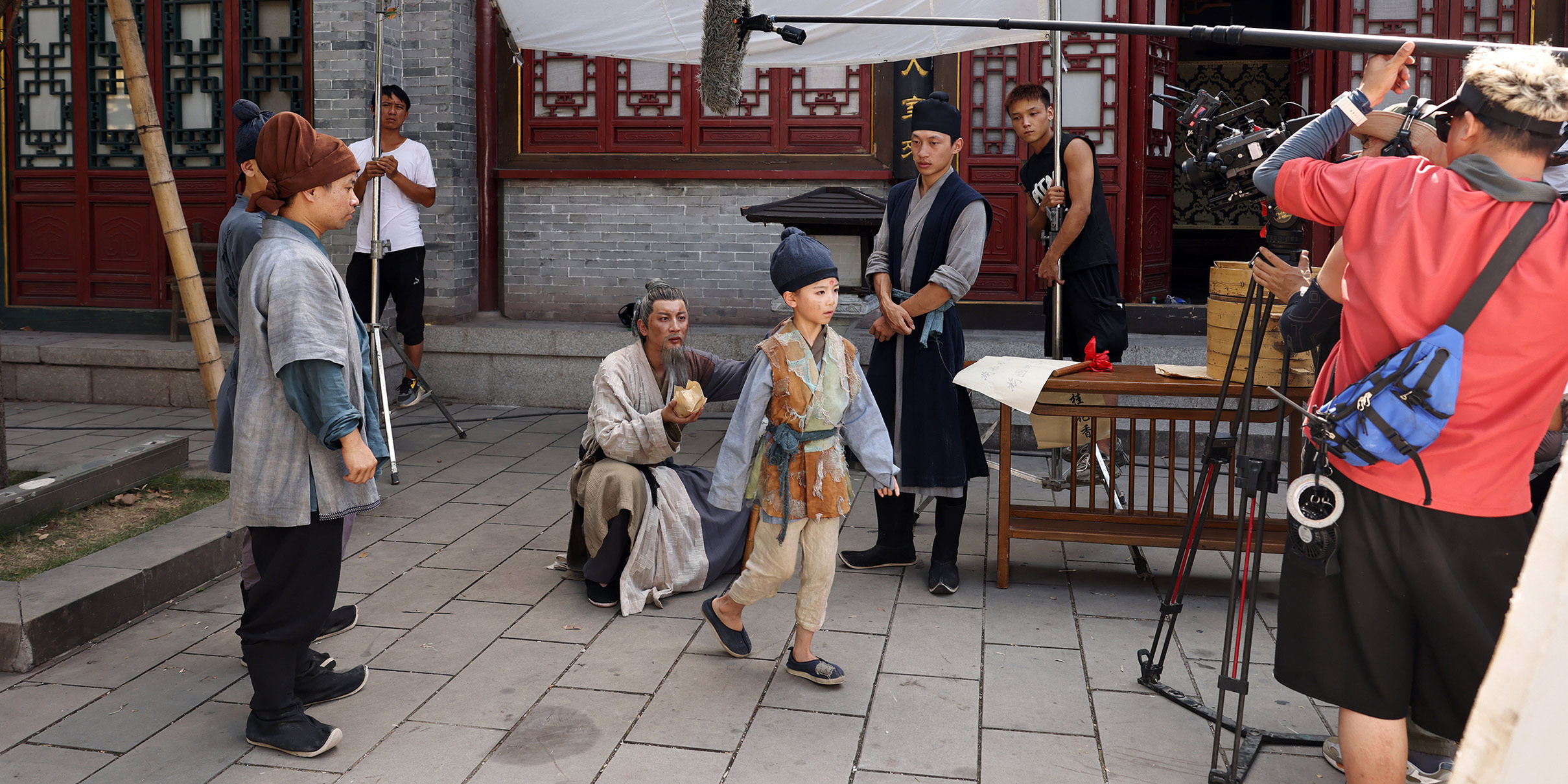
Yueyue’s ultrashort drama is just one of many in production at the Hengdian Huaxia Culture Park, part of China’s largest film and TV studios, in the eastern Zhejiang province.
Her character has the mind of an elderly person, the body of a child, and an arsenal of superpowers. Alongside her are two male co-stars: one is 13 years old; the other is in his 30s. Yueyue doesn’t really understand the plot, she only knows she “has magic.”
The scene requires shooting each character from various angles — wide, medium, close-up. As she waits between takes, Yueyue is flanked by two makeup artists, who adjust her hair and costume. Just off set, her mother stands holding a live jellyfish in a bag, a small reward for when shooting wraps for the day.
More than 5% of the ultrashort dramas saved across various platforms in 2025 featured children in central roles, according to Datawin, a Chongqing-based digital research company that tracks Chinese shows. Its data identifies three hit formulas for these dramas: “golden finger,” in which a child has supernatural abilities such as foresight or healing; “bloodline awakening,” centering on some hidden heritage or inherent power; and “catalyst,” where they play a key role in a romantic pairing.
Fangfang, age 5, has had roles in productions covering all three formulas. In one drama themed on reincarnation, she played a child who could predict the future and helped her single mother land a wealthy husband.
“Hengdian is booming in the winter and summer holidays, as many parents bring their children here looking for acting jobs,” says Li Wen, Fangfang’s mother. “If there’s work, they film. If not, they take their kids to the amusement park here instead.”
Fangfang, who lives in Beijing, began acting in commercials at age 3 and moved into ultrashort dramas this year. A typical filming schedule for her lasts five to eight days. Her mother says a minor part can require as little as four hours of filming, but for a lead role, Fangfang can be on set for much longer. She recalls that her daughter once shot 20 scenes in a day, spending more than 10 hours on standby.
Although China’s Labor Law prohibits employers from recruiting minors under 16, exemptions are made for those in certain industries, such as the arts or sports. However, provisions set out by the National Radio and Television Administration relating to child actors do not set any limit on how long they can work, stating only that their clothing and performances should be “age appropriate,” while they must not be induced to discuss topics such as fame, profit, and romantic relationships on camera.
With no official guidelines to follow, it’s up to parents to negotiate overtime terms and compensation with the production crew upfront. Yueyue’s mother says midnight is her absolute cutoff for filming.
Other parents are apparently not so strict. Xixi, a 6-year-old actor from Baoji, in the northwestern Shaanxi province, once arrived to start hair and makeup at lunchtime and was still acting on set the following morning. “Shooting sometimes starts at 4 or 5 a.m.,” he says.
In return for meeting grueling schedules, families can make decent money, although most see it as an investment in their child’s future career. Li says that the daily rate for shooting a commercial is usually 200 to 1,500 yuan ($28 to $213), “rising to between 3,000 and 5,000 yuan for more established child actors.” Newcomers on ultrashort dramas stand to earn 100 or 200 yuan a day, while those who have already appeared in popular shows can demand up to 5,000 yuan.
Quiet on set
While some of these preschool child actors are signed to talent agencies, most are managed by their parents, who seek out casting calls online, arrange auditions, handle transportation and logistics, and accompany them on set.
During filming, Li feeds her daughter lines while taking photos and videos to share on social media and build her public profile.
For one role, Fangfang’s character had claustrophobia and had to foam at the mouth. The crew provided an effervescent prop to create the effect, which Li tested first before showing Fangfang how to generate the foam.
Another time, when Fangfang was struggling to cry on cue, Li told her that if she didn’t perform well, her grandparents — who were visiting the set that day — might have to be sent home. Her daughter immediately burst into tears.
Li also recalls that Fangfang wept constantly after one scene in which her character received heavy criticism, feeling she’d been wrongly accused. “The character is not you,” Li told her daughter. “They weren’t bullying you but the character. And later the father got revenge on the bullies and even hit them.” She says this made the girl smile again.
Yueyue’s mother provides similar support. She always finds a spot on set with a clear view of the action, phone in hand. She has shared more than 300 videos of her daughter online, mostly behind-the-scenes snapshots taken while filming ultrashort dramas. Her channel on Douyin, the Chinese version of TikTok, now has over 30,000 subscribers.
During a set change, mother and daughter nap on a foldable deckchair. Inside the stuffy studio, Yueyue complains about the heat, but quickly adds, “It’s OK, Mommy, I’ll be strong.” Her mother also brings picture books and toys for when Yueyue inevitably gets bored with waiting.
Several parents at the Hengdian studio insisted that they are selective about the scripts they choose for their children, usually preferring positive roles.
However, Li admits that she unwittingly once agreed to a project with a romantic storyline that involved Fangfang kissing a boy. Before shooting, she asked the director if the scene could be dropped, but they felt it was a selling point and denied the request. She now turns down similar scripts.
Yueyue appeared in her first advertisement at 7 months old. Her mother says they have been trying to land her more ultrashort dramas to help her gain experience and increase her exposure.
“We thought they would be too demanding at first, but after trying it, we found it wasn’t so bad. Many producers were asking for us, so we kept accepting roles,” she says. “Last year, we filmed four projects. This year, in just a few months, we’ve done six or seven.”
Li adds, “So many kids are competing intensely in academics and other fields. For some parents, cultivating their child’s acting ability is another avenue.” She mentions meeting a 4-year-old girl at one audition who only interacted with her parents and cried when approached by anyone she didn’t know. Later, the parents got the girl acting work in dramas, and she can now talk more easily with strangers.
Now a full-time mother of two, Li used to work in public relations for an auto company. She believes that through filming dramas, her daughter has learned to focus and cooperate with others to complete tasks, an ability she considers crucial for a child.
Blurred lines
Despite the potential upsides, parents and experts say life in the entertainment industry can also disrupt a child actor’s early years development, putting a strain on their education and psychological well-being.
For youngsters at the Hengdian studios, life is a constant balancing act between “self” and their on-screen identities. Yueyue appears to have found a way to compartmentalize, according to her mother. “I feel like she understands she has two roles. When she’s shooting, she’s working; when she’s home, she’s just a kid,” she says.
During set changes, the 4-year-old often retreats to the side with her tablet PC, fully engrossed in cartoons. As soon as she’s called, she springs to life and is led by her grandfather to discuss her scene with the first assistant director.
For others, the lines are more blurred.
Xixi says he prefers life on set than at kindergarten. “You go to so many cool places: there are slides, forests, and it even snows,” he explains, adding that he never looks forward to returning to Baoji after filming elsewhere. “The outside world is better. I’m curious about everything and don’t want to go back.”
Li sees her daughter’s time on set as a valuable learning opportunity, but she also highlights the deeply unstable nature of the work. Children drift from “one crew today, another tomorrow,” leading to a transient existence in which relationships are inevitably cut short. “Just when you’ve built rapport with a few kids, it’s time to wrap and leave,” she says. “It’s like everywhere is your home, and yet nowhere is.”
The adult-oriented roles filled by child actors in some ultrashort dramas has also sparked considerable debate.
Zhang Jing, a professor in the School of Drama, Film, and Television at the Communication University of China, warns that, as most children under 6 have yet to fully develop the ability to distinguish between imagination and reality, immersing them in adult roles could lead to cognitive confusion and hinder their psychological development.
“Respecting the interests of children and adhering to the principles of child development is a societal responsibility, not solely a parental one,” Zhang says.
China’s Law on the Protection of Minors states that no organization or individual can encourage minors to participate in performances or other activities that endanger their physical and mental health, and that they must protect the rights and interests of child performers at all times.
Off set, Zhang also believes that comments on social media and ultrashort drama platforms could have a negative impact on pre-adolescent child actors, increasing the risk of cyberbullying.
During a break on the last day of shooting, Yueyue visits a nearby stretch of farmland with her grandfather to enjoy the sunshine. Asked about her happiest moment in Hengdian, she says it was when she went to the beach with her family. She’s excited about returning to kindergarten, “because there are always lots of kids.”
“We’re going with the flow for now,” says Yueyue’s mother. “She doesn’t really understand this business, so we let her participate. Later, when she has her own thoughts, we’ll definitely ask her opinion. As she grows up, education will take priority, and she might only film during the winter and summer breaks.”
In a different part of the Hengdian studios, Xixi talks about spotting various big-name actors arriving in their trailers with dedicated makeup artists and wardrobe stylists. He wants to be a star when he grows up, “so I can save money and buy a trailer,” he says. “And then I want to be an astronaut and go to Mars.”
(Due to privacy concerns, all names except Zhang Jing are pseudonyms.)
Reported by Chen Lei, Zhao Qiuyi, and He Junyi.
A version of this article originally appeared in The Paper. It has been translated and edited for brevity and clarity, and is republished here with permission.
Translator: Chen Yue; editors: Wang Juyi and Hao Qibao.
(Header image: A child actor at work in Hengdian Huaxia Culture Park, Jinhua, Zhejiang province, 2024. VCG)