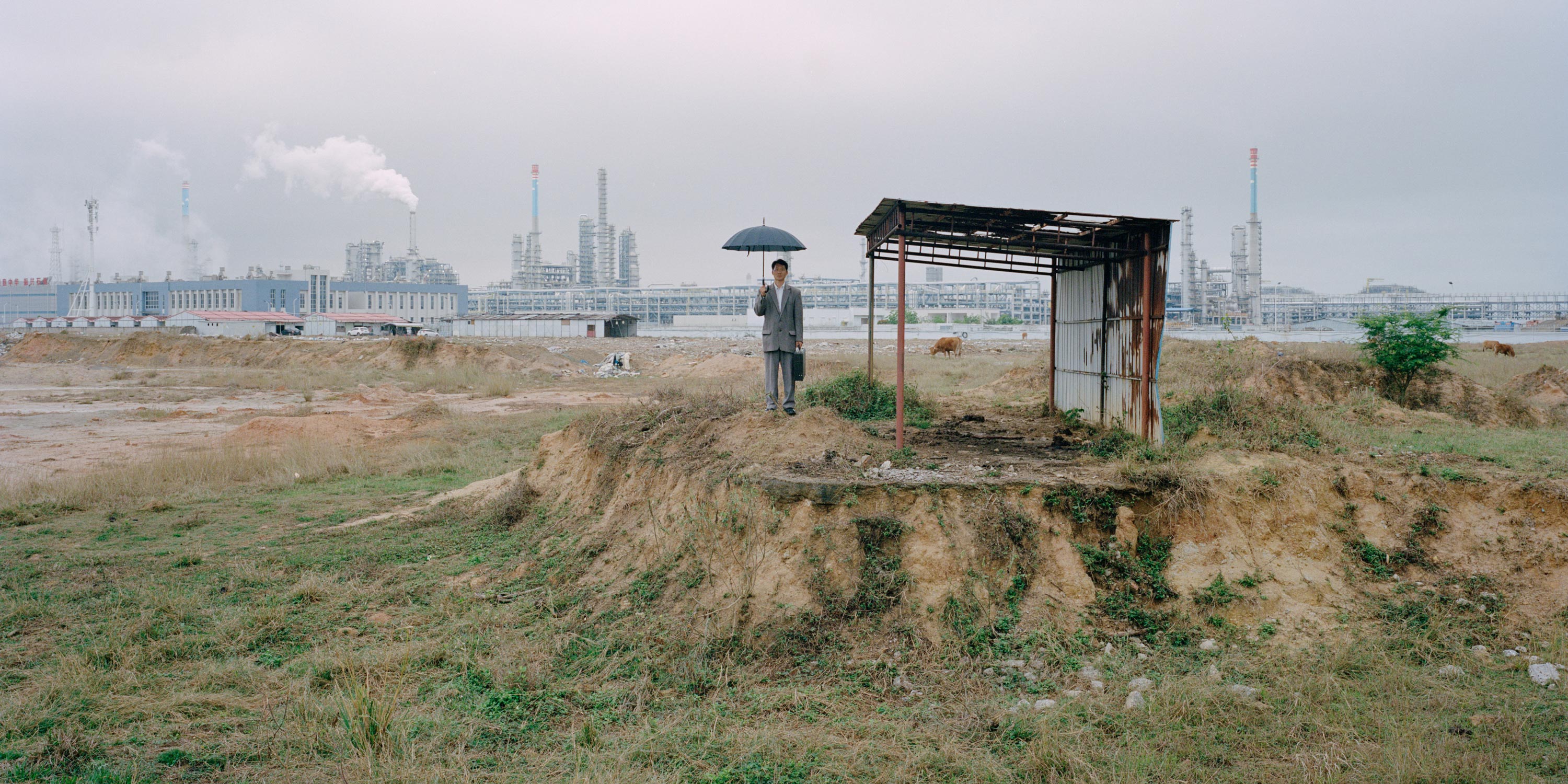
The Island, the Man, and the Long Goodbye
The wind off the South China Sea sweeps across the beach of Donghai Island, Guangdong province, carrying its familiar briny scent. On an empty stretch of sand, Chen Liang stands beside an old house half-buried in sand — a side effect of land reclamation. He wears his late father’s dark-gray suit — too tight at the shoulders — and holds a leather suitcase and a black umbrella. After adjusting his Mamiya 7 camera and setting the self-timer, he walks to a mark in the sand, straightens his jacket, and waits for the shutter. The resulting photograph, part of his series “Returning Home,” shows a man who appears to “return in glory,” though the landscape around him has been reshaped beyond recognition.
For a decade, Chen has photographed Donghai Island, shooting thousands of rolls of film and spending more than 400,000 yuan ($57,000) — enough, he notes, “to buy a decent apartment here.” His work has won awards and been widely exhibited.
At home, the response has been different. “In my mother’s eyes, I was the family’s greatest failure,” he says. No house, no children, no stable job — only “useless pictures.” He is now 41. In 2013, he returned to the island thinking he would stay. Today, he is preparing to leave again.
A fading world
Donghai, China’s fifth-largest island, was once remote, shaped by Minnan migrants, ancestral rites, and wandering god festivals. Until the early 2000s, life revolved around fishing and sugarcane. Then came a state plan: steel plants, petrochemical complexes, paper mills — a sudden redrawing of the island’s boundaries.
Chen’s childhood unfolded inside a world that was fading. “We were Donghai’s wild children,” he says. His home stood 700 meters from the sea; typhoons were background noise. He remembers moonlit nights chasing sand crabs, cooking rice in seawater, tossing sand into waves to watch phosphorescence spark.
His father, a cargo ship captain, returned with small treasures, including a secondhand cassette recorder. The children hung it from a casuarina tree and listened to Cantopop drifting across the yard, a memory that Chen calls “a kind of freedom that seems impossibly rare now.”
A leather football from his father became central to his youth, and the beach served as his training ground. At school he played striker — an old football board game — remembering classmates singing over the loudspeaker.
University introduced him to photography. He leaned toward sports journalism, studied photo books obsessively, and won multiple campus awards. An internship at Yangcheng Evening News in the provincial capital of Guangzhou — during what many now call the “golden age” of Chinese journalism — made a lasting impression on him. “Everyone scrambled for news, trying to outdo each other,” he recalls.
But by the time he graduated, that era was fading. He narrowly missed a major newsroom recruitment, eventually getting a position at a slower-paced local newspaper. Much of what he shot never made it into print.
“My own edge began to dull,” he says. On his birthday in 2013, he resigned, cashed out his housing fund, packed his Alto with medium-format 120 film, and drove to Lake Tai, eastern Jiangsu province, for a project he would name “By the Water.” Empty lake, lone tree, misted hill, figures swallowed by the humidity of Jiangnan, the region south of the Yangtze River.
“I was extreme — trying to sever every visual tie to the past,” he says. The mist dissolved his frustration, and the 6×7 film demanded a slower pulse. “I was healing inside the viewfinder.”
Two eras, side by side
At the end of 2013, he drove home for the Chinese New Year. The stark flatness of the reclaimed land made him stop. “Where are my casuarina trees?” he muttered. What came into view struck him with waves of shock. “I felt like an outsider trespassing on a colossal construction site.”
The urge to record was instant. He shuttled between Lake Tai and Donghai; each return revealed new amputations. In 2016, he abandoned “By the Water.” He photographed banyans — village “tree gods” felled for a road widening that never happened; the annual wandering god festival where elders prayed and teenagers partied; ancestral halls framed against silvery petrochemical tanks. His viewfinder captured two eras slammed together.
At home, the family’s response remained complex. To his mother and neighbors, he was not an artist but an oddball. “My mother was ashamed; she believed I’d been poisoned, gone mad.” In the village calculus, only houses, cars, wives, and cash counted. His cameras and “useless” pictures might as well have been “spirit money” — paper they’d burn for their ancestors.
In 2016, he opened a studio in the old house and named it Return-to-Fallow Hall. He photographed weddings, portraits, and other commissions — anything “that could be traded for grain.” At reunions, old classmates compared apartments and cars. No one spoke of photography or industrial scars.
A quiet goodbye
As the landscape changed, so did Chen’s methods. Evidence alone felt insufficient. He began wounding his own prints — soaking them in seawater, tea, and mud. More radically, he submerged film in polluted seawater under the sun.
Mold bloomed; scanned images looked corroded, streaked with fungal filaments, reminiscent of skin carcinoma. “I want the invisible plastic stench to be made visible for viewers,” he says, referring to the smell that now permeates Donghai.
His “Homecoming” series grew even more personal. Wearing his father’s ill-fitting suit, he photographed himself against rubble, factories, and abandoned houses. “The older I get, the more I resemble him,” he says.
After more than a decade, Chen plans to move a few miles inland. “One day I had a meal, and the air tasted of plastic for days afterward,” he says. He wants cleaner air and distance, though not too much. He will keep returning.
“For the rest of my life, I will keep saying goodbye to my homeland with my camera,” he says. “And in photographs, I will meet it again and again.”
Editor: Marianne Gunnarsson.
(Header image: Chen Liang poses as his father near an abandoned cattle shed, Donghai Island, Guangdong province, 2023. Courtesy of Chen Liang)