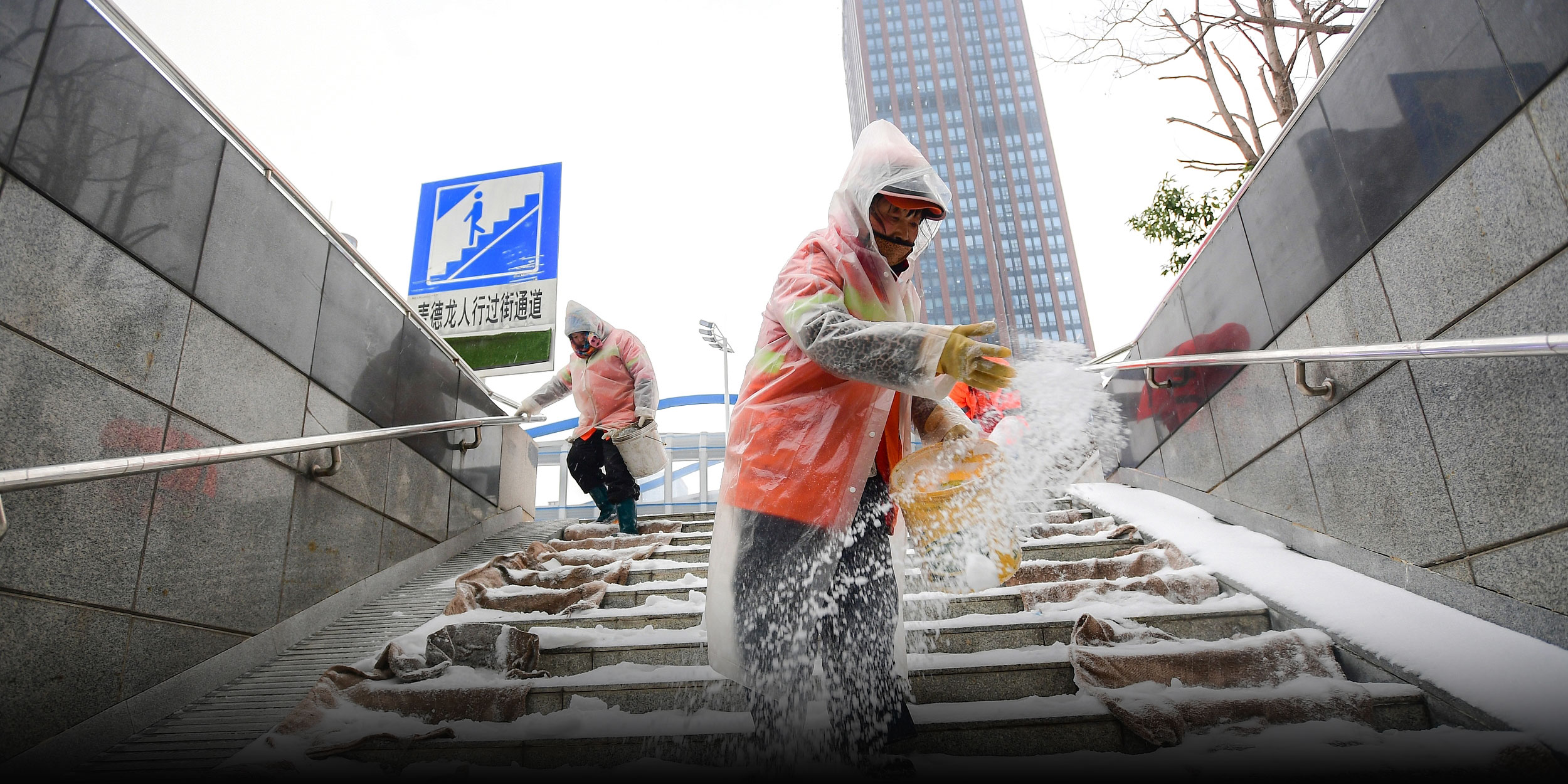
After Decades of Heavy Use, China Curbs Road Deicing Chemicals
For the first time in decades, Beijing and several other major Chinese cities are restricting the use of chemical deicing agents this winter, moving away from long-standing reliance on salt-based snow control to limit environmental and infrastructure damage.
The move drew national attention after the Beijing municipal government issued its strongest restrictions to date, calling for deicing agents to be avoided “wherever possible” in parks, public squares, residential compounds, and pedestrian areas. The ban was announced at a municipal meeting in November and took effect after the national capital’s first snowfall on Dec. 12.
Similarly, Weihai, in the eastern Shandong province, tightened controls in October, while the northern port city of Tianjin launched pilot programs in December to use “less or no” deicer, citing the need to “minimize potential ecological harm.”
Deicing agents work by lowering the freezing point of water to prevent ice formation. Since their introduction in the 1970s, northern China has relied heavily on chloride-based salts to reduce traffic accidents during long, cold winters. In 2024 alone, China used about 600,000 tons of such chemicals.
But studies show that chloride salts can corrode concrete road surfaces and vehicle undercarriages and contaminate soil, groundwater, and roadside vegetation.
Environmentally friendlier organic alternatives exist, but can cost up to 20 times more than conventional deicers, limiting their use largely to airport runways.
Past pollution incidents have helped drive the policy shift. After Beijing spread 7,000 tons of chloride salts to cope with record snowfall in 2002, more than 400,000 roadside plants died.
And during the nationwide snowstorms in 2008, deicing chemicals polluted drinking water in parts of southern Guangdong province and sickened residents, state broadcaster CCTV reported at the time.
Such cases prompted authorities to tighten national standards, including caps on chloride content and bans on spraying deicers near green belts. In 2022, China’s first domestically developed eco-friendly deicing agent production line began operations in the northern Shanxi province.
With chemical use restricted this winter, cities have expanded manual and mechanical snow removal. Beijing, for example, has deployed 11,600 snow-clearing vehicles and machines and mobilized 265,000 sanitation workers and volunteers to clear snow.
The bans are not absolute, however. Beijing media report that at “critical points” such as slopes, ramps, and bridges, limited amounts — no more than 25 grams per square meter — are still being used to prevent icing.
Elsewhere, local governments are testing longer-term alternatives. In the northern Inner Mongolia Autonomous Region, anti-icing materials have been mixed directly into asphalt, with effects said to last up to eight years. And engineers in the southwestern Sichuan province have embedded heat pipes beneath a 2-kilometer stretch of highway.
Public reaction has been mixed. On social media, many users voiced support for the policy. Others said they experienced skidding on icy roads or cited an uptick in orthopedic clinic visits, arguing that current alternatives are not yet sufficient.
“Urban governance is, after all, a complex systemic project without a single fix that works instantly, nor can results be achieved overnight,” domestic media outlet The Beijing News wrote in a commentary. “This was only the first snowfall of the winter, and greater tests may still lie ahead.”
Editor: Marianne Gunnarsson.
(Header image: Sanitation workers spread salt to clear snow in Beijing, Feb. 22, 2024. VCG)