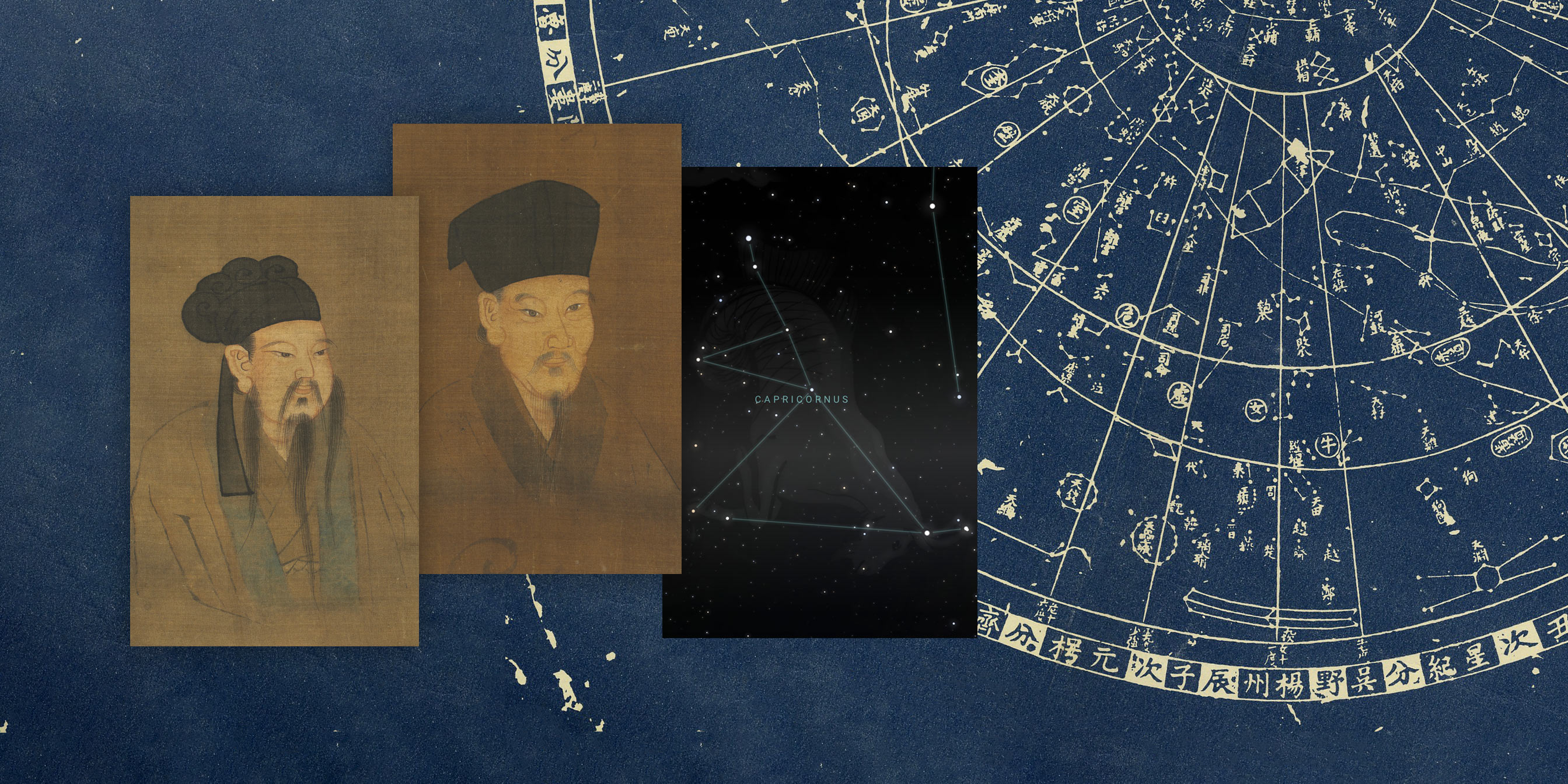
Why So Many Chinese Literati Were Capricorns
This is the second of a two-part series on traditional Chinese zodiac. Part one can be found here.
Since their introduction to China nearly 1,500 years ago, the 12 zodiac signs have gradually occupied a meaningful place in Chinese culture. As they became evermore popular, they were also appreciated within scholarly circles and widely served as spiritual targets for ordinary people to send their hopes, frustrations, and resilience as they sought help beneath the vast, mysterious sky.
In fact, the connection between the ancient zodiac and personal destiny was not based on an individual’s birth month, as it is in modern society. Instead, it depended on the positions of the sun, moon, and the five planets — later extending to a proposed nine or 11 celestial bodies in ancient China — in relation to the zodiacal coordinates at someone’s time of birth. In other words, any zodiac sign could be linked to a person’s fate in some way.
Among these, the most important were the zodiac sign rising on the eastern horizon at someone’s time of birth, known as the Ascendant or Rising Sign — referred to as the House of Destiny — and the zodiac sign where the moon was positioned at birth — known as the House of the Body. It is said that the first Roman Emperor, Augustus, publicly revealed his natal chart to the world in order to proclaim that his ascension to the throne was his divine destiny. His House of Destiny was Libra.
Interestingly, among the 12 signs, Capricorn stole the spotlight in China — not because a large number of people happened to be born when that sign rose on the eastern horizon, or the moon was located in the sign, but because of astrological and literary tradition.
As early as the Tang dynasty, Han Yu (768–824), one of the most influential literary figures and thinkers of his time, used the stars to reflect on his own fate. Court insider, literary superstar, and serial dissenter, Han blasted political corruption and Buddhism as a foreign religion so loudly that he spent half his career being exiled to mosquito-infested backwaters.
In his poem “The Three Stars,” he wrote:
On the day of my birth, the moon rested in the Southern Dipper.
The Ox struggles with its horns, and the Winnower opens its mouth.
The Ox did not see the box of offerings, the Dipper did not draw the wine.
Only the Winnower has divine power, never ceasing its sweeping motion.
No good name is known, no bad name is heard.
Fame accumulates and diminishes, achieving little and losing much.
The three stars are arranged in the sky, in groups of 10 or five to the east and west. Alas, you Ox and Winnower, you alone cannot summon the gods.
Han was talking about Chinese constellations, not Western zodiac signs. But based on a simple comparison, it is obvious that the celestial position of the moon resting in the Southern Dipper lunar mansion is aligned with Capricorn. Three centuries later, people would need not turn to calculation, because someone stepped forward to out Han as a Capricorn. That someone was Su Shi, better known as Su Dongpo, one of the most beloved literary figures of the Song dynasty (960–1279) — and indeed, of all Chinese history.
Su Shi wrote: “In Tuizhi’s (Han Yu’s courtesy name) poem, it says: On the day of my birth, the moon rested directly on the Dipper. Thus, I knew that Mojie (Capricorn) was Han Yu’s shen gong (body palace).”
Su Shi went even further, drawing a parallel between his own life and Han’s: “And for me, Mojie is my ming gong (life palace). Throughout our lives, we both encountered praise and blame — surely this is our shared fate!”
An important detail to note is that, according to ancient astrology, Mojie (Capricorn) and the corresponding Southern Dipper often foretold a turbulent destiny of suffering harsh criticism from others. In other words, being a “Capricorn” or “Southern Dipper” was not only about birthdays — it was an astrological badge of honor that said, “I’ve been through the mill.”
From then on, many scholars who felt the press of the universe’s grindstone could hoist the Capricorn banner while bowing to these two early masters.
One such figure was Wen Tianxiang, a national hero of the Southern Song dynasty (1127–1279) whose life was marked by political struggle, imprisonment, and ultimate martyrdom. As a scholar-general, Wen led resistance efforts against the Mongol conquests and was eventually captured and executed. In his poem “To Zeng Yixuan,” he opens with the Dipper and Mojie. He writes: “In the palace of Capricorn I have seen the stars of the Dipper.” Then, in one stanza, he writes: “I have passed the Dipper’s degree range, while the Celestial Tail lodges in Capricorn.” All of this is to tell Zi Yixuan, an astrological diviner, that although he shared an astronomical configuration with Han Yu and Su Shi, he would not listen to the diviner’s prediction and believed instead that his future would go beyond the edge of the known sky.
In the Ming dynasty (1368–1644), the littérateur Gao Qi wrote a reflective piece titled “Preface to Qian Wenze,” in which he also explored this tradition. Gao began by noting the shared fate of Han Yu and Su Shi — both being Mojie, both achieving literary greatness, and both enduring lifelong hardship and exile. He then pointed out that his own astrological sign also aligned with theirs and thus likewise experienced a destiny filled with praise and slander.
He regarded himself as a literary descendant of them:
“I, a late learner, have long admired the two gentlemen across the span of several centuries, yet I am powerless to serve them. My destiny is also that of a Capricorn, and I was born in the same year as Wenzhong (posthumous title of Su Shi), both of us in the sexagenary-cyclical year of Bing Zi.”
Within China’s cultural tradition, Capricorn is so much more than a constellation spanning 414 square degrees that the sun passes through from Jan. 20 to Feb. 15, or a sign averaging 30 degrees. Rather, it had become a metaphor — a reflective symbol and a cultural discourse through which individuals have narrated personal destiny, confronted adversity, and explored the delicate interplay between fate and virtue.
Thus, the zodiac was less a tool for predicting the future and more a means of giving shape and voice to human experience — a quiet dialogue between the heavens and those willing to walk beneath them, eyes open, pens still moving. In contemplating these celestial signs, people are reminded that human life, like the cosmos, is full of cycles, challenges, and quiet perseverance.
(Header image: Visuals from Taipei Palace Museum Open Data, Stellarium Web, and the public domain, reedited by Sixth Tone)