How Late Architect Frank Gehry Silently Shaped Chinese Cities
On Dec. 5, American architect Frank Gehry, famous for designing landmarks such as the Guggenheim Museum Bilbao and the Walt Disney Concert Hall, passed away in Los Angeles at the age of 96.
Unlike other internationally renowned architects — Rem Koolhaas, Zaha Hadid, and Tadao Ando, who designed the CCTV Headquarters, Beijing Daxing International Airport, and several Chinese museums, respectively — Gehry left no works in the Chinese mainland. He was invited to compete for, but didn’t win, the commission for the National Art Museum of China. While he was selected to design the Quanzhou Museum of Contemporary Art, his plans were so radical that it remains unknown whether they will be implemented.
But despite the mainland lacking a Gehry building, he has had a profound influence on how Chinese cities have changed in the past two decades. This influence is not due to any particular architectural style, but lies in the urban development logic that a visually striking landmark will enhance an area’s profile, drive up land values, and spark commercial activity.
This urban development trend can be traced back to the northern Spanish city of Bilbao, which in the 1980s was mired in crisis. With shipyards closing and blast furnaces shutting down, it had become Spain’s rust belt — similar to America’s Detroit, Germany’s Ruhr, or China’s northeast. Unemployment soared to 25%.
The local government bet on high-end culture to reinvent the city as a services and consumption center. In 1991, it struck an agreement with the U.S.’s Solomon R. Guggenheim Foundation to jointly establish the Guggenheim Museum Bilbao.
Gehry would design it. He pushed the limits of architecture, using aerospace software and 33,000 titanium sheets to create a building that resembled a sci-fi spaceship that had landed amid the industrial ruins on the banks of the city’s Nervión river.
During its opening year, 1997, the museum attracted 1.36 million visitors — nearly triple expectations. The government recouped its construction costs in just three years. In 2023, the museum’s contribution to the local economy since its opening was calculated to be €7.7 billion ($9 billion).
More importantly, the museum transformed Bilbao’s reputation from a polluted industrial port into a major cultural center. This is the “Bilbao Effect,” a formula that says declining city + star architect’s landmark building = refreshed image and economic boom.
The legend of Bilbao found a rapt audience in China that, at the time, had just begun to rapidly urbanize. Just one year after the museum’s opening, in 1998, China’s Ministry of Culture and the National Administration for Cultural Heritage collaborated with the Guggenheim Foundation to host the major exhibition “China: 5,000 Years” in Bilbao.
The impactful visuals created by the Terracotta Warriors, juxtaposed with futuristic deconstructivist spaces, made an impression on Chinese cultural officials and allowed them to see firsthand how architecture can transcend the exhibits and attract visitors in its own right.
At the 2010 Shanghai Expo, which was themed “Better City, Better Life” and had an “Urban Best Practice Area,” Bilbao had its own pavilion. Millions of visitors — including Chinese mayors and urban planning officials — could see the city’s before and after comparison, from abandoned industrial port to gleaming art city.
A major source of income for Chinese cities is making new land available for urban development. But how to get a good price for this land on the fringes — places without any established companies or population centers — proved a challenge when cities began to expand outward in the 2010s.
Gehry’s Guggenheim Museum Bilbao inspired what would become a standardized solution. Cities would first plan a large public cultural building designed by a star architect. Thus, they would create a landmark in the middle of an otherwise undeveloped area, raising land prices enough to recoup the building’s costs and cover other government expenditures.
Prominent examples of this method include the Meixi Lake International Culture and Art Center in Changsha, capital of China’s central Hunan province, and the Ordos Museum, in the northern Inner Mongolia Autonomous Region. The former was advised by Thomas Krens, the former Guggenheim director who had overseen that museum’s global expansion, and was designed by Zaha Hadid, while the latter, designed by the Chinese firm MAD, aimed to replicate the Guggenheim Bilbao’s monumental scale. In both cases, land values skyrocketed.
Many smaller cities built new areas around some combination of museums, a library, a grand theater, and a sports center. Especially for cities looking to diversify their economies away from resource extraction or heavy industry, such a collection of spectacular buildings was an entrance ticket into the club of modern cities.
However, this method of urban development also had serious foundational problems. The most significant issue was that governments focused so heavily on architectural spectacle that they neglected to consider how these buildings would best be put to use, or whether their functionality met actual needs. In today’s context of declining land revenues and tighter government budgets, excessively grand cultural facilities can instead become a burden.
The reason is that followers of the “Bilbao Effect” often overlook the complex engineering behind this success story. Gehry’s eye-catching design was just one factor in a multidecade plan that incorporated the Guggenheim’s global network as well as the city’s vibrant art and entrepreneurial communities. The oversimplified interpretation of many imitators ignores everything but the building.
The good news is that Chinese cities are realizing that a museum’s exhibits are at least just as important as their building’s form. Take for example Shanghai’s West Bund Museum, a striking design by British architect David Chipperfield. It has an ongoing, five-year collaboration with Paris’ Centre Pompidou, providing a stable supply of high-quality exhibitions.
An example of Gehry’s continuing impact on China is the Bai’etan Greater Bay Area Art Center, which opened in Guangzhou in 2024. Designed by Chinese architect He Jingtang, it has been dubbed “China’s own Guggenheim” due to its avant-garde lines and waterfront location.
But while the city might expect its version of the “Bilbao Effect,” the focus should shift from just the building’s visual impact toward a more multifaceted appreciation of architecture’s aesthetics and function, and how it incorporates local — as well as national and global — culture and communities. Guided by such more thoughtful approaches, we may see a better preservation of Gehry’s legacy in China.
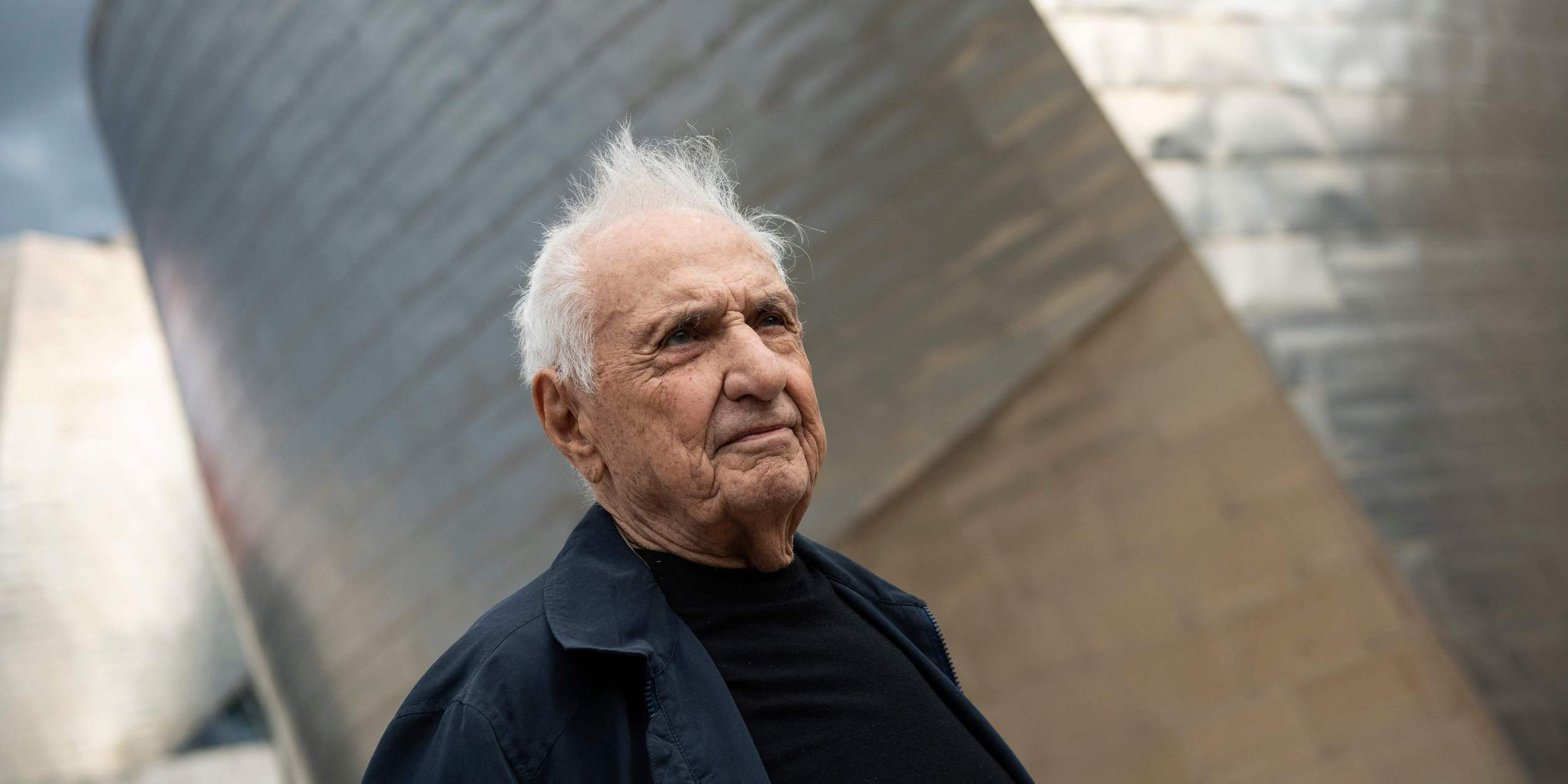
(Header image: Frank Gehry poses in front of the Guggenheim Bilbao Museum during its 25th anniversary celebration in Bilbao, Spain, 2022. Ander Gillenea/AFP via VCG)