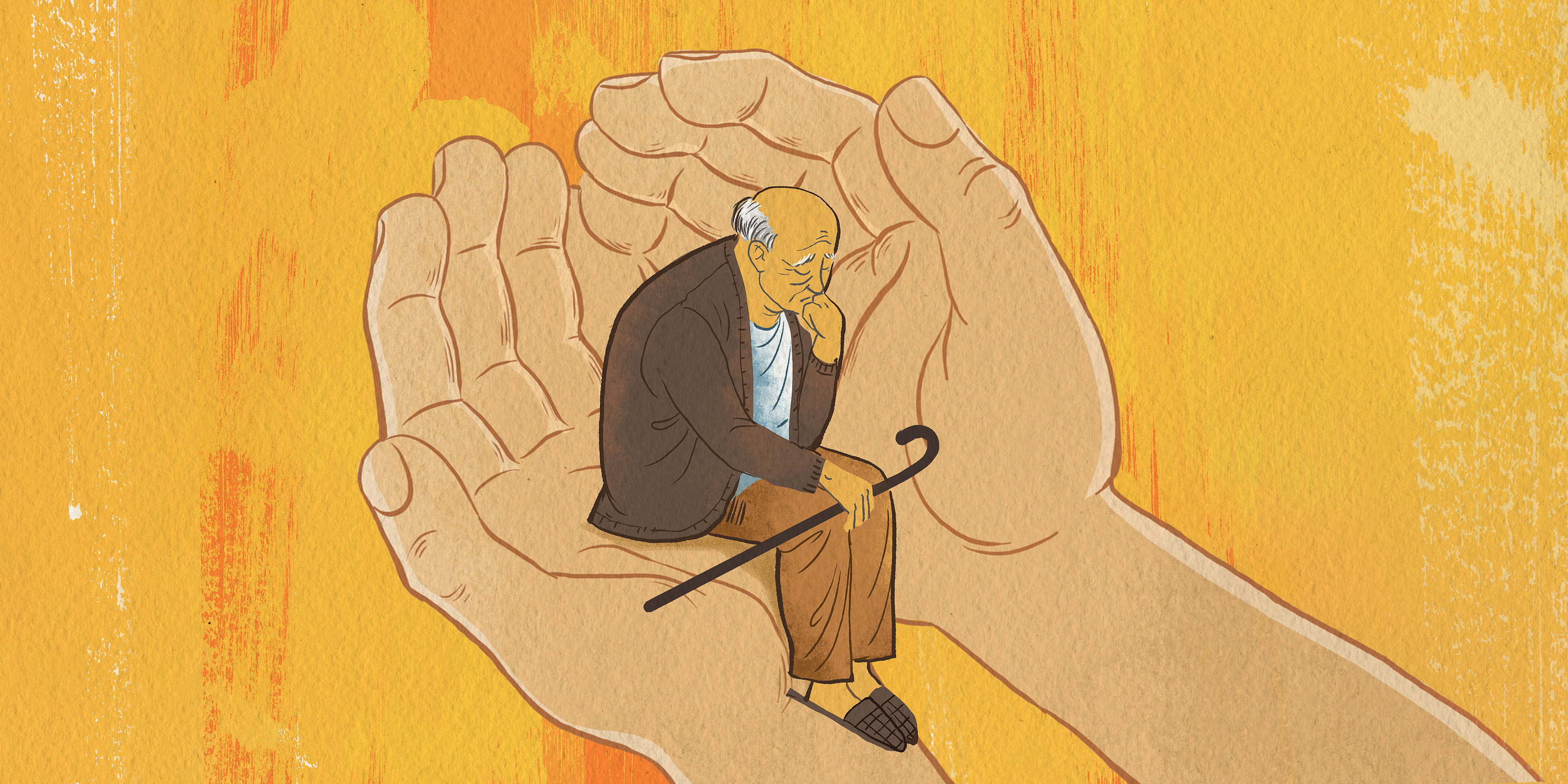
His Fight, My Future? A Childless Daughter in China Reflects on Her Dad’s Decline
Editor’s note: Architect and blogger Lu Yuan cared for her 92-year-old father for almost 10 years before moving him to a nursing home in 2023. There, he guards his independence with fierce resolve. As a childless, unemployed woman in her 40s, Lu is also coming to terms with her own uncertain future, opening a window onto the struggles facing many single people in China’s aging society. Here, Lu shares her story.
Around 6 p.m. every evening, a low hum of anxiety starts to set in. That’s when I know my father is most active — bathing, using the toilet, taking medication; he’s always on the move. He leans heavily on his cane, shuffling around unsteadily until he finally goes to bed at 10 p.m. Only after that can I relax.
This year, he began frequently falling over. The worst was this summer, when he hit the left side of his head in the bathroom, leaving a gash nearly eight centimeters long. There was blood everywhere — on his body, on the floor. I was terrified. At 92, he’s shrinking — his spine, legs, muscles, brain tissue. His motor skills are failing. He wobbles with every step, and peeling an egg takes him forever.
At the hospital, while getting stitches and a brain scan, he refused any help. When the doctor asked how many fingers he was holding up, my father responded in English, “Two, one,” before adding, “Thank you very much.” He had to keep up his stiff demeanor. Back at the nursing home, when he needed the toilet, he roared at the nurse and me for offering help, instead heaving himself from the sofa and hobbling in alone — only to urinate on the floor and his pants.
The staff are accustomed to difficult residents, but they still tread carefully around him. Nursing homes run on routine, but he insists on keeping his own schedule. He makes his bed each morning, washes his clothes, refuses help while bathing, and insists on walking to the toilet alone, even after a fall. I encourage him to use the call button, but he ignores me.
During that summer, I was constantly on edge, expecting him to fall again. It wore on my nerves. I finally asked the staff to check on him every 20 minutes. Whenever he noticed, he’d shoo them away.
My father is nearly deaf, so we communicate using a small chalkboard. I wrote, “If you’re unhappy here, we can go home.” He shook his head and answered, “I won’t have you resent me. What if I live to be 100?” He’s been in the nursing home for more than two years now. On holidays or his birthday, when I bring him back to our home, it feels more symbolic than familiar. He doesn’t recognize the layout anymore — even the bathroom frightens him.
Placing him in a care home wasn’t an easy choice. After my mother passed away, it was just the two of us. Before the pandemic, he could still shop for groceries. But then his motor skills went into decline. I worked from home, and I witnessed two serious falls — one resulting in a spinal fracture, the other a head injury.
When we could all finally return to our offices, I had to go. I’m an architect; our industry has been shrinking. I couldn’t quit my job, and leaving him home alone wasn’t an option.
We considered a live-in aide, but he’s a proud man. “If I become immobile, I don’t want a woman helping me in the bathroom. At least the nursing home has male attendants,” he said. I found a facility nearby and, after I told him it cost less than his pension, he reluctantly agreed.
It pained me to uproot someone his age, especially with his temperament. He doesn’t socialize like others. But there was no alternative. After the Chinese New Year holiday in 2023, we moved him with all his clothes and toiletries. No photos or books were taken because of his deteriorating eyesight.
Final curtain
Time has stopped for him in the nursing home. He used to fill his days with cooking, watching the news, and eagerly telling me about events from around the world when I’d return from work.
Now each day repeats, the only change being his slow physical decline. He sits in front of the TV, reading headlines he can’t hear, watching figures come and go. The home organizes activities such as card games, singing, calligraphy, and park visits, but he joins in with none of them.
He’s always been an outlier, even in our family. Decades of work yielded no close friends. After retiring, he devoted himself to my mother, who lived with chronic illness for years.
At the care home, he remains detached — this isn’t his world. Once, during a birthday celebration, a staff member tried to place a party hat on him. He snapped, “Take it away — that’s fascist!” The head nurse later told me all about it. I felt guilty. I know his behavior stems from his past, but I can’t explain that to them. He’s quite lonely, actually.
They’ve never invited him back to their group activities. He has no friends. His only interest is international affairs, but no one listens. He saves his commentary for me when I visit — the Israeli-Palestinian conflict, military parades, Donald Trump, tariffs, and even artificial intelligence. He’ll hum John Lennon songs, spell out the names of countries, “Mississippi,” “Mediterranean,” or “Nile” to prove his mind’s still sharp, then add, “But none of this matters to me anymore.”
He’s very well read. His father was part of China’s first generation of meteorologists. My father fled the war as a child, and was ambitious and socially engaged in his youth. Later, working in a factory, he found no kinship with his colleagues. He grew isolated, yet clung to his pride, refusing to forget his English or Russian language training.
He only began sharing these stories with me in his 80s. It’s as if he wants me to know everything. On holidays, he used to call old classmates — both sides deaf, shouting updates as if speaking into a void. I think he feared his stories would die with him.
I’ve come to appreciate my father. When my mother died, I moved in with him — I couldn’t leave an 80-year-old all alone. We’d never communicated well. As a child, I saw him as odd, preferring to stay with easygoing people. Sensing our distance, he started to tell me about his past. I began to see why he became who he is, understanding his internal world.
Now that he’s in the home, the phone calls have stopped, but the stories continue. His is a life shaped by personal and social upheaval. I feel a responsibility to be his soulmate. If not me, who?
Writing became my outlet. I started posting online about his life. Sometimes, after struggling with him until 11 p.m., I’d write through the night. Only then could I rest.
I’ve stopped trying to change him. His dignity comes before everything — even his life. So I honor that. Now I see myself in him. When he falls, and people fuss over him, I wonder how I’d react in his place. Just like him — ashamed, feeling helpless.
Now when the home calls about a fall, I ask for photos first. If he’s still OK, I’ll finish my work first. I’ve told them not to overreact — just check on him regularly; don’t disrupt his life.
In July, one of his old coworkers died. It moved him. “Ran (his friend) was one year older, a good friend,” he’d said. In truth, they had been rivals. As the names fade, anyone remembered becomes a “friend.”
But one by one, they’re gone. I’ve stopped telling him about new losses. He’s said more than once, “I’m in the deep sea now, counting down, waiting for the curtain to fall.”
Family footsteps
I used to avoid caring for my parents. They had me in their 40s. Growing up, everyone said that I was “born to look after them” and shouldn’t move far, even after marriage. But I insisted on leaving. My mother called me selfish and cold. As she neared the end, I hesitated to return — I’d worked hard to set boundaries, unwilling to fulfill the role of someone “born to serve.”
Now in my 40s, I’m single and childless — partly because of them. I fear repeating that dynamic, as I’d never want a child feeling responsible for me.
I’m grateful that my father encouraged my independence. Living together initially felt obligatory, but as my career faltered, I realized, who do I have? Only him. I’ve grown emotionally reliant on him. When he first left for the nursing home, our house felt empty. I know nursing homes are normal, but the guilt still lingers.
My cousin advised, “Be a professional daughter, not an emotional one. Don’t fall into that black hole.” But I’ve always been emotional. When people call him “difficult,” it feels personal to me. I see myself becoming more like him. Life’s uncertainties have shown me what he endured. I recognize his stubbornness in myself.
“We’ll find a way”
Early this year, the firm I worked for folded. I saw it coming. I’m not job hunting — at my age, opportunities are scarce. Some peers are selling insurance; others have quit the industry. I scrape by with freelance projects, which means lower rates, more work, and all the risk.
I pretend I’m still employed, visiting my father only on weekends. But he’s noticed. He follows the news, knows our industry is struggling. After two of his falls, I arrived on the scene in just 10 minutes. “You’re not working,” he said. I didn’t admit it. He already worries about my future, how could I tell him I’ve no income?
He’s deeply pessimistic. He often says, “What will you do? Stand all alone with only your shadow for company.” I tell him, “It’s not so dire. Did you ever imagine your life would be like this? We’ll find a way.” He backs off when he senses his worry weighs on me.
I’m one of the most involved relatives at the nursing home. Many residents have been effectively abandoned — their families don’t come even for falls or fevers. Staff attention can depend on family engagement. The aides send me photos and videos because they know I care.
When I see him, I see myself. I wonder, what will become of me? I’m still capable and socially functional. But when all my roles are stripped away, if I become difficult, isolated, and stubborn, how would I want to be treated?
We’ve discussed his funeral, and he wants simplicity. After seeing my mother in intensive care, he refuses such measures for himself. I’ve always been a planner. When my mother died, I arranged my father’s finances, insurance, even prepared his burial clothes and portrait. I don’t want a last-minute rush.
As for my own future, I’m saving money and stating my wishes for medical care. The rest — dementia, cognitive decline with no children — remains unresolved. Perhaps I’ll find solutions as I get older. Our situation will probably become more common, as this is the inevitable path of an aging society.
(Due to privacy concerns, Lu Yuan is a pseudonym.)
As told to reporter Wei Xiaohan.
A version of this article originally appeared in White Night Workshop. It has been translated and edited for brevity and clarity, and is republished here with permission.
Translator: Kiong Xin Xi; editors: Wang Juyi and Hao Qibao.
(Header image: Shijue/VCG, reedited by Sixth Tone)