Ancient Chinese Incense, Rekindled
On Oct. 13, 2025, the World Expo in Osaka, Japan reached its final day after 184 bustling days and nights. All participants hoped to give the grand event a perfect ending, and the award-winning China Pavilion, steeped with delicate fragrances, was no exception.
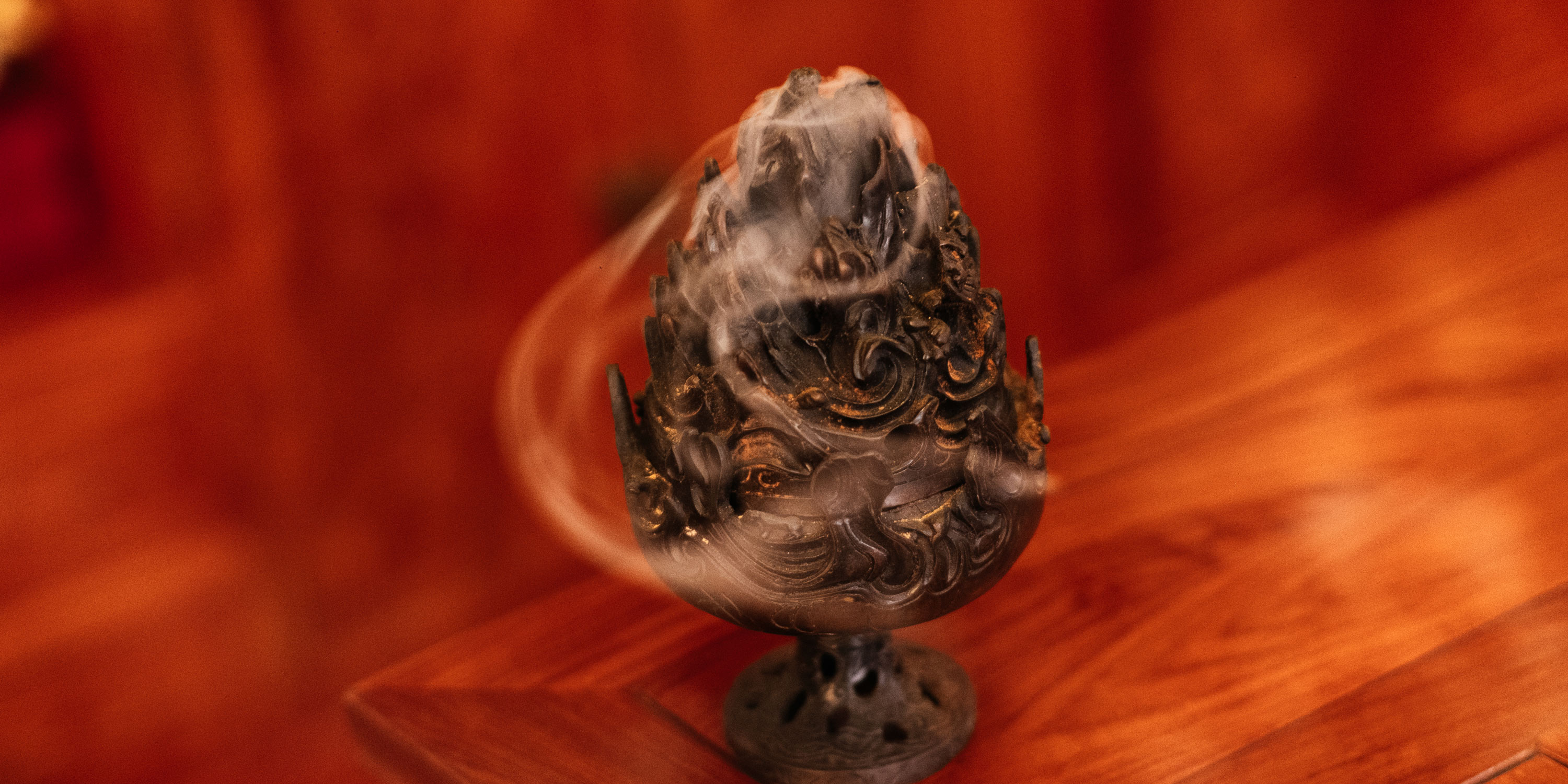
Atop the display table, a five-legged silver censer burned the iconic, subtly sweet aroma of “Jiangnan Lord Li’s sleeping incense,” while in another, the 57-year-old Wu Qing demonstrated jianxiang, the ancient Chinese incense technique of indirectly heating aromatics over charcoal. One by one, Wu brought to life some of the most celebrated incense recipes from ancient China — some that had accompanied court dancers from the Tang dynasty (618–907), some beloved by a Song dynasty (960–1279) literary master. As he worked and passersby lingered in the ephemeral aromas, his apprentice roamed the pavilion with a “fragrance ball,” emitting the scent of agarwood throughout the space.
For Wu, the aroma of the China Pavilion was essential. As the official inheritor of the “scholar’s incense ceremony” and creator of the China Pavilion’s fragrant ambience, the World Expo made for an ideal stage to showcase China’s traditional incense culture. After all, the ancient art has been intertwined with the wider world for almost two millennia — and is seeing renewed interest as more look to integrate some of the ancient world into modern life.
Incense has had a long and storied journey in China. Some archaeologists date it back to the Neolithic era, when it was used as offerings to heaven, deities, and ancestors, eventually becoming two core traditions — ritual incense and incense for personal cultivation and daily life — in the Western Zhou (1046–771 BC).
Chinese incense culture flourished during the Western Han (206 BC–AD 25), when Emperor Wu expanded the empire’s southern frontiers and opened routes to Central Asia, ushering in large quantities of aromatics from Southeast Asia, South Asia, and the Arabian Peninsula — along with the very charcoal-burning technique that Wu demonstrated at the China Pavilion.
Wu Qing would have felt at home with the ancients as spice and aromatic imports took off in the Tang dynasty along the Maritime Silk Road, and by the Song dynasty, burning incense had become one of the quintessential literati pursuits among the upper class — a means of cultivating tranquility and aiding contemplation. Scholar-officials such as Su Shi, also known as Su Dongpo, elevated the appreciation of fragrance to a spiritual discipline, calling it “nasal meditation,” in which the sense of smell became a channel for aesthetic and moral refinement. By the late Ming dynasty (1368–1644), the invention of stick incense allowed incense to spread more widely among the general populace.
At this point, China’s demand for spices was so great that when Europeans in the 15th century began competing for control over the global spice trade, they discovered that China consumed more than half of the world’s supply. Unfortunately, incense would be caught in the crosshairs of a changing world. The rapid rise of modernization and industry in the 19th and 20th centuries upended the scholar-gentry class and culture that had sustained incense culture for hundreds of years. Soon, in the wake of the Opium Wars, synthetic fragrances from outside China flooded the market.
By the mid-20th century, traditional Chinese incense culture was on the brink of extinction, living on in ritual incense often made from artificial essences, wood powder, and binding agents — far removed from the meticulous handcrafted incense of old. Just like that, scents that had once accompanied courtiers the moment they woke up or even entered a room were in danger of becoming nothing more than a relic of bygone days.
In the past 10 years or so, however, Wu has been noticing signs of a revival amid national efforts to promote and preserve traditional arts. People caught up in the frenetic pace of modern life are drawn to an art that invites them to take the time to appreciate an intricately crafted work. Incense-related content creators and vendors have been cropping up on Xiaohongshu, also known as RedNote, along with incense workshops and experience centers.
As incense gets rekindled in modern China, so too does the art of making it, as the future of incense falls on cultural inheritors like Wu. Now, a new generation of inheritors is taking shape, each creator drawn to the heady, redolent trails of smoke.
Aromas of the ancients
Wu describes himself as a bai xiang ning — a term in the Shanghai dialect literally meaning “a person who loves to play” and a self-effacing way to express the refined tastes of a classic Jiangnan gentleman that dates back to the Song dynasty.
His interest in incense stems from both his education and family heritage. As a graduate student at Beijing’s Chinese Academy of Social Sciences, he specialized in jade and art archaeology. He is also a descendant of Jiangnan silk-and-bamboo musicians and grew up in a home rich with traditional instruments, ancient books, and historical swords, prompting him to pursue classical Chinese instruments like the xiao, a type of flute, and the plucked, seven-stringed guqin. While he also dabbled in incense to emulate ancient scholars, he ultimately stopped because the incense he could obtain — mass-produced, often using artificial ingredients — had a harsh and off-putting aroma.
Then, during an academic exchange on ancient jade in 2004, Wu met Professor Liu Liangyou, who had come from Taipei and been appointed as a special researcher at the Shanghai Museum. Liu was a leading scholar of ancient incense, having come into contact with numerous court incense utensils and agarwood artifacts during his time at Taipei’s National Palace Museum in the 1970s. Over the ensuing 20-plus years, he developed a study that combined artifact research, literature review, and field visits to incense-producing areas and archaeological sites, even publishing a series of scholarly works on incense.
Through Liu, Wu got his first experience of traditional incense appreciation, or pinxiang. “The moment the fragrance spread, I was stunned — I never imagined the world contained such a beautiful scent,” Wu recalled to me. “At that moment, I decided to become Liu’s disciple.”
Liu had strict standards for his disciples. They had to be knowledgeable, patient, possess an aesthetic sensibility, and maintain a dedicated incense room with a small courtyard and a tea room. Fortunately, Wu met all these requirements and formally became Liu’s disciple, attending weekly lessons at his master’s home. Tragically, Liu passed away just three years later while traveling. The bereft Wu resolved to continue exploring the art of incense to honor his master’s legacy.
Lately, one of Wu Qing’s greatest passions has been restoring historical incense formulas. Known as xiangfang, these recipes represent a unique approach to fragrance that dates back to the Han dynasty (206 BC–AD 220) and involves a complex process of selecting and combining aromatic materials based on distinct qualities.
At first glance, it might seem fairly straightforward to reproduce ancient incense formulas, given the abundance of historical records. The “Chen Family Incense Manual” from the late Song to early Yuan dynasty (1279–1368), for one, documents over 280 formulas with detailed ingredients and methods. Yet, as Wu explained to me, the actual work is far more complex. Even simple instructions often require painstaking experimentation.
Wu explained how certain ingredients, such as sandalwood, lemongrass, or frankincense, require a “wine-soaking process” that can often be undermined by store-bought alcohol. Only after several rounds of experimentation with alcohol proofs did he grasp the subtlety.
“You cannot use high-proof alcohol, because it destroys the aromatic compounds,” he said. “You need very mild rice wine, below 10% (in alcohol content) … So you see, recreating these formulas from ancient texts is no simple task.”
Many incense recipes are associated with historical figures. For example, one of the recipes Wu brought to the Osaka Expo — “Yang Guifei’s bedchamber incense” — features exotic ingredients such as agarwood, aloeswood, chicken-tongue incense, musk, and sandalwood, which reflects the luxury of the Tang imperial court where Yang Guifei became a figure of legend. It also incorporates the traditional Chinese herb Lysimachia foenum-graecum, which gives the fragrance a subtle, elegant quality.
After his painstaking experimentation to capture this essence of the ancients, Wu gets an indescribable sense of accomplishment when these recipes are faithfully reproduced.
“As you light the incense and watch the smoke spiral and drift, the fragrance envelops you, carrying you across centuries,” Wu said. “In that moment, it feels as if you are conversing silently with the ancients, sharing their thoughts, their sensibilities, as if time itself has folded.”
Scents of healing
Like Wu, Liang Qianli is a Shanghai-based incense maker. Unlike Wu, the 35-year-old’s introduction to incense culture had origins that felt straight out of an epic.
It all began when Liang’s grandparents moved in with his family for health reasons when he was 13. Their home quickly filled with all kinds of objects, especially jars of medicinal herbs belonging to his grandfather, Feng Yulin, a respected traditional Chinese medicine doctor. Soon, this room became an object of Liang’s curiosity.
One day, while rummaging through the clutter, he discovered a set of old booklets — five volumes in total — containing mysterious, vaguely recipe-like writings. When he asked his grandfather about them, the elder smiled and began to tell the family’s story.
It turned out these booklets were an incense manual written by a monk nearly 1,000 years ago. During the Southern Song dynasty (1127–1279), the Zen master in Yongjia (today’s Wenzhou, in the eastern Zhejiang province) discovered that certain fragrances could calm the mind and bring tranquility, and vowed to use his incense to help people. His blends proved highly effective, but they transformed the secluded monastery into a place frequented by officials and nobles seeking his fragrances. Realizing that his creations were circulating mostly among the elite — contrary to his original intent to benefit all beings — the monk decided to pass along the art discreetly among the commoners.
With no descendants of his own, the monk entrusted the secret to a local medical family surnamed Feng, stipulating that the manual be transmitted secretly. Descendants could choose whether to learn it, but it must be passed down from generation to generation. By the time it reached Feng Yulin, he was the 26th generation of custodians.
“Now, I pass it on to you,” Feng said to Liang, once he’d completed the story. Strictly speaking, Liang was not a Feng descendant, yet for some reason, Feng deemed him the rightful heir.
Liang was overjoyed. “At that moment, I felt like the protagonist of a martial arts novel who had just obtained a secret manual, as if destined to become a master myself,” he recalled to me.
Eagerly, he pored over the hundreds of formulas in the manual, immersing himself in the knowledge of incense materials and techniques. Yet for years, he struggled to create the exquisite blends he had envisioned.
It wasn’t until nine years later that Liang realized the truth: Most of the formulas in the manual were designed as “trial-and-error” exercises. The true inheritance lay not in mastering the formulas themselves, but in understanding the principles and the underlying philosophy.
By 2012, Liang felt he had become a qualified successor of the “Feng Family Incense Manual” and began developing his own blending system, which focused more on health and wellness. Soon, news of his creations spread by word of mouth as his friends told him they were sleeping better and had improved moods.
Intrigued, Liang reached out to the School of Psychology and Cognitive Science at Shanghai’s East China Normal University in 2020 to study the medical effects of incense. The faculty introduced him to Yang Yang, a master’s student specializing in neuroscience who conducted two surveys in 2021 and 2022 to examine the effects of his incense on mood, sleep, and stress.
“Olfaction, unlike other senses, projects directly to the brain’s emotional and memory centers, giving fragrance enormous potential to influence mood,” Yang explained to me. “Both psychology and clinical medicine have explored aromatherapy as a complementary therapeutic approach.”
Yang intends to continue combining modern technologies, such as MRIs, with the ancient art to learn more about how incense affects brain activity. Yet these studies have also changed Yang’s personal trajectory: She became fascinated by traditional blended incense and, after completing her master’s degree, chose to work with Liang.
Reigniting the flame
Both Wu and Liang consider themselves inheritors of China’s incense culture, yet many others enter the field purely out of curiosity. Among them is Yuan Jin, director of the Training Center at the School of Humanities, Shanghai Jiao Tong University.
In 2020, as the COVID-19 pandemic raged, disinfection became an unavoidable part of daily life. Most chemical disinfectants, however, carried harsh, pungent odors, and Yuan was eager to find an alternative. He consulted a friend at Shanghai Leiyunshang Chinese Herbal Pieces Factory — a leading manufacturer of traditional Chinese medicine — who provided him with line incense containing ingredients such as Atractylodes rhizome, Angelica dahurica, and mugwort. Yuan found it pleasantly mild, even calming after prolonged exposure.
This sparked his interest in traditional incense. He began reading books on the subject, studying incense materials, contacting experts, and experimenting with making incense himself. The more he explored, the deeper his fascination grew. To his surprise, once he’d gotten used to traditional incense, modern chemical fragrances seemed harsh in comparison.
“At first, I was confused. The scent of traditional incense is so different from what I had long associated with ‘fragrance’ — like soap or perfume,” he said. “I even began asking myself a strange question: What exactly is fragrance? Why do scents used by our ancestors, which they considered ‘fragrant,’ not always seem so to modern noses? Has the Chinese sense of smell been altered in modern times?”
According to Zou Yue, vice chair of the Daily Chemicals Committee of the Chinese Chemical Society, Yuan may not be that far off. He told me that a person’s perception of pleasant smells is largely because of “education.” While humans possess a large family of olfactory receptor genes, scent preferences and the behaviors they inspire are not purely determined by genetics, as in insects or other species, but are mostly learned. This helps account for why perceptions of fragrance can vary across time and culture.
In 2022, Yuan’s center at Shanghai Jiao Tong University collaborated with the Shanghai Leiyunshang Chinese Herbal Pieces Factory to launch a beginner-level course to become a Chinese medicinal incense practitioner. What started as an experiment quickly became the most popular program at the center — greatly surpassing their three-day advanced coffee course, despite costing three times as much and Shanghai having more than 8,000 coffee shops.
The course is now in its ninth run, and I found that most participants are young women drawn by a general interest in Chinese classical studies or traditional culture. Others said they were seeking a “slower, more refined” lifestyle to relieve daily stress.
Wu, the official inheritor, has also taught in Yuan’s program. Already, it’s a stark change from when he and his mentor Liu first promoted incense culture on the mainland more than a decade ago. Back then, responses were sparse, with people often asking, “I’m not a regular at temples — why study this?” Today, however, there has been an obvious surge in interest, with prices for incense materials — from common atractylodes to precious agarwood — having doubled in recent years.
As far as Wu is concerned, this resurgence of incense culture is only natural, given that, at its core, it is a luxury art — one that relies on rare resources, active markets, thoughtfully designed spaces, and the time to savor them. “Only in eras of peace and prosperity can people truly seek the finer things,” he said.
A Chinese idiom originating from incense practices aptly illustrates this renewed interest. Meaning “dead ashes reignite,” it refers to how ancient censer ashes could become “dead” if not tended, yet easily rewarmed by hidden embers as the fire persists unseen in the gaps, ready to flare up again.
Just as ashes rekindle, so too can ancient fragrances stir once more, crossing time itself to rise delicately into the present.
(Header image: Wu Huiyuan/Sixth Tone)