Stuck in the Mud: Climate Chaos Deepens Divide on China’s Farmlands
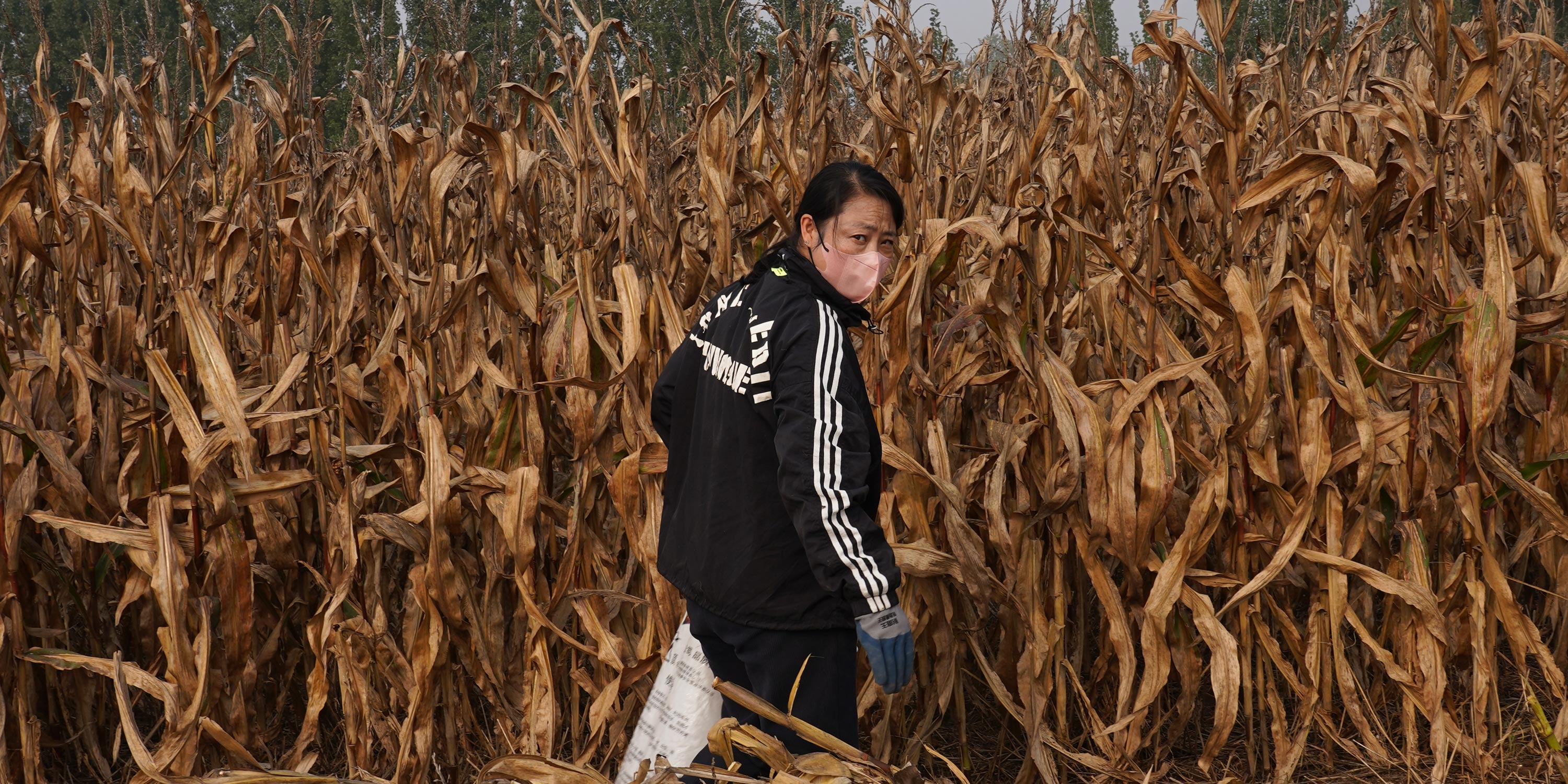
HENAN, Central China — On a gray October afternoon, 60-year-old Liang Aiqin peeled open ear after ear of corn, her frown deepening after each one. More than half were streaked with black and green mold; a few had already begun to sprout.
Her daughter, standing beside her on their two-hectare plot, muttered, “Another year of work for nothing.” Of the corn that had barely survived the summer drought in central China’s Henan province, only about a third made it through the autumn rains.
A few hundred meters away, Wan Jinhu’s 77 hectares took losses too, but still pulled in about 550 kilograms per mu (around 8.25 tons per hectare) — a harvest close to what smallholders manage in a normal year.
Years of investment had built him a buffer: a drying tower, two tracked harvesters, a mobile dryer, and multiple seed varieties to hedge against whatever weather arrived. “The weather has been too strange, and margins are basically gone,” Wan said. “But if you expand, strengthen, and manage carefully, you can still make it work.”
Same village. Same weather. Two farmers ending the season on opposite sides of loss.
Henan is China’s breadbasket, producing a quarter of the nation’s wheat and a 10th of its food. The farm year usually follows a predictable sequence: wheat from autumn to spring, then corn and peanuts.
This year, the rhythm broke again. A summer drought was followed by nearly 40 days of rain — almost four times the usual and the heaviest since records began in 1961 — leaving fields too wet to harvest on time.
It was the latest in a series of extreme seasons: droughts and heavy rain in 2024, pre-harvest rain in 2023, and the 2021 floods that killed 398 people and destroyed 367,000 hectares of farmland.
And in Henan, not everyone had the same ability to absorb another blow.
In village after village that Sixth Tone visited across Jiaozuo, the province’s highest-yielding grain area, large farms with land and machinery kept going, while smallholders faced losses they simply weren’t prepared for.
Higher ground
Zhang Xiangdong never expected the tracked harvester he managed to buy after the 2021 floods to matter again. It was costly and slow, built for the rice paddies of south China, not the hard, dry fields he farmed.
But this autumn, after weeks of rain turned Henan’s fields into mud, the usual wheeled harvesters bogged down at the field edges. In Jiaozuo, where the soil can trap water for days, Zhang’s treaded rig kept crawling through the muck, one of the few machines in the region that could move at all.
By mid-October, more than 15,000 hectares of corn were still standing in Zhang’s county, but only about 30 tracked harvesters could enter the fields. After finishing his own crop, Zhang drove his machine from village to village, earning 1,500 yuan ($212) per hectare.
“In 2021, the water went down fast,” a neighbor said. “This year, the rain isn’t heavy, but it never stops. Without the sun, you just have to wait.”
Provincial authorities rushed to fill the gap, dispatching thousands of tracked harvesters across Henan. While authorities released disaster relief funds for emergency harvesting, drainage, and drying, farmers said demand far outstripped supply.
But that was only part of the scramble. In the months leading up to the harvest, farmers across Jiaozuo had tried anything they thought might help.
Zhang installed drip-irrigation pipes for the first time this summer, a move that unexpectedly saved his crop from the drought that followed. Not far away, Wan Jinhu planted four varieties of corn across his fields, each suited to a different kind of weather. “Because you never know if it’ll be drought or flood,” he told Sixth Tone.
But with tracked harvesters running around 100,000 yuan, most farmers fell back on cheaper workarounds.
Zhang spent 2,000 yuan adding a second tire to each front wheel of his wheeled harvester to reduce pressure on the mud. Others paid 20,000 yuan to convert two-wheel-drive harvesters to four-wheel-drive, or 30,000 yuan to replace front wheels with tracks.
But even the best-prepared farms found the limits. Tools that had worked in past floods failed in weeks of steady rain, and drought-ready setups meant little once the fields stayed waterlogged.
Unable to afford either upgrade, smallholders like Liang Aiqin could only wait: for the rain to ease, and for the machines owned by larger farmers to finally reach their fields.
Sinking in
By late October, the fields had dried just enough to appear firm, but underneath, the soil was still soft. The first harvester sank within an hour.
“The ground’s too wet,” said the driver, who has operated harvesters for more than two decades. “It almost never used to happen, except in 2021.”
A second machine made an attempt, but as it started to bog down, the operator abandoned the effort and drove on to other fields. Twenty minutes later, a friend arrived with a tractor and dragged the stuck machine free.
By the time the machines were freed, much of Liang’s remaining corn was already beyond saving. The drought had stripped kernels in summer, the rains had blackened the husks for weeks, and a few cobs had even begun to sprout.
Liang is one of China’s 200 million smallholders — farmers working less than 3.3 hectares who manage about 70% of the country’s arable land, yet rarely own the machines needed in a year like this.
Buying a harvester is out of reach, so she rents from harvesting teams or nearby large growers. “We pay 50 yuan per mu,” she said — about 750 yuan per hectare. Tracked harvesters cost at least double, and the big farms book them first.
Around 30 kilometers away, 55-year-old Jiao Wen was racing to save both her corn and her peanuts. Henan is China’s biggest peanut-producing province, mostly for oil, but the crop normally comes two weeks after corn, a rhythm the autumn rain completely wiped out.
“The harvests collided,” Jiao told Sixth Tone. “We can hardly keep up anymore.”
By the time the fields were dry enough to enter, most peanut vines had turned from green to black, and many pods had already dropped into the soil. Even when machines could reach the fields, they couldn’t retrieve what had fallen, so Jiao and her neighbors picked the pods by hand.
She started on a small stool, then moved to kneeling as the bending became unbearable, taping plastic sheets under her trousers to ease the pain in her knees. Refusing to leave the fallen pods behind, she walked the field with a reused seed sack tied around her waist, slipping in every peanut or missed corn cob she spotted.
Farther north, 39-year-old Song Jiaojiao said she has “lost money every single year.” She and her husband carry a 2-million-yuan debt to run their 20-hectare farm.
A week earlier, as mold spread through her cornfield, she had no choice but to drag the wheel harvester with a tractor, pulling the bogged-down machine forward.
On the day Sixth Tone visited her farm, a morning fog hung on until noon “because the fields are too wet,” Song said. She had planned to harvest peanuts and soybeans that day, but the crew took one look at the ground and drove away.
Fault lines
But even the crops pulled from the mud weren’t safe. With no sun for weeks, the moisture buried in the kernels and pods stayed locked in, and whole piles began to sour within days.
Freshly harvested corn and peanuts came in at 30-40% moisture — far above the 13-14% required for sale. In past years, smallholders relied on the sun: spreading grain across rooftops, courtyards, village lanes, even the edges of highways, or stacking corn cobs in wire cages so the wind could dry them naturally.
“But in this weather, the pods come up wet, coated in mud,” said Song. “You can’t dry them properly.”
To keep grain from molding, Henan’s agricultural authorities published emergency lists in late September — 2,900 grain-drying centers and nearly 5,000 dryers — urging farmers to “contact facilities in advance, prevent mold, and protect grain quality.” Cities and counties released their own directories for drying services and tracked harvesters.
But most smallholders could only sell their crop as “wet grain” to drying companies for 1.2-1.8 yuan per kilogram. The companies would dry it later and resell it at a margin. Moldy corn fetched even less — just 1 yuan per kilogram at industrial alcohol plants, roughly half the normal price.
Amid the surge in demand, drying quickly became one of the region’s fastest-growing climate industries. Zoomlion, a major agricultural-machinery maker, sold 1,650 dryers in 2023; by 2025, sales had nearly doubled to 3,000, driven by soaring demand across northern provinces facing longer stretches of rain.
Around 30 kilometers away from Song’s land, farmer Wu Dongdong was betting on the same boom. By October, a drying house was rising on his field: a bare patch of farmland surrounded by corn, its metal frames exposed as welders fused the beams together.
“With the rainfall belt shifting north, there will be business to do,” Wu said, even though the project means taking on new debt — a calculation few smallholders could make.
Qian Long, a professor of grain studies at Nanjing University of Finance and Economics, said climate volatility is accelerating a reshuffling of rural China. Larger growers and cooperatives have the capital and subsidies to keep adapting; smallholders, by contrast, are increasingly exposed.
“Extreme weather creates pressure on smallholders,” Qian said. “They’re like traditional wooden fishing boats in a storm. They can’t withstand the waves. Large-scale operations are like modern ships, far more resilient.”
But the transition, Qian cautioned, will be slow. Many farmers Sixth Tone interviewed said they can’t leave agriculture even if they want to, bound by five-year land contracts, loans, or machinery they hope to amortize.
Authorities have begun adjusting policy toward an era of slower, more weather-disrupted harvests.
In the 2024–2026 machinery subsidy cycle, the central government raised subsidy rates for tracked harvesters under a new category titled “disaster prevention and mitigation machinery reserves.” After rains disrupted the wheat harvest in 2023, Henan also increased subsidies for drying businesses to expand local capacity.
Still, Qian underscored, the shift will require more: stronger agricultural insurance, and better ways for smallholders to integrate with larger growers.
“For farmers themselves, it’s also necessary to actively learn and adapt to this era of climate disruption,” he said. “Smallholders will remain the main body, but more young, educated, large-scale operators will emerge, people with the ability and motivation to understand climate risks and respond.”
By late October, the next season was already slipping behind schedule. With wheat sowing delayed by one to two weeks, farmers were already bracing again for whatever came next.
Wu’s drying house stood one month from completion. Song’s husband was plowing soaked soil at half his usual speed to keep pests down before the wheat season. Wan said the rains had at least replenished the groundwater lost to this summer’s drought, easing irrigation next year.
Over the following weeks, wheat sowing had caught up in much of the province. According to official data, nearly 80% of wheat had been sown as of Nov. 14, including more than 60% in Jiaozuo.
For Jiao, however, the worry was simpler: “I just don’t want to ask my son for money.”
Editor: Apurva.
(Header image: Liang Aiqin’s daughter-in-law works in a cornfield in Jiaozuo, Henan province, Oct. 30, 2025. Jiang Xinyi/Sixth Tone)