After Hong Kong Fire, China Orders Sweeping High-Rise Safety Check
Days after a deadly blaze in Hong Kong killed at least 151 people, China has ordered a nationwide fire safety inspection of its more than one million residential and public use high-rise buildings.
The Ministry of Emergency Management issued the directive on Nov. 29, urging local authorities to review such high-rises, especially those currently undergoing exterior or interior renovation.
The Hong Kong fire, which began on Nov. 26, tore through a residential complex where blocks were wrapped in bamboo scaffolding, plastic foam boards, and green safety mesh. Investigators believe these temporary renovation materials helped accelerate the spread of the flames, which engulfed much of a residential estate housing more than 4,600 people.
The ministry’s notice also states that authorities will verify whether buildings comply with China’s 2011 mandate requiring flame-retardant scaffolding mesh and the 2021 ban on bamboo and wooden scaffolding.
With failed fire alarms reportedly delaying evacuation during the Hong Kong blaze, inspectors have been ordered to pay close attention to alarms, hydrants, and fire doors.
The notice further highlights stricter management of “hot work” — welding and other tasks that generate flames, sparks, or high heat — as well as exterior insulation layers. These two factors are among the leading causes of deadly fires in China, Xu Chuansheng, an expert with the China Fire Protection Association, told Sixth Tone.
“This notice not only responds to the Hong Kong fire but also addresses many fire accidents on the Chinese mainland,” said Xu, “Our fire-safety policies come from devastating past and painful lessons.”
Several deadly high-rise fires around 2010 pushed China to gradually roll out detailed regulations to curb such risks. A key challenge has been exterior insulation, which is widely used on China’s high-rises to improve energy efficiency, but the versions popular in earlier years were highly flammable.
It took roughly a decade to phase out flammable materials and develop fireproof alternatives, as fire authorities pushed to strengthen flame-retardant standards while construction regulators weighed structural durability and supply chain limits.
In August 2021, China formally banned flammable exterior insulation, as part of a comprehensive fire-safety regulation. From July 2022 to June 2023, authorities carried out the country’s first nationwide inspection of high-rise fire risks.
But fires have continued to rise, said Wang Tianrui, a senior commander at the National Fire and Rescue Administration, at an October 2024 press conference. He underscored that risks are particularly acute in “aging” buildings constructed between the 1980s and early 2000s.
At 3,492, China has the world’s largest number of skyscrapers and more than one million high-rises — defined as buildings over 27 meters, or roughly eight stories — used for residential or public purposes. The number of households living in high-rises grew 150% between 2010 and 2020, census data show.
Xu warned that aging high-rise residential blocks, particularly those built before insulation rules tightened in the 2010s, could be vulnerable to disasters similar to the Hong Kong blaze, where flames engulfed entire buildings rapidly.
“How to prevent and control such fires has now become a major challenge China must confront next,” Xu said. “And one that will require further policies to ‘patch things up.’”
Editor: Marianne Gunnarsson.
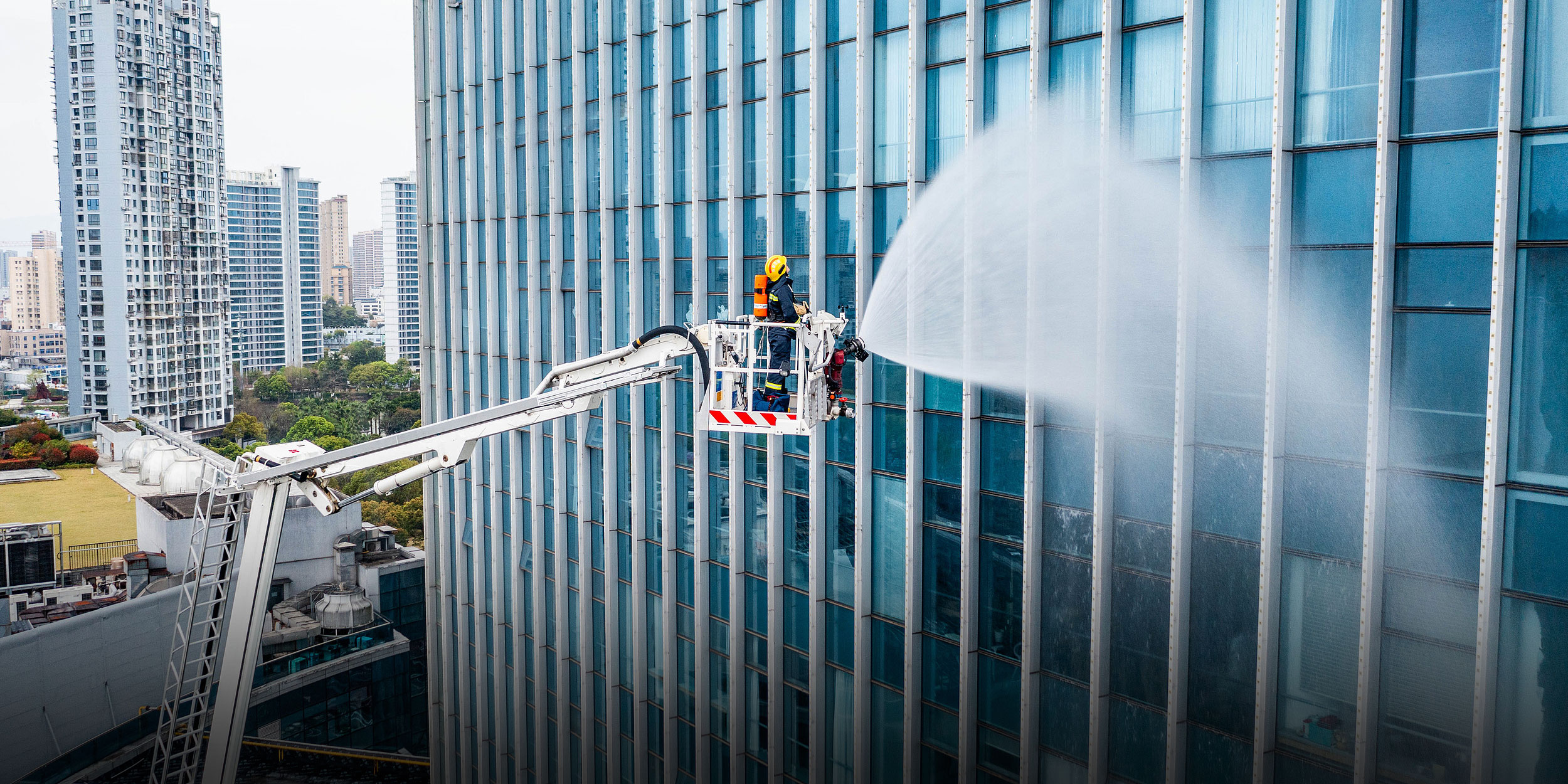
(Header image: A firefighter hoses down a high-rise building during a comprehensive firefighting and rescue drill in Wenzhou, Zhejiang province, March 28, 2025. VCG)