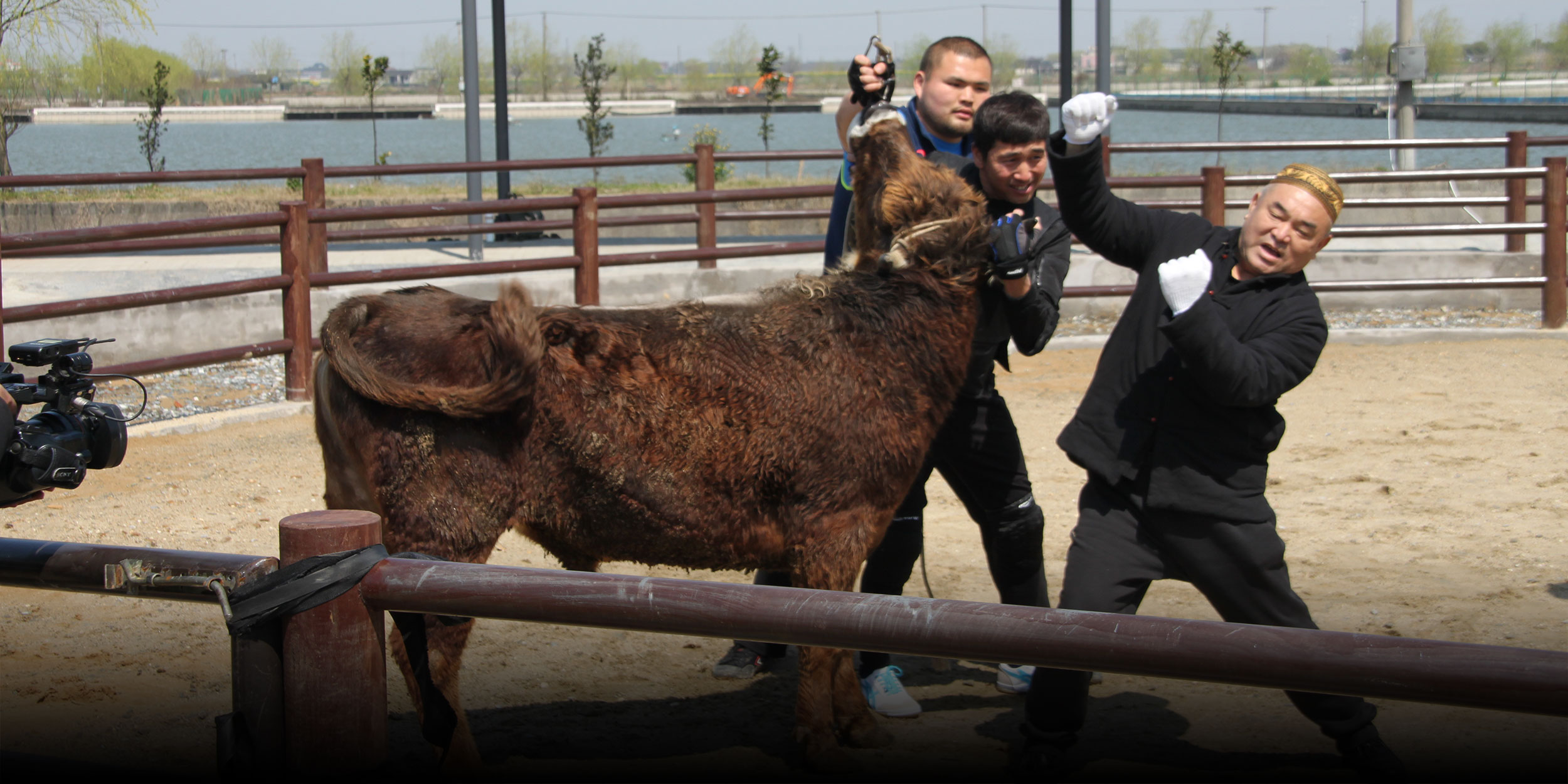
Muscle, Memory: Inside China’s Last Bull Wrestling School
ZHEJIANG, East China — Before wrestling a real bull, trainees at China’s last bull wrestling academy must first square off with a carved wooden head bolted to a courtyard wall. Lock the neck, shift the balance, stay clear of the horns.
“You have to twist the bull’s neck past 90 degrees,” says Master Han Haihua, standing nearby. “And you can’t go in head-on. You have to circle around.”
Months of drills on the wooden stand-in come before anyone is allowed near the real thing — 500 kilograms of muscle and instinct in a centuries-old Hui Muslim practice known as guanniu.
Today, that tradition survives in a single courtyard in Jiaxing, in eastern China’s Zhejiang province. Down one of its quiet back alleys, a wooden gate bears the sweeping calligraphy of the city’s most famous native, wuxia novelist Jin Yong: Chinese Bull Wrestling Academy.
Inside, 71-year-old Han — one of the tradition’s last living masters — has spent decades bringing guanniu back from the brink.
A Hui martial artist born and raised in Jiaxing, Han sees guanniu as an inheritance passed down over centuries. Though the Hui minority is more prominent in northern China, he says their roots run deep here. “We are descended from the Semu,” he says, using a Yuan dynasty (1279–1368) term for Central and West Asian Muslims brought to China as soldiers and officials.
For more than 700 years, Hui families in the region have practiced martial arts and staged guanniu matches during Eid al-Adha, a major Islamic holiday that often falls near China’s Dragon Boat Festival in late spring. Han also points to archaeological digs showing that cattle have been raised in the region for over 7,000 years. “Our bull wrestling tradition,” he says, “comes from both Eid and the long history of cattle culture here.”
For much of the 20th century, guanniu faded from public life, all but disappearing from public memory by the late 1970s. That changed in 1982, when Han brought it back to national attention, staging a match at the Second National Traditional Games of Ethnic Minorities.
Over time, the tradition regained attention. It was listed as intangible cultural heritage at the city level in 2008, then provincially in 2009, and nationally in 2011, with Han and his academy recognized as its formal custodians.
The rules are simple: if the wrestler brings the bull to the ground, they win. If time runs out and the bull is still standing, the bull wins.
Matches are typically held in spring, though the venue shifts — sometimes an arena, sometimes just an open field. Han sits with the judges’ panel, offering commentary like in a wrestling or boxing match. Around the ring, students perform traditional martial arts, part of a wider festival built around strength and skill.
In recent years, Han has used guanniu to build cultural exchanges. One year, a delegation of Maori participants from New Zealand joined the matches. Others have come from as far as Europe and Southeast Asia. “Attendees are generally martial artists, or sometimes strongmen,” he says. “People who are looking for a new way to challenge themselves and push their boundaries.”
Most of the action happens in spring, when matches are held and visitors pass through the academy. By October, the season has tapered off; the courtyard is quiet, and training is kept up by only a handful of students.
Outside the academy, Jiaxing faces its own struggle to draw visitors. The city sits in the shadow of bigger draws like Shanghai, Hangzhou, and Suzhou, and typically ranks in the middle tier for tourism in the region.
While Jiaxing has its share of canals, temples, and lakes, Han believes guanniu offers a tradition that exists nowhere else.
Yet for all the spectacle, preparing to face a bull is slow, physical work. The animals weigh approximately half a ton, and no one is allowed near one without weeks of training. Most participants arrive early, living in dormitories at the academy as they prepare. Those with martial arts or wrestling experience may progress faster, but everyone starts from scratch.
Alongside repetitive training on the wooden bull’s head, students practice traditional qigong exercises — breath, movement, and body conditioning — to build strength and prevent injury.
Only after weeks of repetition are trainees allowed to face a live bull, first under a coach’s supervision. The goal is to understand how the animal moves, and to stay calm in front of it. Later, if they’re ready, they go in alone.
The harder part, Han says, is the years of work before a bull is even ready to train. The animal must first learn to stay calm around people, respond to cues, and tolerate noise. “A bull has a temperament,” he says. “You cannot bully it into training. You must work with it.”
That kind of preparation takes time — and money. Each bull needs food, housing, and open space year-round, irrespective of whether matches are being held. Han says it takes at least five years to raise one properly, most of it spent earning the animal’s trust.
While Han also preserves other lesser-known martial traditions — including boat boxing and the ancient strength practice of yang dao — guanniu remains his focus, and the hardest to sustain.
Recognition as intangible cultural heritage brings legitimacy and some support. But it doesn’t guarantee funding, or a steady pipeline of new students. Much still depends on visibility, and on whether younger people feel these traditions speak to them strongly enough to commit years of training.
Urbanization, mobility, and endless new forms of entertainment, Han says, have made it harder for people to commit time and attention to ancient arts.
Bull wrestling, with its high costs, limited scalability, and inherent risks, faces particular vulnerabilities. It requires land, animals, long apprenticeships, and cultural framing, all increasingly rare and expensive in China. Yet it also represents a living link to the Hui community’s history in Zhejiang, and a part of Jiaxing’s identity that nearby cities can’t replicate.
Despite the challenges, Han remains cautiously optimistic. He believes guanniu can survive, but only if it continues to evolve in how it’s taught, shared, and understood.
Back outside the courtyard, Jin Yong’s inscription looms above the wooden gate. The novelist once described guanniu as a martial art where “the goal is not to kill the bull, but to win by stopping brutality with skill.”
For Han, that balance is what separates guanniu from spectacle, and why it’s worth keeping alive. For now, the tradition endures, for as long as he can keep teaching it.
Editor: Apurva.
(Header image: Han Haihua (right) at his bull wrestling school in Jiaxing, Zhejiang province, March 14, 2017. Courtesy of Han)