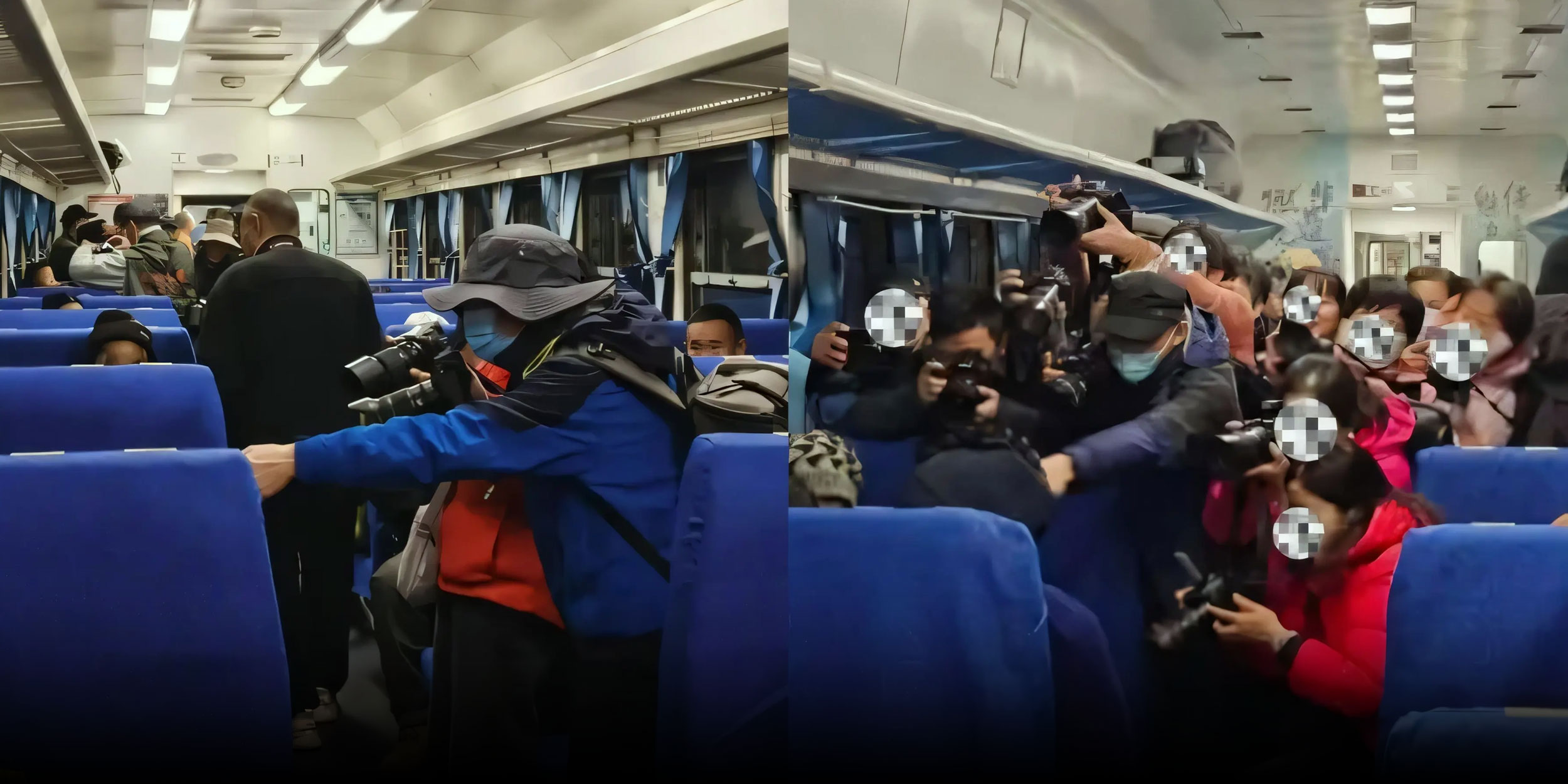
‘Lens Bullying’: Outrage Over Tourists Photographing Minority Women
A photo of tourists crowding an elderly ethnic minority woman on a train in China has sparked heated debate online about personal privacy and common courtesy in public. The incident, which occurred earlier this month on a slow passenger train in southwestern China’s Sichuan province, was captured by a fellow passenger, who posted a picture and caption on Xiaohongshu, also known as RedNote, on Nov. 18.
The image shows around a dozen individuals gathered around four seats where the woman of the Yi ethnic group is purported to have been sitting. Several of the onlookers appear to be holding DSLR cameras, apparently jostling to take pictures.
In the accompanying post, which has received over 6,500 likes, the observing passenger wrote that she too is a documentary film student but that she “... felt very uncomfortable that day, because a camera has a temperature — you can feel the difference between shooting with curiosity and shooting with feeling … I felt like they were placing themselves above others, looking down, treating people as curiosities.”
Numbering around nine million, the Yi people are one of the most populous ethnic minorities in China, and Liangshan Yi Autonomous Prefecture, where the train was passing through at the time of the incident, is designated as the largest Yi ethnic minority territory in China.
The witness, using the pseudonym Liu, told the central Hunan province’s Xiaoxiang Morning Herald that she was traveling on Train 5633 when she saw the woman dressed in what she recognized as traditional Yi clothing. After drawing the photographers’ attention, Liu overheard the woman saying, “Why do they keep shooting?” though she did not explicitly refuse.
During a separate incident on the same train, Liu described how tourists surrounded an older Yi woman carrying a back basket. Despite turning her face away and covering it, as well as saying not to shoot, the group continued to do so, some even using flash.
Many netizens have condemned the tourists for what they describe as “lens bullying.” One commenter wrote how some tourists seem to “treat other people’s daily lives as material for sensationalism and clicks, without ever trying to understand them.”
Running through remote mountains, Train 5633 is not a sightseeing route but a long-standing public service line linking Puxiong and Panzhihua in Sichuan province.
The 370-kilometer, 11-hour route was once known as a “poverty alleviation train” owing to its low fare, ranging from 2 yuan ($0.28) to 26 yuan, prices that remain consistent today. It remains a crucial lifeline for the Yi communities. Residents routinely use the train to transport goods and livestock, and it typically serves 700 to 800 passengers a day, approximately 90% of whom are Yi.
Speaking to domestic media on Nov. 22, Liu said the train increasingly attracts photography enthusiasts. As an amateur photographer herself, Liu said their behavior felt overtly disrespectful: they did not communicate, seek consent, or show concern for their subjects’ discomfort.
“(Amateur photographers) take advantage of the fact that many locals don’t speak Mandarin well enough to strongly object, and they act recklessly,” she told the Xiaoxiang Morning Herald.
According to Liu, a train attendant passed by the scene but did not intervene.
Local authorities have since acknowledged the incident. On Nov. 24, the China Railway Bureau in Chengdu, the capital of Sichuan, issued a notice stating that the train conductor had advised the tourists “to photograph in a civilized manner and not to disrupt normal travel order,” but that “train staff did not receive any requests for help from the person being photographed, nor did any disputes occur on board.”
Deng Haoxian, Ph.D. candidate at the School of Communication of Hong Kong Baptist University, told Sixth Tone that the act of staring at, and taking pictures of, people in the Yi community is a form of internet-age consumerism, exemplifying the romanticization of people and places by tourists and the preexisting inequalities faced by the Yi people.
“The cheap and slow trains afforded to the Yi people for their commutes have slowly been changed, along with the tranquility of their original lifestyles, by the rise in overtourism, and may even be forced to raise their prices, or even stop their service,” he said.
Editor: Marianne Gunnarsson.
(Header image: Screenshots of tourists taking photos of passengers from the Yi ethnic group, 2025. From Douyin)