Taste for Waste: Rare Bears Swap Hunting for Landfill Scraps
The night that herdsman Tenzin first locked eyes with a Tibetan blue bear, the animal was rummaging through piles of putrid waste, its paws digging furiously for scraps of rotten food. Its gaze held not an ounce of vitality, he recalls, “like a horror movie zombie.”
This wretched creature, which the 23-year-old had stumbled across as it dined at the local landfill, was a far cry from the “noble beast” that his grandmother had often told stories about.
Just on the horizon, Tenzin could see the neon lights of Jiajiboluo, a bustling town in China’s northwestern Qinghai province with four-star hotels and chain restaurants — and a key source of the food waste that appears to be changing the habits of these endangered wild bears, affecting their diet, socialization, and even reproduction.
Experts warn that as these natural hunters increasingly rely on scavenging, the ecological knock-on effects could destabilize the fragile ecosystems of the vast Qinghai-Tibet Plateau.
Getting their fill
The landfill — which is perched on a foothill nearly 5,000 meters above sea level — serves Jiajiboluo and the wider Zhidoi County, home to some 34,500 people. The active section of the site covers the equivalent of two soccer fields. It was opened about a decade ago to reduce the costs of transporting waste to treatment centers in the provincial capital Xining and the nearby city of Yushu.
In recent years, this dumping ground has developed an unlikely reputation as a “better place to spot bears than the zoo,” according to the locals. Even those who’ve never visited the site have videos of the countless interactions.
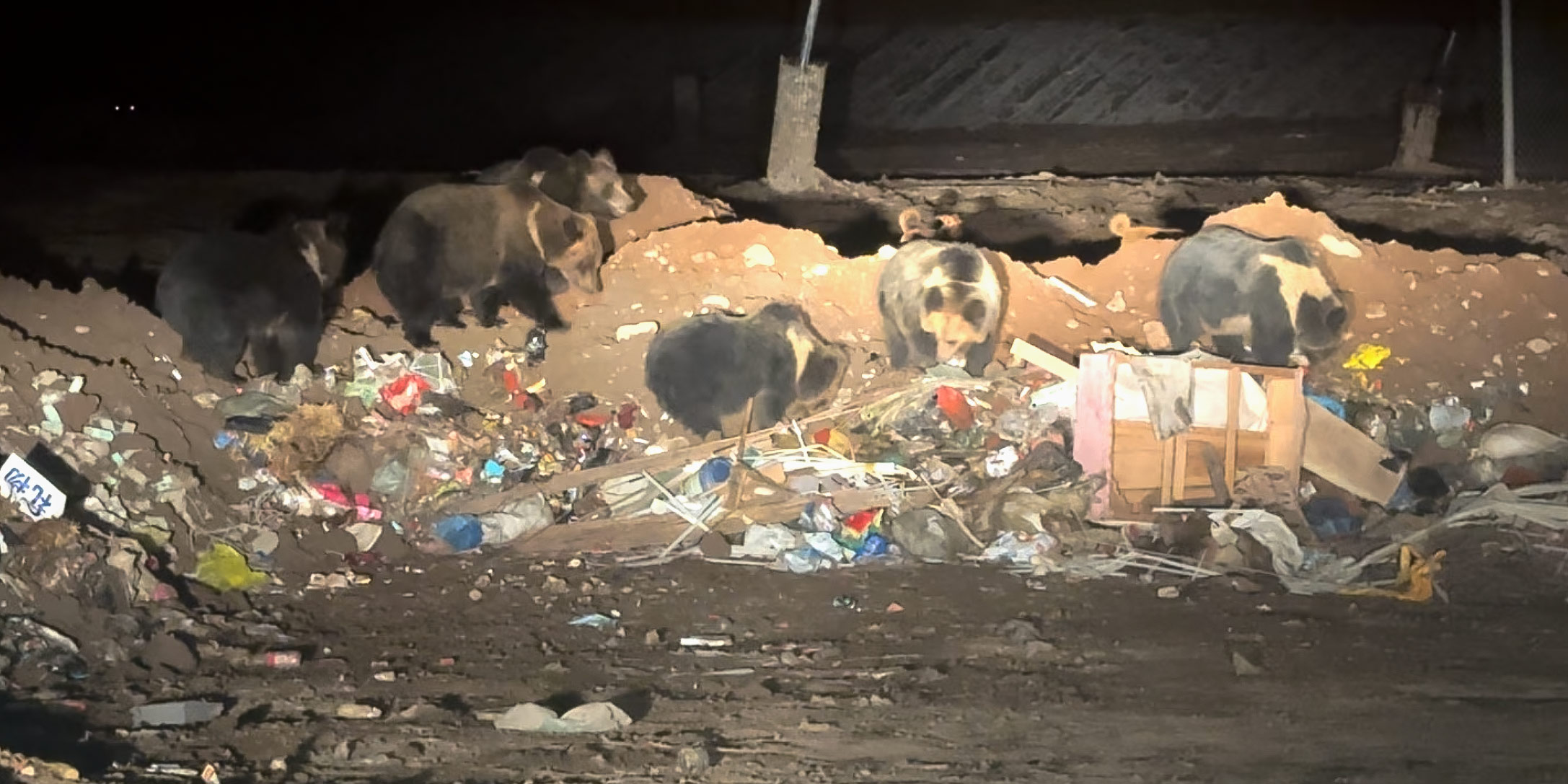
Staking out the spot one night, shortly before 8 p.m., the only sounds in the darkness are from dogs barking in the distance and the shuffling and sniffing emanating from a large, shadowy form. Suddenly, the headlights of an approaching vehicle illuminate a Tibetan blue bear, a rare subspecies identified by a thick ring of white neck fur.
Within half an hour, the bear is joined by at least 10 more, including a mother with two cubs. Each of them paws at the soil, exposing bags and cardboard boxes stuffed with pungent trash. Locals say it’s not uncommon to see more than 20 gathering here at once.
Like many counties across Qinghai, Zhidoi was once mostly inhabited by nomadic farmers, who would migrate with their yak herds between seasonal grazing grounds. They produced little trash — bones went to feed dogs, hides into rivers for the fish to nibble — and used mainly natural products in their dwellings.
Yet at the turn of the century, life here began shifting from nomadic to semi-nomadic, with some eventually settling permanently, driven by better education and work opportunities, and improved health care. As their populations surged, towns and counties expanded — and so did their waste volume.
Zhidoi has grown at least five times in size in just the past decade, according to an ecological researcher who requested not to be identified for this story. By using GPS tracking collars on Tibetan blue bears, he showed how their range now overlaps considerably with human activity.
Tenzin swapped life on the pastures for a permanent home in town 10 years ago. Of the more than 10 members of his family, only his sister and brother-in-law are still herding yaks. They live in a nearby kishlak, a traditional semi-nomadic settlement.
Even for pastoralists, convenience is now king. Packaged foods, which were introduced to the region only a few decades ago, are reshaping dietary habits that have existed for millennia. While many still enjoy a traditional breakfast of porridge made with roasted barley flour and butter tea, other mealtimes are dominated by instant noodles and fizzy soda.
Tenzin regularly eats his meals from single-use paper bowls and uses paper cups. “No washing required, and it doesn’t matter if you throw them away after use,” he says.
Contributing to the ever-accelerating waste volume is the growing preference for e-commerce and online takeout delivery services. By mid-morning most days, lines are already forming outside the parcel distribution stations dotted along the north bank of the Nieqiaqu River. “In two years, we’ve gone from one outlet to nearly 10,” says one station manager, adding that each handles 700 to 800 packages a day, and sometimes more than 1,000.
In its Government Work Report this year, the county said it had invested 7.48 million yuan ($1.05 million) in 2024 to purchase 137 sets of waste transfer equipment for villages and towns, stating that eliminating plastic and reducing waste was a top priority.
Anti-littering messages are ubiquitous, with street signage urging residents to “Tackle waste and embrace healthy living.” Plastic bags have virtually vanished from stores, replaced by biodegradable or cloth alternatives, despite costing twice as much.
Today, six trash compactors and nine trucks make four to five daily rounds, collecting from more than 2,000 homes and businesses. Small sanitation vehicles also ply constantly, and orange-vested street cleaners are never far from sight. Official logs from August show that 36 tons of solid waste were delivered to the landfill daily in the summer.
In addition to the compactors and trucks, private vehicles are also allowed on site. Tenzin says his brother-in-law drives to the landfill once a month to dump his family’s trash and has spotted foraging bears several times. “They love licking those food packages — strong smells and leftovers,” he adds.
Unwelcome guests
In the afternoon sun, a sour stench hangs over the landfill, but further up the hill the wind carries a strong odor of bear scat. Droppings, paw prints, and worn grass trace a path toward the ridge, where a section of wire fence has been torn apart.
“It’s a clearly defined animal trail,” says researcher Zhou Peng, who has been studying biodiversity and human-bear interactions on the Qinghai-Tibet Plateau since 2017. He often finds bits of chili, glass, and candy wrappers in the bear droppings.
He explains that fecal analyses have also revealed evidence of microplastics, mainly from bottles and woven bags. “Long-term ingestion will inevitably harm the bears’ health,” Zhou warns.
According to state regulations on landfills for municipal solid waste, sites should be entirely enclosed by perimeter walls or fencing, while working surfaces should be covered daily to ensure no refuse is exposed for extended periods.
However, observers say that sites across Qinghai’s Yushu Tibetan Autonomous Prefecture — of which Zhidoi is part — fail to meet these standards, either because of the costs of fencing or the scarcity of soil on the plateau for covering the waste.
Some even argue that keeping learned, adaptive bears out of a high-altitude landfill might be near impossible, regardless of these measures. A volunteer at a landfill in Yushu with electrified fencing says he witnessed a bear rush the wire to break through, undeterred by the painful shocks it received.
“We always used to say, ‘If you don’t bother them, they won’t bother you.’ Even if you came across a bear on a mountain, they’d likely run away in fear,” says Tenzin. “But in the past 10 years, they have grown bolder.”
His brother-in-law sees bears roaming near his kishlak almost daily and is woken in the night by the screech of claws on sheet metal at least once a week. He’s taken to leaving snacks outside “like a good host,” and shouting before entering his home to avoid encountering an unexpected furry guest.
Human settlements, with their food stores and kitchen waste, have altered the natural hunting behavior of bears, transforming them from predators into scavengers.
According to research by Wu Lan, a zoologist with a Ph.D. from Peking University, the cost-benefit ratio of seeking out human food is 70 times that of hunting and eating a marmot, which requires digging up 1 cubic meter of soil on average.
Local herders say the bears have visibly increased in size — “They were lean and long, but now have round bellies,” says one — and are converging at the landfill in groups, sometimes as many as six, despite being solitary and territorial by nature. The fact that they are active at night is also a change from their typical behavior.
Reproduction patterns are shifting too. Females typically had one or two cubs per litter, but Zhou’s cameras have recorded some with three, a possible response to environmental factors and changes in food availability.
The head of an ecological conservation organization in the plateau’s Sanjiangyuan region says more mothers are bringing their cubs to the landfill and even teaching them safe routes down steep slopes, pointing toward a growing dependence that could erode their hunting instincts.
In Tibetan culture, bears symbolize good fortune. However, the frequent encounters and damage in recent years have reshaped local perceptions. While most herders remain committed to traditional beliefs on coexistence with nature and express pity for the bears, some now see them as mere pests.
After finding a hole that a bear had made in his bedroom wall, Tenzin bought an electric fence online to install around his family’s home. “At 220 volts, it won’t kill, but it’ll teach a lesson,” he says.
Rodent problem
From an ecological standpoint, changes in the bears’ behavior could have wide-reaching repercussions. Herders have already noted an explosion in the pika population.
Pikas — small, burrowing mammals that prefer environments where grass is mixed with exposed soil — have in recent years been blamed for soil degradation on the plateau, as the mounds they create can affect plant growth.
Tenzin says his summer pasture was once lush with shin-high grass, but is now pocked with pika mounds, causing it to become sparse and brittle. “When the cold wind blows, this will all be gone,” he sighs, pointing to the vegetation. “Nothing will grow. What will the yaks eat?”
Herders recall almost daily sightings of bears digging on the hills for marmots and pika, but now it’s rare. Zhou believes a long-term reliance on human food and trash could see rodent populations become uncontrollable, leading to further grassland degradation and destabilization of the plateau’s fragile ecosystem.
Though not all researchers draw a direct link, most agree that if this apex predator alters its behavior significantly, the ripple effects through the food chain could be profound and unpredictable.
For now, one thing is guaranteed: bears will continue to return to the landfill, night after night.
(Due to privacy reasons, Zhou Peng is a pseudonym.)
Reported by Cong Zhixiang.
A version of this article originally appeared in The Beijing News. It has been translated and edited for brevity and clarity, and is republished here with permission.
Translator: Kiong Xin Xi; editors: Wang Juyi and Hao Qibao.
(Header image: Bears rummage through waste at the local landfill in Zhidoi County, Qinghai province, Sept. 21, 2025. Cong Zhixiang/The Beijing News)