China’s Security Guards Live Lives on the Margin
This is part two of a two-part series on urban China’s security guards. Read part one here.
Over the past few decades, Chinese cities have grown bigger and richer at a breakneck pace. This, in turn, has given rise to what has become the norm for Chinese urban housing: gated communities that are protected by security guards.
Initially to keep out crime, and increasingly to keep up property prices, urban Chinese residential communities have pushed up the demand for guards to such a degree that it has spawned a sprawling private security industry. It now employs more than 6.5 million people — almost all men.
In China’s largest cities, security workers have become unavoidable in daily life. Leaving or coming home will mean passing through the gates they oversee. Where you can go in a city is often limited by whether a security guard will let you in. This indispensable social role is why I decided to research security guards in Chinese residential communities for my dissertation in cultural anthropology. (To protect my sources, the names of individuals and residential communities are pseudonyms.)
Despite security guards being central to urban Chinese society, they also live on its margins. In part to keep up with skyrocketing demand, private security companies have lowered their requirements for guards. So much so that it is now considered a job of last resort for migrant men who lack professional skills, capital, connections, or qualifications.
Security guards today are often people from outside the city who lack a local household registration — the all-important hukou — and are not well paid. They live unstable and anonymous lives. As a result, these guards are often looked down on and even seen as security risks by the residents and property managers whose homes they are meant to protect.
Homeowners sometimes project their anxieties onto those who are supposed to make them feel safe. As a private space for rest and relaxation, one’s home is meant to be the ultimate fortress against outside risks, while security guards have been invited by the property owners precisely to alleviate their security concerns. However, the significant socioeconomic gap between security guards and residents, combined with their close physical contact, makes many residents feel anxious and fearful.
One female homeowner I spoke to expressed her worries to me: “Think about it, the security guards know everything about us. They know how many people are in my family, when our children are at home alone, when I go to work, and when I go on vacation. What if one of them is a criminal? It’s terrifying, because we don’t know anything about them at all.”
But while academic interest — as well as my first article in this series — has focused on such fears and anxieties of middle-class homeowners, these “objects of fear” have their own fears and concerns. To demonstrate, let me introduce you to two security guards — Xiao Bing and Huang Jiaguo.
I first noticed Xiao Bing while watching the night-shift security guards’ evening training in the underground parking garage of Dadi Community, a residential community in central Shanghai where I conducted research. At just over 1.5 meters tall, he was the smallest of the guards. His oversized uniform made the 30-year-old look like a teenager. Later, when chatting with him in the guards’ dormitory, I noticed that his hands were constantly trembling. If he carried a full glass of water across the room, half of it would end up on the floor.
Cheerful and talkative, Xiao Bing told me that he was one of six children from a poor village near Fuyang in Anhui, an inland province close to Shanghai. After his parents divorced, he and two of his siblings went to live with their mother, who remarried and moved to another village. The new family struggled on the poverty line and often didn’t have enough to eat.
After finishing primary school, Xiao Bing did not continue his studies but learned to repair bicycles. He told me that, in 2008, he moved to Shanghai and set up a small bicycle repair stall on the street. Business was promising at first, but about a year in, he began to notice his hands were trembling for no apparent reason. The problem became worse over time until he could no longer do any manual work.
In the years that followed, Xiao Bing spent nearly everything he earned on doctor visits and medicine. Nevertheless, his condition continued to deteriorate. In 2016, he found a job as a security guard in Dadi Community. He told me that he really enjoyed the work — and also the sense of community, living and eating together with dozens of other guards.
In early 2018, Xiao Bing was working nights. One day, he was out buying groceries when he realized he had lost his wallet, which contained cash, bank cards, and his ID. He had no choice but to go to the police station to apply for a replacement ID. The officer checked his information in the computer system and found that he’d been arrested nine times and administratively detained five times across Shanghai for stealing e-bikes.
As soon as Xiao Bing left the station, the officer called Dadi Community’s property management office and informed them of his criminal record. The property manager was furious. One of the guards’ most important tasks was to prevent e-bike theft. If the homeowners found out that one of the guards had a record as a serial e-bike thief, it would be a huge scandal for both the property management and security guard companies.
Xiao Bing was fired that same day. The head security guard, A’de, lent him 300 yuan ($42) to buy a train ticket back to his hometown. The incident left some of the other guards wondering whether Xiao Bing’s oft-told story about having been a bicycle repairman had been true. Did he turn to stealing after becoming ill and losing his livelihood — or had the repair stall been a fabrication, and he’d been just stealing e-bikes in Shanghai before becoming a security guard?
No one — myself included — knew for sure. Despite living on top of one another for years, the guards knew almost nothing about each other’s pasts. But they vouched for their former colleague: During the two years Xiao Bing worked as a security guard in Dadi Community, he had not broken any laws.
More than a month later, I messaged him on WeChat to ask where he was now. Instead of typing, he immediately called me. “I’m in Beijing now,” he said excitedly. “I couldn’t find another job as a security guard in Shanghai, but I’ve found one in Beijing.” He explained that although his new job’s monthly salary was 800 yuan less than at Dadi Community, it did provide free accommodation and three meals a day.
I had assumed that I wouldn’t hear any more news about Xiao Bing. However, a few months later, one of the other guards mentioned that he’d returned to Shanghai and was working as a security guard in a different community.
According to the current regulations concerning security services in China, security guards are required to meet three basic conditions: be in good health, have at least a junior high school diploma, and have no more than three administrative detentions on their record. Despite not meeting any of these criteria, Xiao Bing has always managed to find his way back into the industry. The reason is simple: companies often struggle to recruit enough guards for residential communities, given the low pay, lack of career prospects, and low social status.
Xiao Bing was the only security guard I met at Dadi Community who had a history of theft. In contrast, Huang Jiaguo was considered a model security guard, having received several commendations from the community’s security team. He was also one of the few guards I interviewed during my research who showed a genuine passion for and had a sense of pride toward his work.
Huang came from an impoverished village in Liaoning province, in northeastern China. He spent his 20s working on construction sites. But after a decade as a plasterer and tiler, he developed back issues and other health problems. At 36, he switched careers and became a security guard in Beijing. Two years later, he took a job as a security guard for a year on a cruise ship that sailed between Shanghai and Hong Kong and Macao. After that, he moved to Shanghai, working in several residential complexes before finally settling at Dadi Community.
In 2017, a family in the community returned from their summer vacation and accidentally left a backpack containing over 20,000 yuan in cash, two laptops, and three passports outside their building. Huang found the bag while on patrol, tracked down its owner and returned it. To express his gratitude, the homeowner gave him 300 yuan and presented him with a velvet banner recognizing his honesty and integrity.
One evening not long after that, Huang came across a wallet in the community containing credit cards, an ID card, and a business card. He called the number on the business card and got in touch with the owner, who also sent a banner to the security guards’ office the next day to express his thanks.
For the property management company, the two banners Huang received in such quick succession were evidence of their excellent service, and so they invited a local TV station to interview him. In fact, during his first seven months working in the community, Huang recovered numerous items, including several of value, lost by residents. His colleagues all envied his “good luck,” yet I couldn’t help but wonder: the security guards patrolled every part of the community each night, so why was it always Huang who found these items?
It wasn't until I joined him on one of his night patrols that I finally understood that he was more hard-working than simply lucky.
One chilly night in the early spring of 2018, we walked along the dimly lit paths in Dadi Community. As Huang answered my questions, he constantly scanned the ground with his flashlight. Suddenly, he bent down and picked up a coin. The area was so dark that I couldn’t help but admire his eyesight.
While Huang seemed content with his job, he also had his worries. Single and over 40, he’d like nothing more than to find a partner. He told me that although he’d had several girlfriends in the past, they only seemed to enjoy the effort he put in and weren’t interested in marrying him. After spending a lot of money on gifts, they’d invariably break things off, saying that they just didn’t feel a connection.
Despite this, Huang remains hopeful that he can marry a local woman so that he can start a family and remain in the city he loves. “Both of my parents have passed away, and I don’t have any children,” he said. “I could move into her home, help care for her parents, and our children could take her surname. Everything I earn as a security guard could go toward supporting our family. I don’t care if she’s been married before or has children. My only requirement is that she’s healthy, both mentally and physically. As long as she can warm the bed and cook for me, that’s enough.”
I asked how he planned to meet such a woman in Shanghai.
“There’s the internet — WeChat, QQ,” he replied. “I don’t sleep during the day, so if I find someone online who’s interested in meeting, I have plenty of time.”
Huang is still living in Shanghai, still working as a security guard and still single. But with digital payments now having almost completely replaced cash, I sometimes wonder if he ever finds any loose change during his night patrols.
Translator: David Ball; portrait artist: Wang Zhenhao.
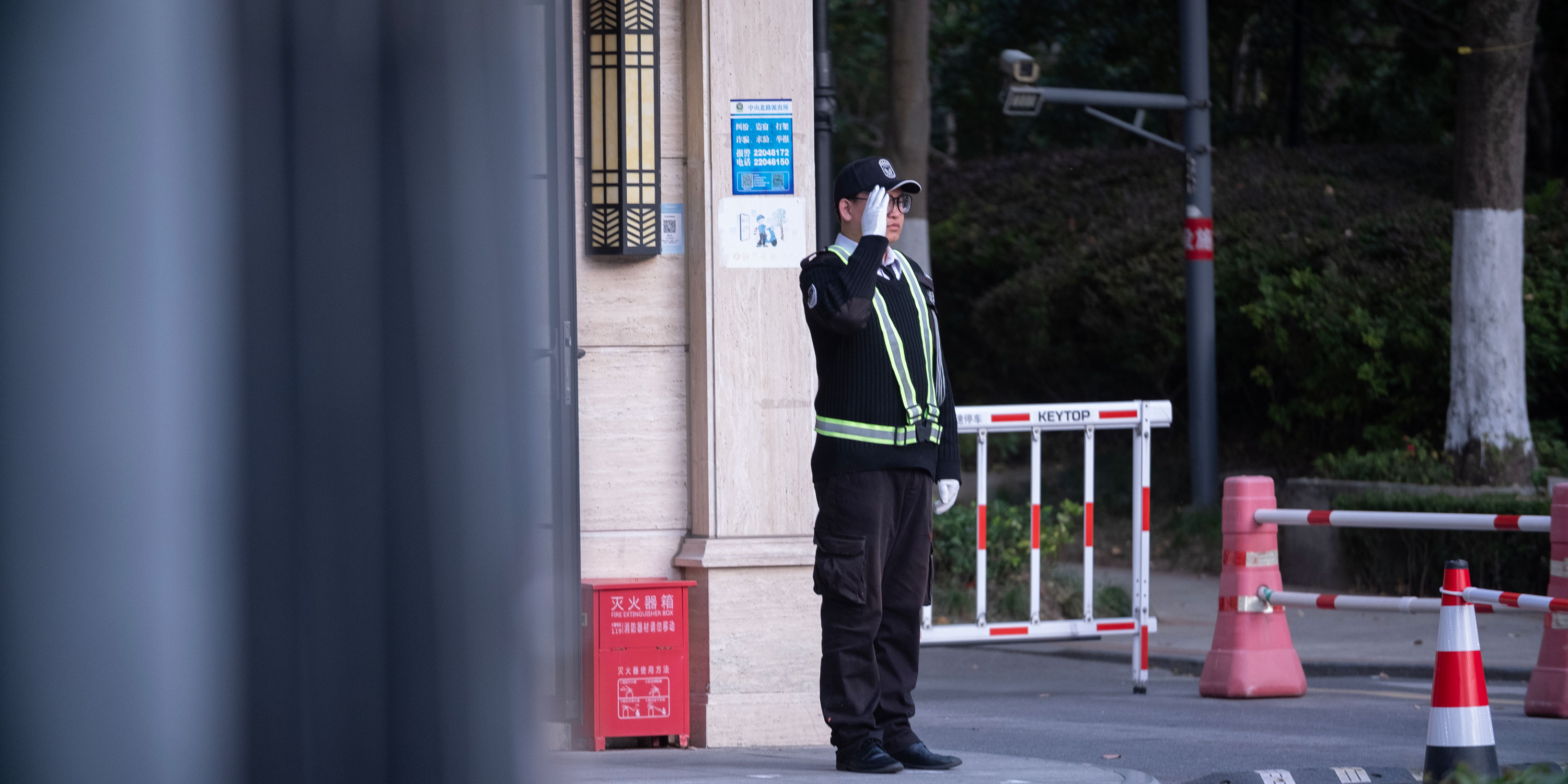
(Header image: A security guard salutes a homeowner, Shanghai, November 2025. Wu Huiyuan/Sixth Tone)