The Class Anxieties Behind China’s Millions of Security Guards
One morning in the fall of 2016, a young man dressed in black was wandering around the Dadi residential community in central Shanghai. For several hours, he anxiously talked on his phone as he observed the people passing by. He knew that his ex-girlfriend was renting an apartment there. Security guard Liu Yong, who was on patrol that morning, noticed him.
Around noon, a young woman and a man came out of a building. The man dressed in black headed directly toward them and pulled a knife out of his pocket. Recognizing the menacing face, the woman started screaming and ran to a nearby grocery store. While she pleaded with a shop worker for help, the man in black had already killed her companion.
Liu was the first person to arrive on the scene, quickly followed by other security guards. The victim was lying on the ground covered in blood, while the murderer was attempting to pry open the shutters that the grocery store had rolled down to protect the woman. Liu was terrified and could only recall calling the police and an ambulance. The murderer was caught later that day at a railway station.
In 2018, I talked to some of the security guards there about the incident. At that time, I was conducting research in the community as part of my cultural anthropology dissertation on security guards in Chinese residential communities. (To protect my sources, the names of individuals and residential communities are pseudonyms.)
I had selected security guards as my research subject because they had become an indispensable part of Chinese urban life. In Chinese cities, nearly all homes — regardless of whether they are upscale or affordable, apartment or freestanding — are inside gated residential communities protected by security guards.
As I chatted with the guards in their office during their lunch break, I casually mentioned, “If you’d arrived earlier, maybe you could have saved the man.”
“Are you kidding?” Liu said. “How could we possibly stop a crazed killer? We don’t even carry a stick.”
I asked the guards what they would do if they encountered a situation like that again.
“Run, of course!” replied a young guard, after which the others burst out laughing.
Looking back, I realized that this interview touched on one of the core findings of my research. Their name implies that security guards exist to provide security. I had expected to observe how they responded to dangerous situations and kept people safe, but the reality was quite different. As Chinese cities have gotten safer, what security guards are protecting most of all is property prices and the class status they imply.
When guards first began to appear in Chinese residential communities, security was indeed their purpose. From 1990 to 2010, due to the widening gap between rich and poor, the rise in population mobility, and a shortage of police officers, the crime rate in Chinese cities increased. Burglary was a frequent concern.
The fear of crime led many ordinary citizens to install metal bars over their apartment windows. My parents even hung a police uniform — which they had somehow gotten hold of — on our balcony in the hope of deterring would-be criminals.
During that same period, China liberalized its urban housing system, gradually moving from people being allocated homes by their work units to people buying homes on a housing market. Property developers answered the demand for ever-nicer homes. Increasingly, what they built were gated communities — a response both to crime fears and government policies that sought to make homeowners responsible for neighborhood maintenance.
Existing communities also erected walls. If one community is not enclosed, while all of those surrounding it are, then it likely becomes a target. These walls and their gates also needed to be guarded. Especially middle- and upper-class homeowners wanted 24-hour security protection to ensure the safety of both themselves and their property.
In subsequent years, crime in Chinese cities has dropped significantly. In 2016, China’s homicide rate was 0.62 per 100,000 people, one of the lowest in the world, while major violent crimes dropped by 43% between 2012 and 2016. The murder Liu responded to was the exception, not the rule.
But that doesn’t mean the middle class’s yearning for heavily guarded gates has diminished. In somewhat of a contradiction with dropping crime rates, the private security industry has continued to flourish. According to the China Security Association, as of July 2021, there were over 13,000 security service companies and more than 6.4 million security guards nationwide.
Security guards are increasingly hired mostly out of other considerations. When I interviewed dozens of Dadi homeowners and asked them to name the most important issues for their community, crime rarely made the top three.
Instead, security guards are now the answer to different fears. The commercial mindset tied to real estate development is rooted in the deep anxieties of China’s middle class about losing their economic status and class identity. During the decades when housing prices in Chinese cities soared, a home became most families’ most important asset. As such, homeowners are extremely sensitive about any factors that might lead to a decline in property prices.
The focus of my research, Dadi Community, is a typical mid-to-high-end residential community in Shanghai. The homeowners there can generally be classified into three types: locals who bought their properties many years ago, affluent outsiders who bought apartments as investments, and highly educated migrants who have settled in the city.
Because of this diversity of Dadi’s inhabitants, as well as its chaotic management and maze-like layout of high-rises, people have long jokingly referred to the neighborhood as a “slum” or a “jungle.” This negative image has directly led to the price of apartments here being lower than those in similar communities nearby.
The community’s homeowners believe that the root cause of this is substandard property management. Dadi’s management team is too small, there are too many non-residents using community facilities, and too often apartments are illegally subdivided into individually rented-out rooms. In their minds, these factors have led to the continuing depreciation of their beautiful gardens and imposing high-rise apartment buildings.
Another concern is that Dadi’s security guards are too old. The issue is not that they are too frail to protect people; it is that a slovenly security team affects property values. Though Dadi homeowners are only somewhat concerned about crime, they desire a team of athletic-looking, well-trained security guards for what they signal to the outside world: here live well-to-do people in expensive houses.
Security guards’ work reflects their true purpose. Their job is about keeping a residential community not so much safe but orderly — without stray animals, left-behind shared bikes, construction waste, or people who don’t belong. As one of the Dadi security guards said to me: “The best thing about the job is that it’s not difficult, but the worst thing about the job is that it’s not difficult.”
Security guards have become a subtle means of shaping class identity and drawing boundaries, while also concealing homeowners’ true unease — their concern about the decline of their economic status. The demand for security guards today therefore continues to be fueled by fear. However, it is not so much fear of violent crime, but of downward social mobility.
Translator: David Ball; portrait artist: Wang Zhenhao.
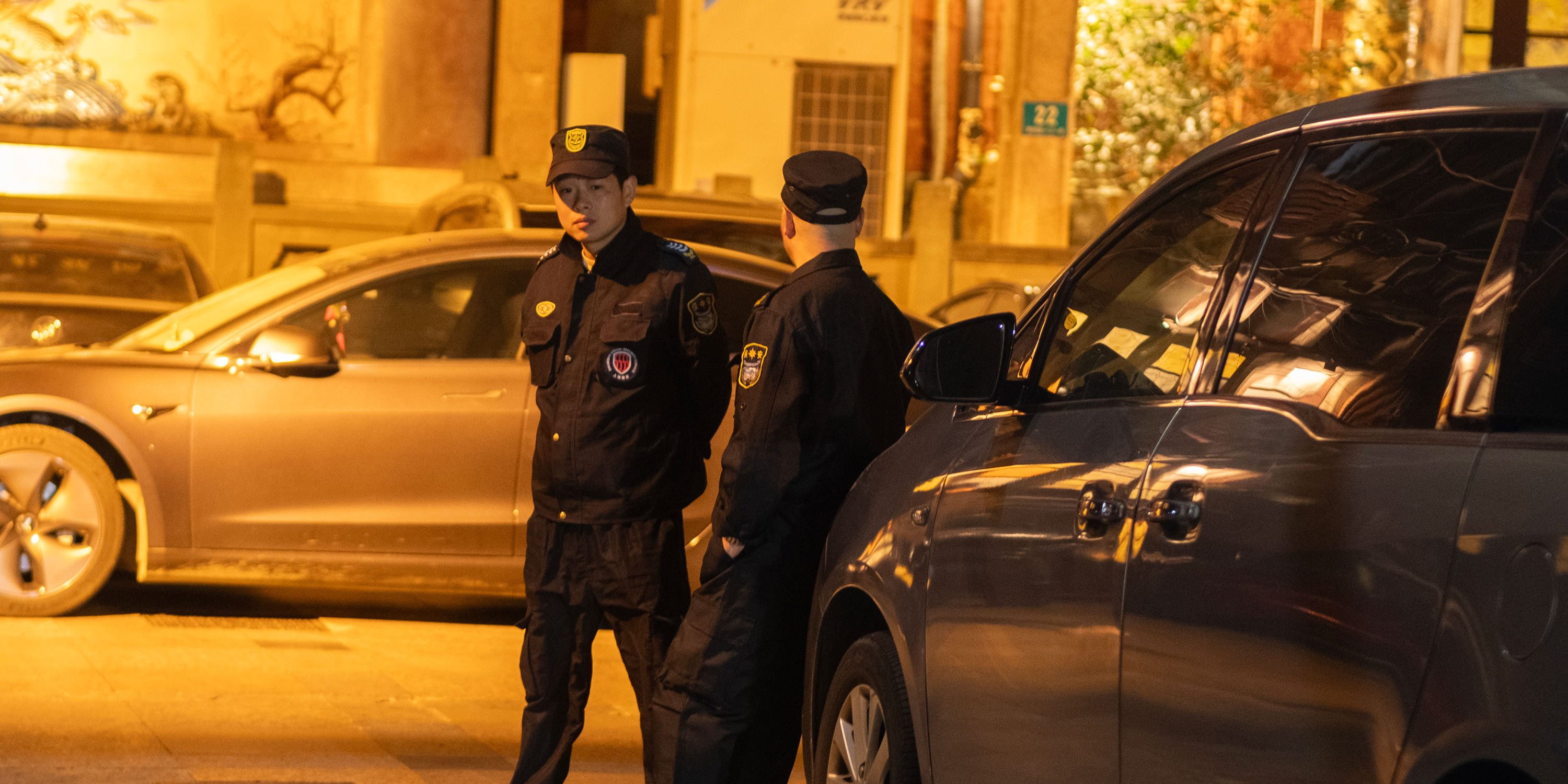
(Header image: Security guards at work in Shanghai, November 2025. Wu Huiyuan/Sixth Tone)