A New Leaf: China’s First Autumn Break Triggers Travel Boom
Chinese tourist attractions have seen a travel boom this month as many primary and middle school students hit the road for their first-ever autumn holiday.
Several provinces, including eastern Zhejiang, southwestern Sichuan, and southern Guangdong, have implemented a three-day autumn break, totaling five days combined with the weekend, for primary and middle school students in November — a measure new to China but common in the West.
These provinces are the first to follow a new guideline issued in September by nine central government departments including the Ministry of Commerce and the Ministry of Education, which encourages localities to adjust academic calendars to include spring and autumn breaks according to factors such as each province’s specific climate and industry production schedules, a major determining factor in parents’ time off.
Apart from better distributing the school calendar, the policy also aims to increase the time for economic consumption, such as via domestic travel.
Tourism bookings in Zhejiang, where the new autumn break holiday began on Nov. 12, had doubled compared to last year, with parent-child trips accounting for 46% of the total trips, according to data from online travel agency Trip.
As well as providing holidays for children, Yang Han, a researcher at Chinese online travel platform Qunar, told local media that the change has been implemented in tandem with measures to support family travel during the new break. These include flexible work leave policies and family admissions discounts at museums, science centers, and scenic spots.
Amid the travel boom, trips built around visiting locations featured in textbooks — from historical sites to natural attractions — are emerging as a top choice for families as parents seek inspiration for trips beyond the classroom.
Tian Tian, an 8-year-old from Jiaxing in Zhejiang, had long dreamed of visiting Huangshan Mountain in neighboring Anhui province, the Grape Valley in the northwestern Xinjiang Uyghur Autonomous Region, and Taiwan’s Sun Moon Lake — destinations featured in classic literature and her Chinese textbooks.
She finally made it to Huangshan Mountain last week during the newly implemented autumn holiday. The UNESCO World Heritage site is renowned for its “four wonders”: peculiar granite peaks, ancient pines, hot springs, and the “sea of clouds” phenomenon, in which low-lying clouds render the area’s mountain tops like floating islands.
“In second grade, Tian Tian had just learned about Huangshan’s famous rocks and, through extracurricular reading, about its ‘four wonders,’” her mother Lu Haiping told Sixth Tone.
Lu added that visiting will leave a far deeper impression than reading about it in a textbook. “I hope that when (my children) face challenges in school or life in the future, they will remember this adventure.”
“Reading without venturing into the world leads only to empty imagination, while traveling without reading often leaves you with little more than having ‘been there,’” another mother who recently took her fourth-grade daughter to the famous Double-Dragon Cave in Zhejiang told Sixth Tone.
“To experience and travel is to engage in a three-dimensional form of reading,” she said.
Editor: Marianne Gunnarsson.
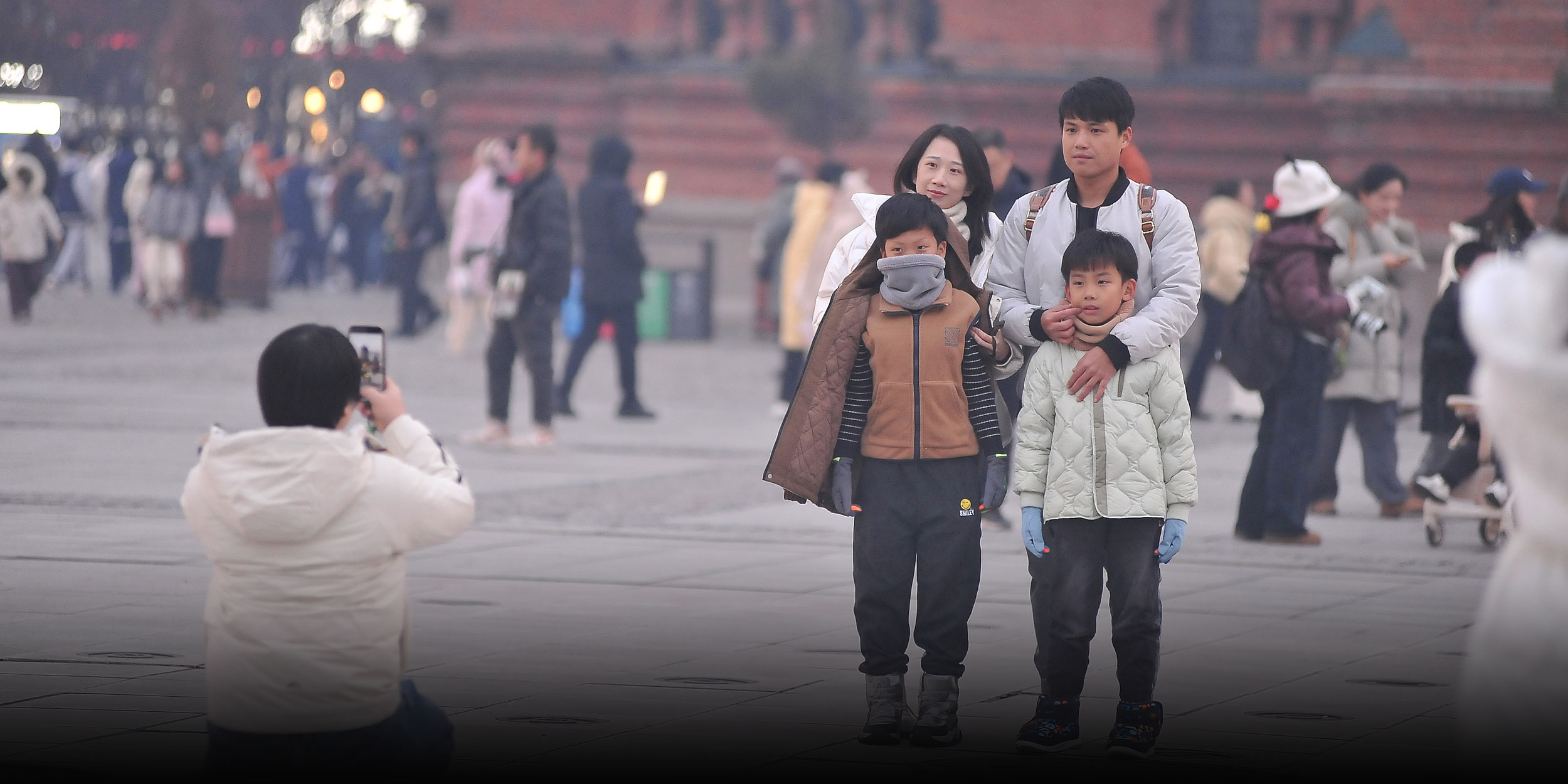
(Header image: A family poses for a photo in front of the Saint Sophia Cathedral in Harbin, Heilongjiang province, Nov. 12, 2025. VCG)