Guarded Looks: China’s Gatekeepers Bring Status and Suspicion
Editor’s note: True-crime blogger and mystery novelist He Wapi this summer released “Strangers at the Gate,” a book looking at the role of bao’an, China’s neighborhood security guards. The work is based on research she conducted in 2017 at a large residential community in Shanghai — which she identified as “Dadi” — while studying for her Ph.D. in anthropology at the University of Wisconsin–Madison in the United States. Following is a conversation between He and The Paper.
The Paper: This book brings to mind American sociologist Peter Bearman’s “Doormen.” Are his doormen in any way comparable to China’s neighborhood security guards?
He: The doormen he writes about and China’s bao’an share one similarity — their socioeconomic status differs greatly from that of the residents they serve, yet they are in close proximity. This is determined by the class to which people in this occupation belong and by the nature of the work.
However, the two jobs differ greatly overall. In the United States, the doormen described by Bearman are generally only in large cities, and their work is relatively simple — registering residents, opening doors, and handling mail; they don’t even have to deal with parking. In contrast, security guards in China’s residential communities usually have more complex duties, especially in large developments with many residents, where they can perform a great deal of the physical labor and miscellaneous tasks.
A few high-end, gated communities in the U.S. have security guards on duty around the clock. These are professionals — often trained, armed, and specifically responsible for patrolling the area. Bao’an are somewhat a combination of American doormen and security guards, but they lack professional training and specialization.
The Paper: Your book touches very little on the interactions between security guards and residents.
He: Bao’an are mainly at the entrances of residential communities and patrol public areas, rather than stationed at one building, so physically they are already somewhat removed from the residents. They have few opportunities to serve residents in close proximity on a daily basis. When they do, these interactions tend to take place at the main gate or while managing a parking situation.
Sometimes residents have special needs, such as when they want to move something large but can’t find anyone to help, and they might turn to the security guards, but this isn’t routine. Some high-end residential communities also now have concierges, who serve like property managers and interact with residents more frequently. My research focused on a residential community that outsourced its security services to a private company, and all the guards were migrant workers. But in my book I also mention older neighborhoods that still employ local residents — where my parents live, for example. There, security guards interact more with long-term residents like my father; they often smoke and chat together after dinner.
The Paper: You saw Dadi’s property management office outsource security to a private company employing migrant workers, who often faced unfair treatment including low pay and excessive working hours. What prompted the switch?
He: Changes were happening in many areas at that time, with the outsourcing of landscaping, cleaning, and security services. This shift was related to changes in the security industry. In the past, only state capital could be used to establish a security company, but in early 2010 the market was officially opened to private capital. Since then, many private security companies have emerged, and the industry has flourished.
However, private companies were unable to secure contracts for places like banks or government buildings, so they focused on residential communities. In addition to promising to cut costs, they advertised their guards as being able to provide more varied and better services compared with locally hired bao’an.
For the property management office, cost considerations were the most important factor, of course. I even did the math — after outsourcing, they saved a large amount of money and were freed from the responsibility of compensating for any accidents or injuries suffered by the security guards. But it wasn’t solely about economics; outsourcing also reduced their workload.
Residents, particularly younger ones, also prefer these new security guards because they are usually more disciplined. For example, the bao’an at Dadi weren’t allowed to play on their phones or smoke while on duty, which the previous security guards would do. The difference in service quality means residents will urge property management offices to make the change.
The Paper: In truth, security today is largely maintained through the use of technology such as surveillance cameras, rather than guards. So are bao’an merely a formality?
He: Their work is, in part, kind of a formality. I discuss in my book why the market is obsessed with young, tall guards, and it’s because youth and height are scarce resources in an industry with low social status, so a community that has them can distinguish itself from others. The guards at the gate are the “face” of the neighborhood, like the stone lions that stood at the entrances of residences in ancient China, symbolizing the owners’ status.
However, bao’an aren’t purely a formality; their work has practical functions. The job is like that of a handyman: they do a bit of everything, mainly light physical labor, which is suitable for middle-aged or older workers and those with limited education. Of course, the situation varies depending on the residential community. High-end neighborhoods have dedicated cleaning, landscaping, and maintenance teams with specialized personnel. But in large yet not particularly upscale communities like Dadi, many miscellaneous tasks fall to the security guards.
Is there a better name for this kind of occupation? Their main function is still gatekeeping, but beyond that, many additional responsibilities are now attached. At the same time, some guards are assigned to patrol rather than stand in place, so calling them doormen wouldn’t be appropriate. As for those in the industry, they prefer to call this work security services, as “security” sounds professional and caters to the anxieties the middle class have about safety.
The Paper: As you point out, youth and physical appearance seem to be valued most in security work. What does this phenomenon signify about modern society?
He: In the cities, we have aging populations, plus there’s been a decline in the number of migrant workers since around 2014 due to the rising housing prices and cost of living. Together, these factors have made young, tall, and good-looking security guards increasingly scarce.
Young people are unwilling to enter occupations that are seen to lack dignity or have low social status. This is related to the expansion of university enrollment — every family hopes their child can obtain a college degree. As a result, many young people, after earning a diploma that may not carry much weight, are reluctant to take on physical labor; they won’t become security guards. Many types of labor that require technical skill, such as renovation or construction work, are done mostly by middle-aged and older workers, while young people compete for white-collar jobs that often pay relatively low monthly salaries. This makes it difficult for the security industry to recruit young people, let alone tall and good-looking young men. And the scarcer a resource is, the more valuable it becomes. When a tall, youthful guard stands at the gate of a residential community, people tend to assume that the properties there are expensive. The residents’ desire for such an image reflects a need for conspicuous consumption.
The Paper: Does this preference for young, tall guards suggest the role cannot be replaced by artificial intelligence?
He: Trends in neighborhood security guards are led by high-end residential communities. After the housing reform of 1998, only upscale neighborhoods initially had guards to courteously serve the residents. Later, middle-class communities adopted the practice, and eventually even public housing projects.
I think future trends will resemble those of luxury goods: AI may first be adopted at high-end communities and then gradually spread. Even now, many upscale neighborhoods have access control systems — residents must swipe a card to enter and use the elevators, and newer developments have facial recognition. Yet, such advanced communities still station guards at their gates and maintain large security teams. This may suggest that — whether because of human flexibility or because hiring people creates a form of “distinction” through their higher cost — for now at least, humans are irreplaceable.
The Paper: What is the source of the distrust that can emanate from middle-class residents towards the migrant workers hired as neighborhood security guards, particularly in relation to fears about crime?
He: In the book I discuss theories about fear. In the 1990s, research by scholars Aviva Briefel and Sianne Ngai found that the protagonists in Hollywood horror movies are almost always middle class, while those who are “feared” often come from the lower strata of society — wanderers, or alienated beings such as ghosts or monsters — and exist in a state of desperate madness.
When middle-class residents in China express fear about, or distrust toward, the migrant workers hired as bao’an, they often mention the guards’ low salaries and believe that they might be unable to resist the temptations of material wealth. They are aware that these migrants’ lives are in a state of despair, and that hardship could drive them to commit crime. This is one root of the residents’ anxiety.
If both sides were in roughly the same economic position, or if there were strong social welfare systems so that people didn’t face such large material gaps, I think homeowners would feel more at ease. But such a change isn’t something that can happen in a single residential community — it’s a trend that will naturally emerge once the security industry reaches a certain development stage. Nowadays, in Shanghai, renovation workers can earn up to 20,000 yuan ($2,800) a month, closing the gap on, or even surpassing, white-collar jobs.
The Paper: Your book also describes some of the everyday resistance shown by bao’an — dozing off on nightwatch, for example — and how some see taking unclaimed property as a way to make extra money.
He: “Everyday resistance” is a concept proposed by American anthropologist James C. Scott. It refers to the continuous, small-scale acts of resistance carried out by the weak in spaces that are difficult to observe and control.
This phenomenon is quite normal. On one hand, security guards have low incomes; on the other, the job lacks purpose or a sense of spiritual fulfillment. Under such circumstances, it’s easy for people to become lax, especially at night when the property managers have gone home. On cold winter nights, they might stay inside the guardhouse instead of going on patrol.
When a job provides neither motivation nor spiritual fulfillment, once external supervision weakens, anyone might engage in everyday resistance. Let’s compare this to a takeout delivery driver: when they slack off, it immediately leads to a lower daily income. Moreover, delivering food requires concentration — losing focus affects efficiency and could even result in a traffic accident.
Some bao’an told me that they wouldn’t want to work in food delivery because it’s too tiring, but in a sense they have already grown accustomed to the mentally unfocused state that comes with security work. They’ve lost the ability to devote attention to tasks that are more demanding.
Reported by Zhu Fan.
A version of this article originally appeared in The Paper. It has been translated and edited for brevity and clarity, and is republished here with permission.
Translator: Sophia Charles; editors: Wang Juyi and Hao Qibao.
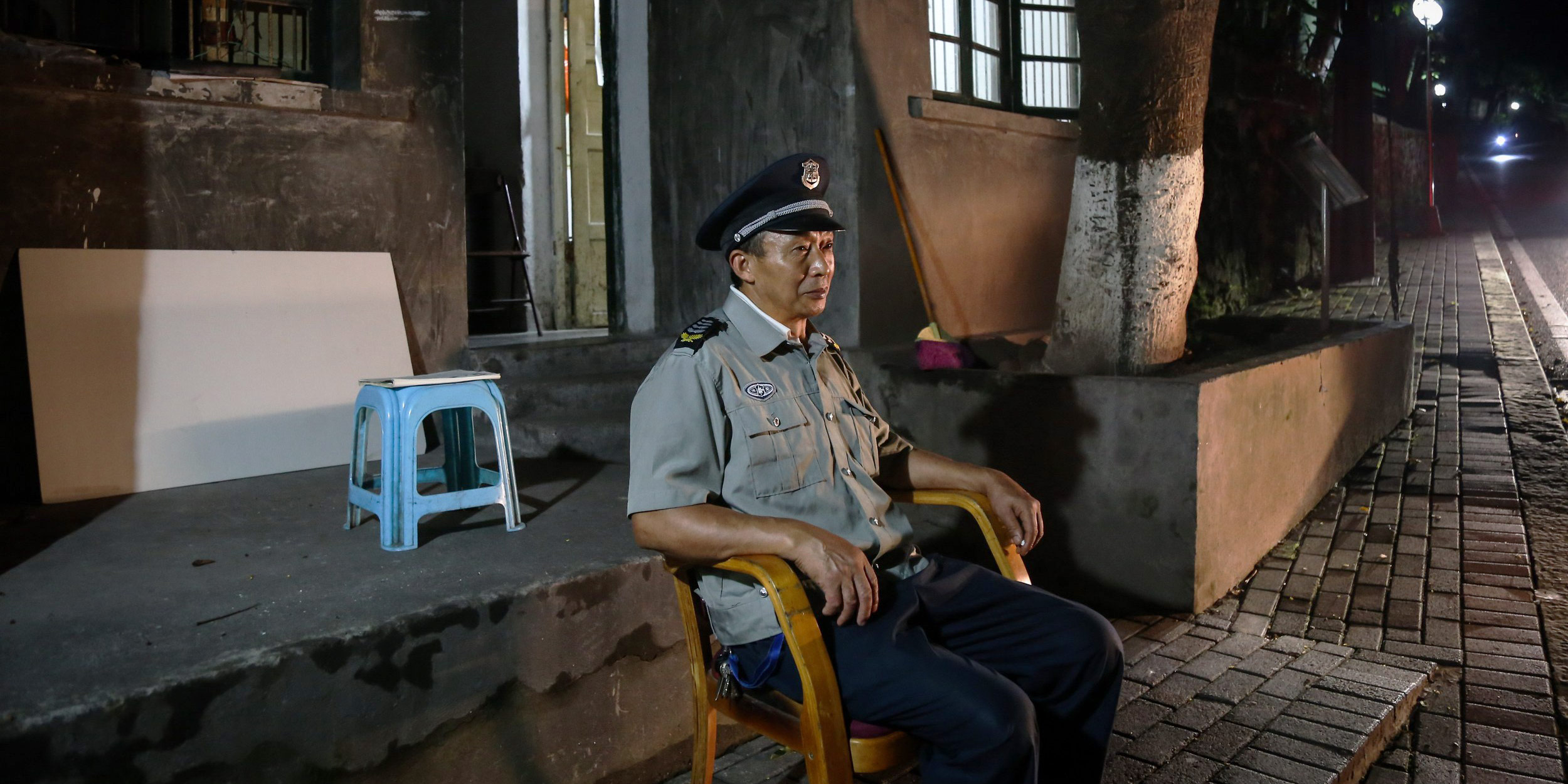
(Header image: A security guard sits by a gate, Chongqing, 2015. VCG)