Why Cai Guoqiang’s Lofty Ambitions Should Come Back Down to Earth
Colorful fireworks shot up from the ground, spiraling along the mountain slope and roaring so loudly that the wind itself seemed to vanish. This was “Ascending Dragon,” a recent work by Chinese contemporary artist Cai Guoqiang sponsored by outdoor brand Arc’teryx. Unveiled on Sept. 19, 2025, in the Qinghai-Tibet Plateau, the 50-second display took place at an altitude of 5,500 meters.
Although the work embodied the artist’s signature style and met the sponsor’s expectations for symbolic uplift, it ignited almost immediate controversy among scholars and environmentalists upon its online release. Many noted the acute fragility of the Qinghai-Tibet Plateau’s ecosystem, saying that fireworks could disturb wildlife and damage the thin alpine soil, while the work’s “eco-friendly materials” and post-event cleanup — involving soil turning and site restoration — could in fact worsen ecological degradation. An official investigation validated their concerns, concluding that the firework show affected about 30 hectares of grassland, and cleanup was incomplete. Both Cai’s studio and Arc’teryx issued apologies.
From within the art world, another wave of criticism developed. This time, it took on a broader comparative lens, arguing that Cai’s work seemingly lacked the anti-commercial and anti-institutional critique that characterized early land and ecological art projects.
Typically, land art — artwork made from the earth itself — centers on a celebration of the planet and rejection of art as a commodity, such as with Robert Smithson’s “Spiral Jetty” (1970), created using black basalt rocks and mud sourced from the host site. Instead, “Ascending Dragon” is what I would term a “conspicuous collusion” between two global brands, namely Arc’teryx and Cai Guoqiang, ultimately failing to align with today’s ecological art paradigms grounded in principles of low impact, restoration, and symbiosis. The piece wasn’t even originally conceived for the Qinghai-Tibet Plateau when it first took shape in the 1980s; instead, it was intended for Mont Sainte-Victoire, the modernist “sacred mountain” that inspired Cézanne.
While it is tempting to focus solely on the environmental scandal itself, I approach the “Ascending Dragon” controversy as a lens through which to rethink the shifting relationship between art, ecology, and globalization. For me, it is an epistemological rupture that forces us to reconsider how an artist like Cai Guoqiang, once hailed as an emblem of China’s global ascent, became so out of touch with the Chinese land, both materially and metaphorically, and how his work became suspended between spectacle and responsibility.
Cai has long been seen in the global art world as a representative figure of China. One of his most enduring motifs is the dragon, and his use of fireworks draws on traditional Chinese customs of celebration and on the nation’s historic invention of gunpowder. He has used other Chinese historical and cultural references in his works, such as the story of Marco Polo’s extensive travels in the country, the Three Kingdoms legend of “borrowing arrows with straw boats,” and even a 1965 socialist sculpture of peasants scrounging to pay rent to a ruthless landlord.
Belonging to the generation of Chinese male artists who rose to international prominence between the 1980s and early 2000s, Cai has skillfully navigated the porous boundaries of globalization. In China, he lit the fireworks for the 2008 Beijing Olympics, becoming an official symbol of a nation eager to join the world stage. In the West, he was celebrated as a Chinese conceptual artist whose narratives challenged Western-dominated visual regimes via the use of gunpowder — a symbol of both materiality and ephemerality. It is worth noting that much of Cai’s international acclaim and criticism has also been applied to other Chinese contemporary artists, who are often analyzed through the lens of either “cosmopolitanism” or “sham avant-gardism.” All of this begs the question: To what extent can Cai’s art genuinely be seen as representative of Chinese conceptual art itself?
To answer this question, we must examine the connection between Cai’s work and the social and cultural reality of contemporary China. From this vantage point, Cai’s art often appears suspended: aestheticized yet detached. While the 1980s and 1990s in China saw the rise of art practices grounded in social critique and local experience, Cai, having relocated to Japan in 1986 and later to New York in the 1990s, has long created from a position of geographical and cultural distance.
Cai’s ability to move fluidly between China and the West once epitomized the success story of globalization and the imagination of Chineseness at the century’s end. At the height of globalization, the West functioned as a stage for performing cultural diversity, while the tale of a rural boy from China’s eastern Fujian province coast ascending the “ladder” of international art — think of the “Sky Ladder” project that won him enormous fame 10 years ago — embodied globalization’s poetic ideal. Yet the dissonance now surrounding “Ascending Dragon” marks the failure of that narrative, a failure deeply intertwined with the post-pandemic reorientation of how we understand both the self and the environment.
In the years when globalization’s promise still glittered like honey, transregional mobility was heralded as the key to personal realization. Yet even before the pandemic halted the world, the anthropologist and philosopher Bruno Latour, in his short yet eloquent work, “Down to Earth: Politics in the New Climatic Regime,” had warned that the seemingly unstoppable process of globalization was an abstraction. Economic, financial, cultural, and artistic globalizations all shared a hidden irony: the more intensely they intertwined, the further humanity drifted from the physical planet itself. This distancing, I argue, parallels Cai’s own artistic disengagement, a separation from the material and social ground beneath the spectacle. For decades, as stories of individual success under globalization spread across China, such detachment was veiled beneath the rhetoric of self-realization, development, and progress.
Then came the planetary pause and the stark escalation of the climate crisis. In confronting global immobility and environmental vulnerability, the earthly conditions of existence have been laid bare, and people can no longer ignore the need to relearn how to coexist with all forms of life, nonlife, and environment — even viruses. In this new awareness, the globalist dream that once defined Cai’s art began to appear anachronistic: few could still admire a spectacle that celebrates transcendence at a time when the very notion of moving beyond the planet feels ecologically tone deaf.
In his book, Latour urged that we replace the word “global” with “terrestrial” to refocus attention on the Earth itself, including its climate, environments, and material precarity, and reverse the abstract enthusiasm once projected onto globalization. I believe this theoretical turn may offer a new way to interrogate Cai’s mountain-blasting event and understand the controversy around it.
With a “terrestrial” perspective, we can approach “Ascending Dragon” in an ethics of the here and now, and call for a perspective that transcends the global-local divide and insists on embodied, situated attention — not unlike what ecologist Fikret Berkes terms “sacred ecology.” This “sacred ecology” then represents a vernacular and traditional wisdom in which mind and nature are inseparable and understanding arises from within rather than above.
Amid Cai’s collision of ice and fire, this very perspective may be the missing element. Rather than having more voices belonging to the scientist, art practitioner, or anthropologist join the debate, we must hear from those who live and work in and with the land itself — voices, to use a Chinese anthropological classic notion, that are “from the soil.”
The criticism surrounding “Ascending Dragon” goes so much deeper than ecological concern or moral outrage. It exposes a profound paradigm shift, that epistemological rupture I mentioned before. The late-20th-century ideal of the artist as global traveler and cultural ambassador, which Cai once embodied, has lost its resonance in an age of planetary anxiety and reset. Thus, as we turn from the “global” to the “terrestrial,” the question is no longer how art ascends but how it can once again take root.
Portrait artist: Zhou Zhen.
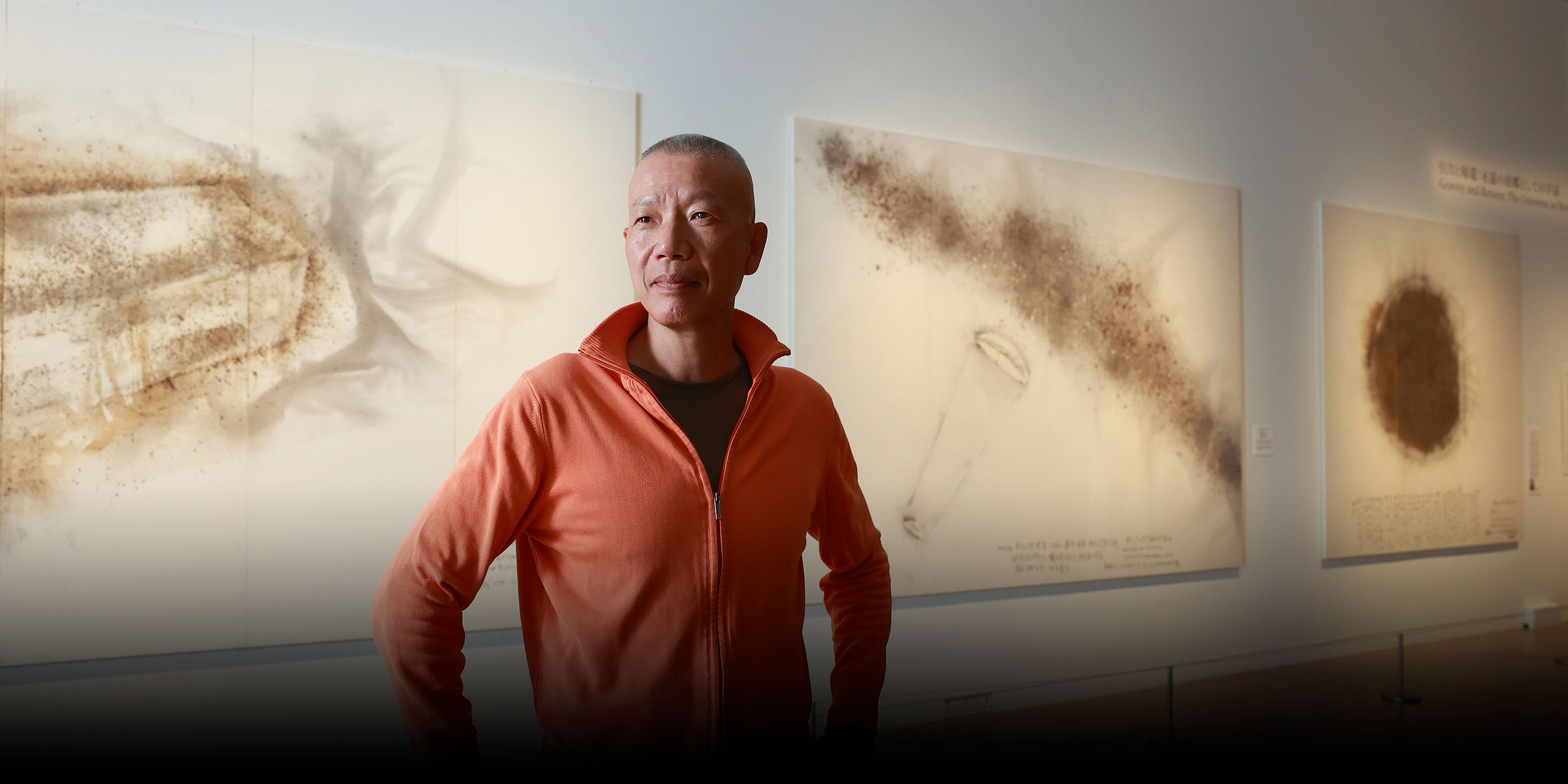
(Header image: Cai Guoqiang poses for a photo at the venue of his exhibition at the National Art Center in Tokyo, Japan, June 27, 2023. VCG)